mindset
Overcome Perfectionism With Future-Self Audio
Overcome perfectionism with a 3-minute future-self audio practice that helps you start, finish, and return without waiting to feel flawless.

A chipped mug sits beside the laptop. The draft is almost done, which is when perfectionism gets loud. To overcome perfectionism, use a 3-minute future-self audio before the task: hear the finished version of you, choose one small action, and begin before the work feels flawless.
Why does perfectionism feel like care?
Perfectionism feels like care because it borrows the language of standards while quietly delaying completion.
I know this in the kitchen first. A mole can always take one more toast of sesame, one more pass through the sieve, one more pinch of salt. But dinner has a time. People get hungry. The pot has to leave the stove. Perfectionism often calls itself care, but care can finish dinner.
Psychologists Paul Hewitt and Gordon Flett described perfectionism in 1991 as more than wanting to do well; it can include harsh self-demand, fear of mistakes, and the belief that others require flawlessness. Later research by Thomas Curran and Andrew Hill, published in Psychological Bulletin in 2019, looked at 41,641 college students between 1989 and 2016 and found perfectionism had risen across several measures. That is not a small whisper. It is a cultural habit many people carry into private rooms.
The trick is that perfectionism often starts with a true thing. You do care. You do want the email to be clear, the dish to taste right, the application to represent you well. The harm begins when care becomes a locked door. The work stops moving. Your body learns that safety means not finishing.
Here is the first gentle distinction:
| What it says | What it often means | What helps |
|---|---|---|
| I need more time | I am afraid to be seen | Set a finish line |
| It is not ready | I do not feel ready | Do one visible step |
| I have high standards | I fear ordinary evidence | Practice completion |
| I will start tomorrow | I want relief now | Use a 3-minute cue |
A finished version teaches the nervous system more than an ideal one kept private. In behavioral terms, the brain needs evidence. One sent draft, one served meal, one honest request. Small proof is still proof.
If you are already reading about manifestation, this is where the practice becomes very plain. You are not pretending fear is gone. You are giving your attention a new place to stand.
What is a 3-minute future-self audio?
A 3-minute future-self audio is a short recording that lets you hear the version of you who already finishes with steadiness.
The the AYA Method is a daily audio manifestation practice. Each day you listen to a short personalized recording — your Dream-Self Moment — narrated from the version of you who has already manifested the life you intend. Listening is the practice. Repetition is the work. The audio is the method.
That matters here because perfectionism is not only a thought. It is a whole-body pause. Your shoulders lift. Your breathing gets shallow. The cursor blinks like a small judge. A future-self audio gives your body a different rehearsal. Not a lecture. Not a list of reasons. A scene.
Dr. Hal Hershfield’s work on future-self continuity, including studies published around 2011, suggests people make different choices when they feel connected to their future self. In one line of research, participants who interacted with aged images of themselves showed more willingness to save for the future. The exact behavior differs, but the principle is useful: when the future self feels real, present action gets easier.
Three minutes is small enough to repeat and long enough to interrupt the old spell. It can hold a beginning, a middle, and an exit. For example:
- First minute: You name the room and the task.
- Second minute: You speak as the self who completes it.
- Third minute: You choose the next visible action.
The app also includes a daily affirmation and a Manifestation Board as complements. They can support the tone and image of the life you are practicing. But they are not the center here. For this method, listening is the work.
If affirmations have helped you before, keep them close. The affirmations pillar can help you shape language that is clear and kind. Just remember: a sentence can open the door, but the audio walks you through it.
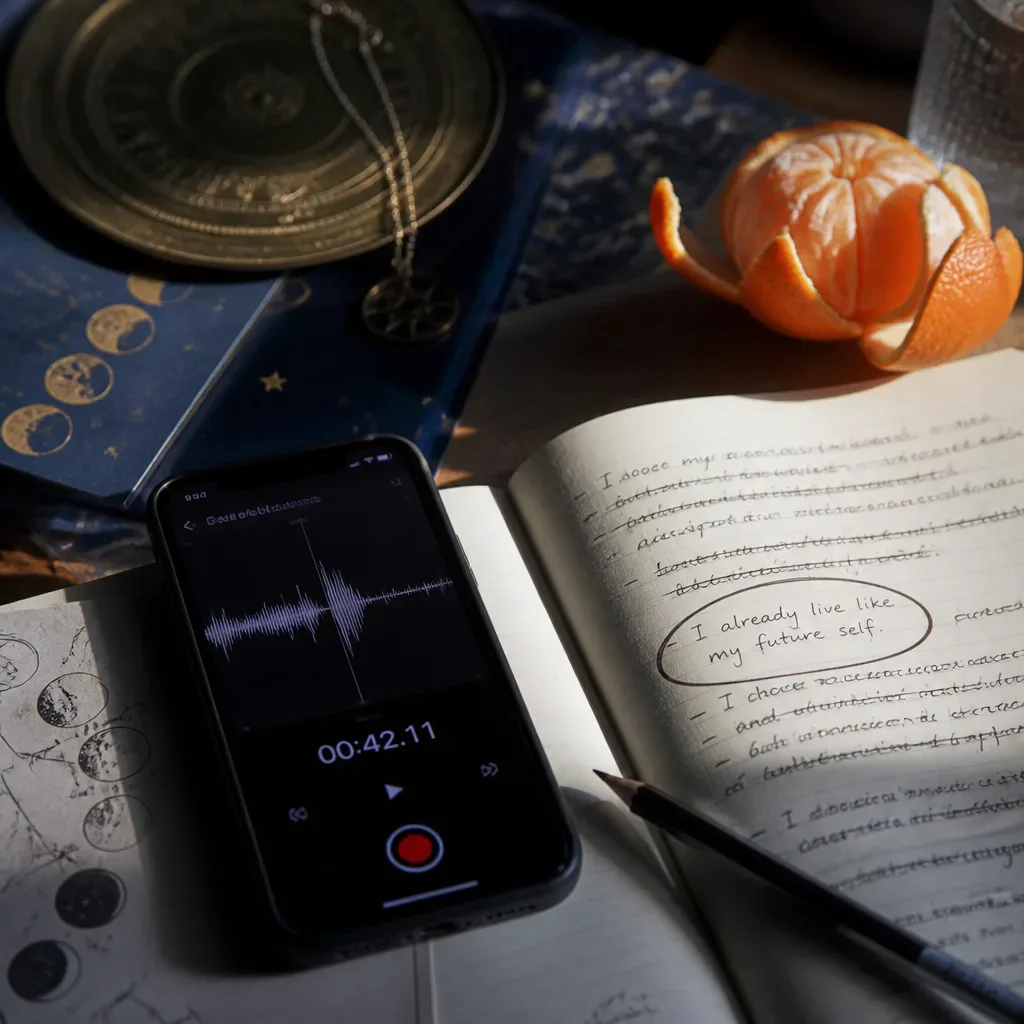
How do you write the audio without making it perfect too?
You write it badly on purpose first, then make it true instead of polished.
Set a timer for 6 minutes. Not 30. Not the whole afternoon. The point is not to craft a beautiful script. The point is to give your future self a voice before the critic takes over. Researchers often use timed writing in expressive writing studies; James Pennebaker’s early work used brief sessions, sometimes 15 to 20 minutes, to help people put inner material into words. You need less here because the target is narrow: one avoided action.
Start with the task that has been sitting too long. A proposal. A text. A decision. A messy drawer. A recipe you keep testing but never serving. Then ask: what would I be doing if I were already someone who finishes with care?
Use this small recipe:
- One place: the desk, the kitchen table, the parked car, the studio floor.
- One body cue: relaxed jaw, warm hands, feet on tile, slower breath.
- One completed behavior: I send, I ask, I publish, I serve, I stop.
- One honest standard: clear enough, kind enough, cooked through, ready for now.
- One closing line: I begin within 60 seconds.
Your future self does not need to shout; she needs to be heard daily. If the sentence sounds like a poster, cut it. If it sounds like something you would say to a younger cousin at the table, keep it.
Try this short draft:
I am sitting at the table with my feet on the floor. The draft is open. I read it once for clarity, not for punishment. I fix the one sentence that blocks the meaning. Then I send it. My work is allowed to be useful before it is perfect.
Notice the numbers. One read. One sentence. One send. Perfectionism likes fog. Specifics bring you home.
How do you use the 3 minutes when you are about to avoid the task?
You listen once, then take the next action within 60 seconds.
This is the part that must stay simple. If you listen and then make tea, check messages, change clothes, and research one more thing, perfectionism has found a side door. The audio is a threshold. Cross it while it is still warm.
BJ Fogg’s behavior model, made widely known through Tiny Habits, says behavior happens when motivation, ability, and a prompt meet at the same time. A 3-minute future-self audio works as a prompt, but only if the next action is small enough. Do not ask yourself to finish the whole chapter. Ask yourself to open the file and write 80 rough words. Do not ask yourself to clean the whole kitchen. Ask yourself to wash 10 plates.
Use this order for seven days:
- Put the task in front of you before you press play.
- Listen to the full 3 minutes without editing the audio.
- Breathe once at the end.
- Start the next visible action within 60 seconds.
- Stop tracking quality. Track only whether you began.
The 60-second rule is not magic. It is protection. In procrastination research, Piers Steel’s 2007 meta-analysis in Psychological Bulletin connected delay with task aversion and lower self-regulation. The longer you leave the gap between cue and action, the more room the old pattern has to speak.
This is also where astrology and manifestation can stay grounded if you use it. A transit, a moon phase, or a birth chart note can be a timing ritual. It does not replace the action. It helps you choose a doorway.
Completion can be quiet. No announcement. No dramatic new identity. Just your hand moving before the critic has arranged the room.
What if the audio brings up shame instead of relief?
If the audio brings up shame, make it smaller, kinder, and more believable.
Shame often appears when the gap feels too wide. If your script says, I complete everything with ease, your body may refuse it because the evidence does not match. That refusal is not failure. It is information. Bring the statement closer. Try: I complete one honest part today. I let it be seen when it is useful. I can be careful without being cruel.
Self-affirmation research can help here, though it is often misunderstood. A 2014 review by Geoffrey Cohen and David Sherman in Annual Review of Psychology described self-affirmation as a way to maintain a wider sense of self-integrity when facing threat. It is not about lying to yourself. It is about remembering you are more than this one performance.
For a food writer, shame can sound like this: If the dish is not perfect, I have dishonored the recipe. But my grandmother did not cook from fear. She tasted. She adjusted. She fed people. Tradition survives through hands that keep moving.
Use these softer swaps:
| Shame script | Future-self audio line |
|---|---|
| I always ruin it | I repair one part and continue |
| Everyone will judge me | Some people will understand the work |
| It has to be flawless | It has to be honest and complete |
| I am behind | I take the next small step now |
There is a difference between high standards and self-erasure. One helps you serve the work. The other makes you disappear before anyone can receive it.
If your nervous system feels flooded, shorten the audio to 90 seconds for a day or two. Dr. Andrew Huberman often speaks about using breathing patterns to shift arousal; even without a formal protocol, 3 slow exhales before pressing play can make listening feel safer. The practice should feel like a hand on the back, not a verdict.

How can you tell the practice is working?
You can tell it is working when you recover faster, finish smaller things, and need less inner argument before starting.
Do not measure this by whether you feel confident every day. Perfectionism loves mood-based contracts: I will begin when I feel ready, clear, rested, certain. Better measures are more ordinary. Did you send the message? Did you stop revising at the chosen time? Did you serve the meal while it was still warm?
Track 3 numbers for 14 days:
- Start time: How many minutes between cue and action?
- Completion count: How many small finishes today?
- Recovery time: How long after a mistake before you return?
A 2022 review in Health Psychology Review on habit formation noted that repetition in stable contexts supports automaticity, though timelines vary widely. The old 21-day claim is too neat. Some habit studies, including work by Phillippa Lally and colleagues in 2010, found automaticity could take a median of 66 days, with a broad range. So give yourself data, not drama.
Here is what progress may look like:
- You still feel nervous, but you press send.
- You notice the edit spiral by minute 12, not hour 2.
- You ask for help before the deadline is burning.
- You let one good-enough version teach you.
- You return after a mistake without making it a biography.
This is why the manifestation pillar matters when it is kept close to real behavior. You are not only picturing a life. You are practicing the person who can live it in small, repeatable ways.
If you use the AYA Method daily, keep the same Dream-Self Moment for a week before changing it. Perfectionism may want a fresh recording every morning. Let repetition be the medicine. The brain learns from what returns.
What should you do for the next 7 days?
For the next 7 days, use the same 3-minute audio before one imperfect action.
Choose only one area. Work. Food. Money. Art. A conversation. If you choose five, perfectionism may hide inside planning. Keep the bowl small enough to hold.
Here is a quiet 7-day plan:
| Day | Practice | Finish line |
|---|---|---|
| 1 | Write and record the audio | One 3-minute recording |
| 2 | Listen before starting | 10 minutes of action |
| 3 | Listen before sending | One visible send |
| 4 | Listen after a mistake | One repair |
| 5 | Listen before asking | One clear request |
| 6 | Listen before stopping | Stop at the chosen time |
| 7 | Listen and review | Keep or revise one line |
Use the same cue each day. After coffee. Before opening the document. After washing the breakfast bowl. Specific cues matter. In a 2019 Pew Research Center report, 28 percent of U.S. adults said they were online almost constantly; the phone can pull attention before intention has a chance. Let your audio be the first sound, not the feed.
If you want one supporting sentence, choose an affirmation from your script and write it where you will see it. The affirmations pillar can help you keep it plain. If you want one image, place it on your Manifestation Board as a complement. But do not make the board another project to perfect.
The practice is this: listen, begin, finish one small thing, return tomorrow. Seven days is enough to gather evidence. Not proof that you will never fear judgment again. Proof that fear does not have to be the one who decides.
Put the spoon down. Listen once. Begin.