mindset
Manifestation Consistency in 3 Minutes
Manifestation consistency can return softly. Use one 3-minute audio listen to come back after you fall off, without shame or a full restart.

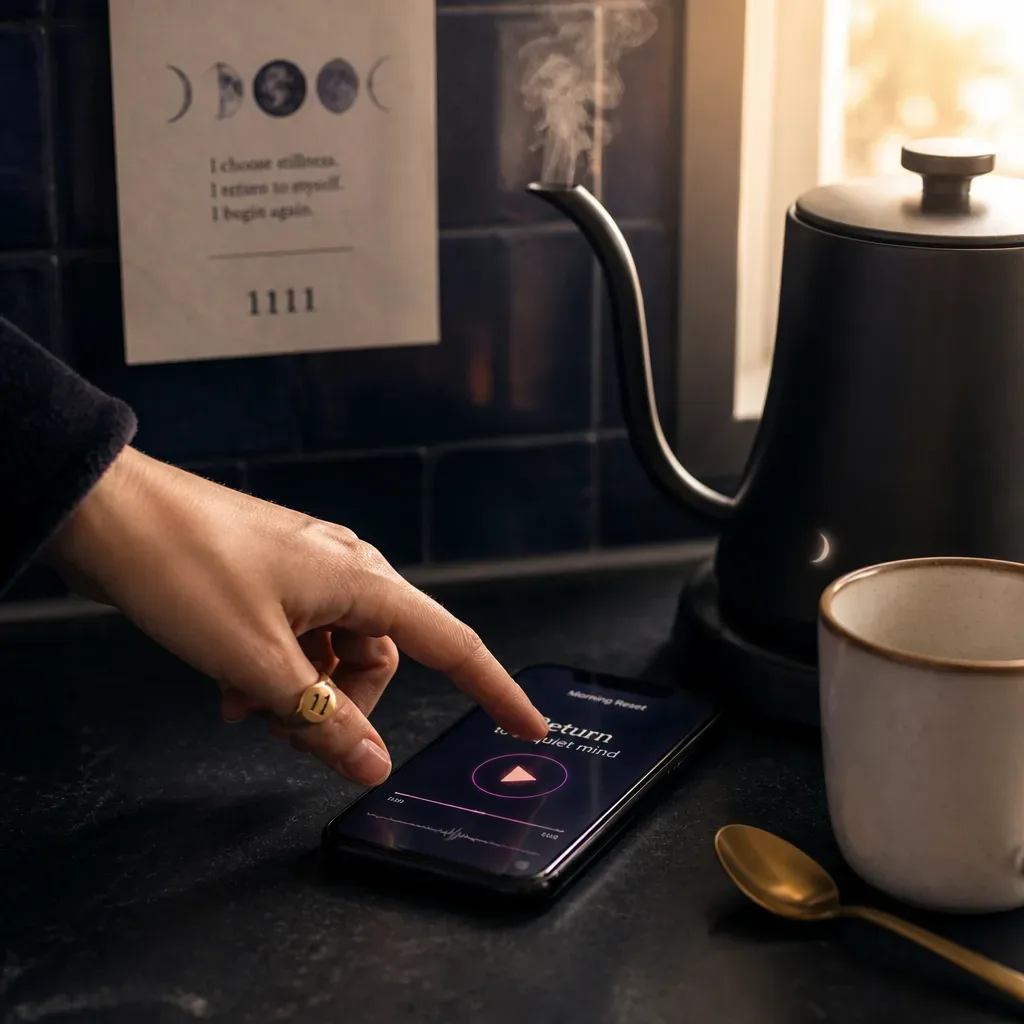
The phone is face down beside the cup. You missed four days, maybe more. Manifestation consistency returns when you make the restart almost too small to refuse: one 3-minute audio, one listen, no punishment, no new identity to perform. Come back before you explain why you left.
What should you do first when you fall off?
Start with one listen, not one lecture.
When you fall off a practice, the mind often reaches for a verdict. You were disciplined, then you weren’t. You were becoming someone, then you stopped. That story feels neat, but it isn’t very useful. Behavior research is kinder and more exact: a lapse is common, and a lapse is not the same as a collapse.
In a 2009 study in the European Journal of Social Psychology, Phillippa Lally and colleagues followed 96 people building new daily habits over 12 weeks. The average time to reach automaticity was 66 days, with wide variation from 18 to 254 days. One missed opportunity did not erase the habit-forming process. That matters here. Your missed days are data, not a sentence.
So the first move is small enough to protect you from shame. Don’t open the whole list of goals. Don’t redesign your morning. Don’t ask whether you still deserve what you wanted. Put on the audio and listen once. The practice is not asking for a performance. It’s asking for contact.
Consistency is not the absence of falling off. It’s the softness of the return.
If you need a clean sequence, use this:
- Notice that you stopped.
- Say, “I’m back now,” without drama.
- Open the 3-minute audio.
- Listen all the way through.
- Do nothing extra for one full minute.
Kristin Neff’s work on self-compassion has repeatedly linked kinder self-talk with greater willingness to try again. In a 2012 study by Breines and Chen in Personality and Social Psychology Bulletin, self-compassion after a setback increased motivation to improve. Not because people were being easy on themselves. Because punishment makes the room smaller. Kindness gives you space to move.
Why does a 3-minute audio work better than a restart plan?
A 3-minute audio works because it lowers friction while giving your attention a specific future-self cue.
A restart plan can look noble. It can also become another way to delay. You make a schedule, choose a notebook, rewrite your desire, and by the time you’re done, the practice has become heavier than the life it was meant to support. Three minutes cuts through that. It gives you a beginning and an ending. It asks for 180 seconds, which is about 0.2% of a 24-hour day.
This is where the AYA Method stays plain and useful: The AYA Method is a daily audio manifestation practice. Each day you listen to a short personalized recording — your Dream-Self Moment — narrated from the version of you who has already manifested the life you intend. Listening is the practice. Repetition is the work. The audio is the method.
The detail matters. Audio is harder to over-perfect than a written plan. You don’t have to make the sentence beautiful. You don’t have to stare at a blank page. You press play and receive a voice from the self you’re remembering. Dr. Andrew Huberman has often described behavior change through cues, repetition, and reward timing; in practical terms, a short listen gives the brain a repeatable cue without asking for a long decision chain.
| When you fall off | What it asks of you | What often happens |
|---|---|---|
| Full restart plan | 20 to 60 minutes | You delay until you feel ready |
| Long journaling session | 15 to 30 minutes | You try to write your way out of shame |
| 3-minute audio | 180 seconds | You return before the mind argues |
The plan can come later. First, let the voice find you.
How do you make the first listen so small it happens?
Attach the listen to something you already do, then remove every extra decision.
B. J. Fogg’s Tiny Habits method is built around a simple idea: behavior grows when it is small, prompted, and easy to repeat. His classic formula is “After I do X, I will do Y.” For manifestation consistency, that might be: after I put water on for coffee, I press play. After I sit on the edge of the bed, I press play. After I close my laptop, I press play.
The cue should already exist. Don’t create a new ceremony on a day when you’re trying to return. Wendy Wood and colleagues found in a 2002 diary study that about 43% of daily actions were performed in familiar contexts while people were thinking about something else. You can use that. Place the 3-minute audio next to an ordinary pattern your body already knows.
Use this five-step return. It takes less time than scrolling one thread you won’t remember.
- Choose one cue. Pick tea, teeth, bed, shoes, or the first unlocked screen of the day.
- Open only the audio. No edits. No goal review. No checking streaks.
- Take one slow breath. Not ten. One.
- Listen for three minutes. Let the Dream-Self Moment carry the structure.
- Name one sentence. Say, “This is still mine,” or another line that feels true enough.
If you want more context for the wider practice, the manifestation guide holds the larger frame. But on a return day, smaller is wiser. You’re not trying to prove devotion. You’re rebuilding trust with a practice you can actually repeat.
A practice that needs your best mood will disappear on your ordinary days.
Three minutes is not a compromise. It’s a door that stays open.
What should you listen for inside the Dream-Self Moment?
Listen for the part that sounds like home before it sounds believable.
The Dream-Self Moment isn’t a test of certainty. It’s a short contact with the version of you who already lives inside the desired reality. Some days you’ll feel close to her. Some days she’ll sound like someone speaking from another room. Both count. The nervous system learns through repetition, not through dramatic feeling on command.
Mental rehearsal has a long history in psychology and neuroscience. In a 1995 study, Alvaro Pascual-Leone and colleagues found that mental practice of a five-finger piano exercise produced measurable changes in motor cortex maps, though physical practice produced stronger effects. That doesn’t prove manifestation as a mechanism. It does show that repeated inner rehearsal can shape readiness, attention, and response.
So listen for one of three things:
- A detail. The apartment key, the calmer inbox, the body that isn’t bracing.
- A tone. Less begging. More knowing.
- A sentence. Something simple enough to repeat later.
Joe Dispenza often speaks about rehearsing a future self until the body begins to recognize the state. Neville Goddard used different language, teaching the feeling of the wish fulfilled. You don’t have to adopt anyone’s full worldview to use the practical overlap: the self needs repeated contact with the scene it’s learning to choose.
The audio gives that scene a voice. The voice matters because it can bypass the perfectionist habit of editing every word. You’re not composing. You’re listening. You’re letting the future self be spoken to you in a form that can be repeated tomorrow.
Audio gives identity one place to sit down.

How do affirmations and a board help without becoming the method?
Affirmations and a Manifestation Board help when they support the listen instead of replacing it.
The daily affirmation can be one sentence you carry after the audio. Not twenty. Not a page. One sentence. Self-affirmation theory, reviewed by Cohen and Sherman in the Annual Review of Psychology in 2014, suggests that reflecting on valued aspects of the self can reduce defensiveness and support adaptive behavior. That is useful, but it stays most useful when it remains simple.
If your Dream-Self Moment says, “I wake with a quiet trust in my work,” your daily affirmation might be, “My work can meet me gently.” That’s enough. A sentence becomes a small handle. You can hold it while washing a cup, walking to the train, or answering the message you’ve avoided for two days.
The Manifestation Board works differently. It gives the desire a visible home. Images can clarify what words blur. But a board can also become another perfectionist room if you keep arranging it instead of listening. If you need support with language, the affirmations guide can help. If you want a wider map of desire, manifestation can hold that question.
Keep the order quiet:
- Audio first.
- One affirmation if it helps.
- Board as a visual reminder, not a substitute.
Some readers also like timing practices. If moon phases, birth charts, or seasonal cues help you remember to return, keep them gentle. The piece on astrology and manifestation is best used as a timing companion, not as permission to wait for the perfect day.
The method is the listen. The rest is scaffolding.
What if you miss again tomorrow?
If you miss again tomorrow, you return again the same small way.
This is the part the perfectionist self hates. It wants a clean streak because a streak feels like proof. But a streak is fragile. A return is sturdier. In Lally’s 12-week habit study, missing a single day did not meaningfully derail habit formation for many participants. The pattern depended more on repeated opportunities than on flawless attendance.
There is a useful distinction from relapse prevention work by Marlatt and Gordon in the 1980s: a lapse is a slip, while a relapse is the story that the slip means everything is ruined. You can interrupt the second part. The missed day is not the danger. The danger is the meaning you attach to it.
Try this rule for the next 7 days: never repair with more than the original practice. If you miss Monday, don’t do 18 minutes on Tuesday as penance. Do 3 minutes. If you miss Tuesday too, do 3 minutes on Wednesday. This keeps the practice from becoming a debt.
A quiet tracking page can help, if tracking doesn’t make you harsh. Use three marks only:
| Mark | Meaning |
|---|---|
| L | Listened |
| M | Missed |
| R | Returned |
The R matters. It teaches the mind that coming back is part of the pattern. Over 30 days, even 15 listens gives you 45 minutes of future-self contact. That is not nothing. That is a room you entered again and again.
You don’t need a perfect streak. You need a trustworthy return.
Put the phone down softly after the audio ends.
You’re here again.