manifestation 101
Pillow Method Manifestation With 3-Minute Audio
Try pillow method manifestation with a 3-minute Dream-Self audio before sleep, using repetition, intention, and a calmer nervous system.
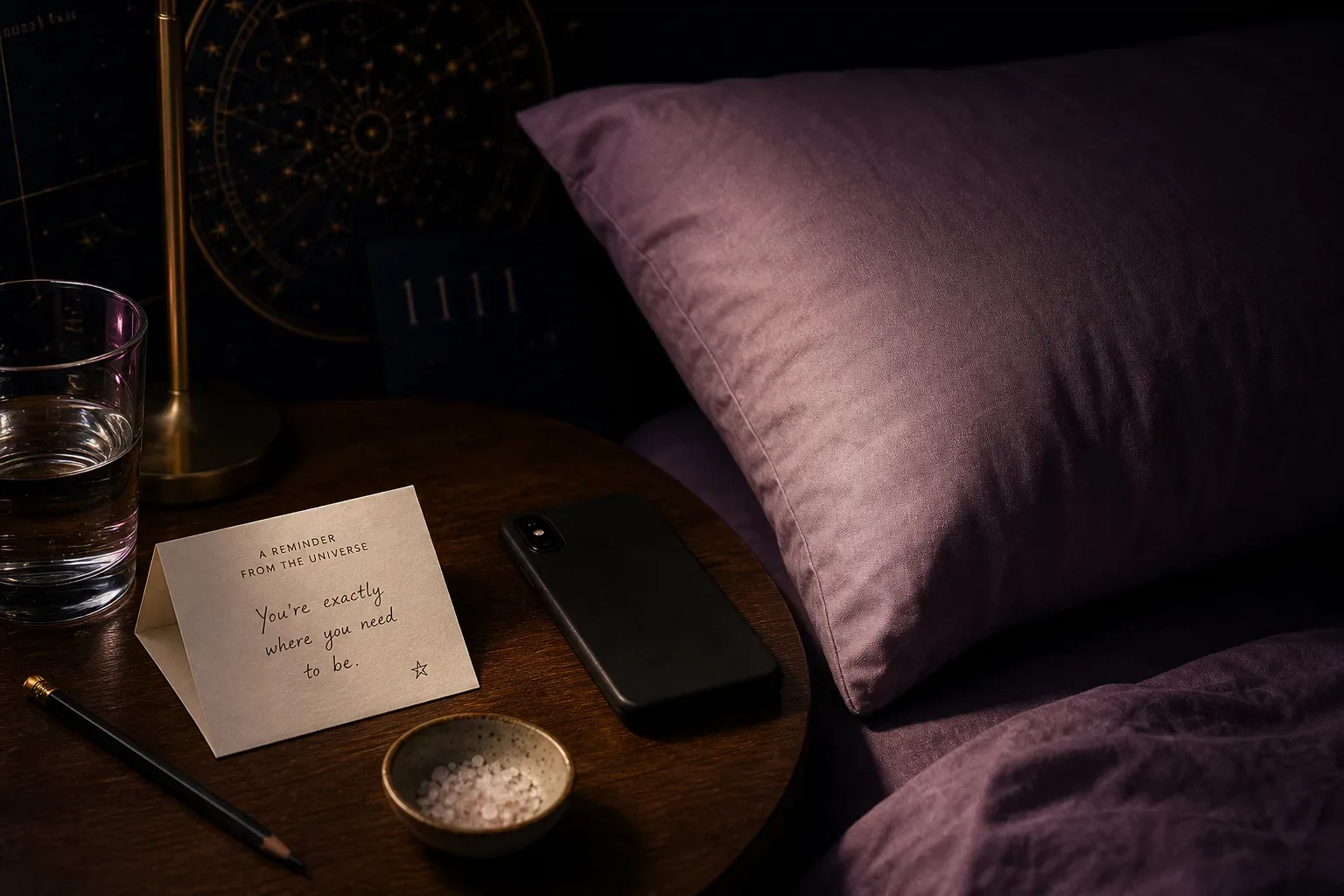
Pillow method manifestation works best when it is simple: write one clear intention, place it under your pillow, and listen to a 3-minute Dream-Self audio before sleep. The audio gives your mind a precise cue, while the pillow note turns the cue into a nightly physical signal.
What is pillow method manifestation, really?
Pillow method manifestation is a pre-sleep intention ritual that pairs a written desire with the suggestible state before sleep.
The old version is almost comically plain. You write a sentence on paper, tuck it under your pillow, and go to bed. That is the whole scene. No altar required. No fourteen-step ceremony. Just paper, pillow, and the particular honesty that arrives after 10 p.m., when the house stops performing.
The stronger version adds audio. In the AYA Method, the AYA Method is a daily audio manifestation practice. Each day you listen to a short personalized recording, your Dream-Self Moment, narrated from the version of you who has already manifested the life you intend. Listening is the practice. Repetition is the work. The audio is the method.
That matters because the pillow note can become a wish list if it has no voice behind it. The Dream-Self audio gives the written line a living narrator. Three minutes is short enough to repeat and long enough to interrupt the usual bedtime static: the bill you forgot, the message you decoded 6 different ways, the sentence someone said at lunch that is now somehow evidence.
Sleep researchers often describe the pre-sleep period as a sensitive transition. The American Academy of Sleep Medicine reports that adults generally need at least 7 hours of sleep per night for health and functioning. That does not make the pillow method a clinical tool. It does suggest that the gate before sleep deserves respect.
A written intention is the match. Audio is the flame that tells it where to burn.
Why add a 3-minute Dream-Self audio before sleep?
A 3-minute Dream-Self audio gives the pillow method a repeatable signal your nervous system can recognize.
Three minutes has a useful discipline to it. Long enough for your breathing to change. Short enough that you will actually do it on a Tuesday. In behavior design, the smaller the action, the less friction it carries; B.J. Fogg’s Tiny Habits model is built around this principle. A bedtime ritual that takes 3 minutes has a better chance than one that requires candles, perfect silence, and a personality transplant.
The Dream-Self audio also shifts the method from begging to rehearsing. Instead of saying, “Please let this happen,” you hear language from the identity that can receive it. That difference is not decorative. In mental rehearsal research, including work popularized by Dr. Joe Dispenza and studied more broadly in sports psychology, repeated internal imagery can influence attention, emotional readiness, and behavior. The body does not need a 40-minute speech. It needs a believable cue, repeated.
Here is the clean comparison:
| Version | What you do | What it trains | Risk |
|---|---|---|---|
| Classic pillow note | Write and sleep | Focus | Becoming vague |
| Affirmation only | Repeat a phrase | Self-talk | Feeling forced |
| Dream-Self audio plus note | Listen, write, place | Identity rehearsal | Skipping nights |
The pillow method becomes more grounded when it has a sound you return to. In my kitchen, I trust the timer more than my mood. Bread rises because the conditions are repeated, not because I stare at the bowl with dramatic devotion.
If you want the larger frame, read the Manifestation pillar before you complicate the ritual. A practice is not stronger because it has more parts. It is stronger when it can survive ordinary evenings.
How do you do the pillow method step by step?
You do the pillow method by choosing one intention, writing it once, listening to your Dream-Self audio, placing the note under your pillow, and repeating the cycle.
Keep the order steady. A ritual is a recipe. Change everything at once and you will not know which ingredient mattered. The first night is not for fireworks. It is for setting the dial.
- Choose one intention. Pick one outcome or identity, not five. “I am the kind of person who is chosen for aligned work” is stronger than “money, love, confidence, health, and a sign by Friday.”
- Write it in present tense. Use one sentence. Under 15 words is ideal.
- Listen to the 3-minute Dream-Self audio. Put the phone face-down if you can. Let the voice finish before you judge it.
- Fold the note once. Folding is not magic. It is a clean ending.
- Place it under your pillow. Do it after listening, not before, so the gesture seals the audio.
- Sleep without checking for signs. The checking is often anxiety wearing a costume.
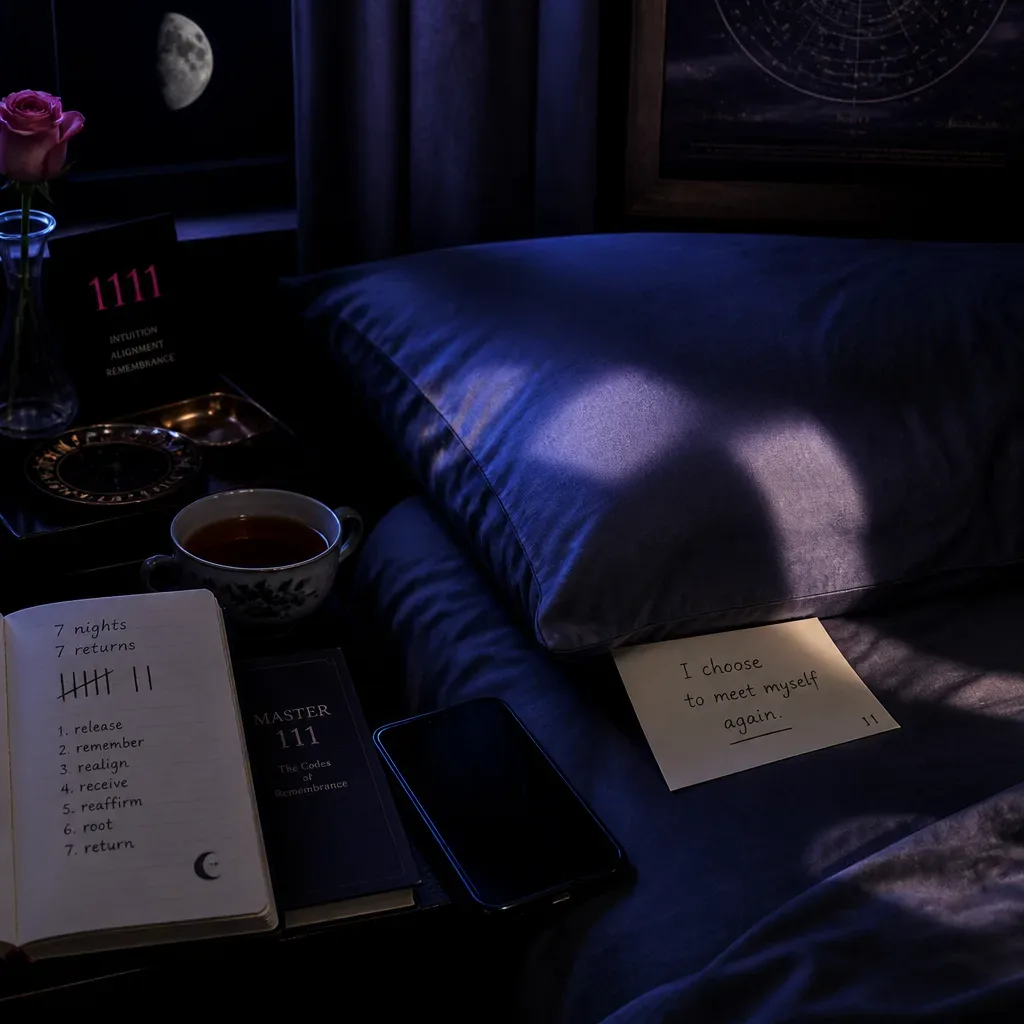
- Repeat for 7 nights. Review after the cycle, not every hour.
The number 7 has religious and cultural weight in many traditions, but here it is also practical. One week gives you 7 repetitions, 7 mornings, and enough ordinary life to observe whether your choices have shifted. Research on habit formation from Phillippa Lally and colleagues at University College London found a wide range, averaging 66 days for habits to become automatic. Seven nights is not automation. It is an audition.
Use language that your body does not reject. If “I am wildly successful” makes your chest tighten, write something truer: “I keep showing up where my work can be seen.” A believable sentence is not smaller. It is better seasoned.
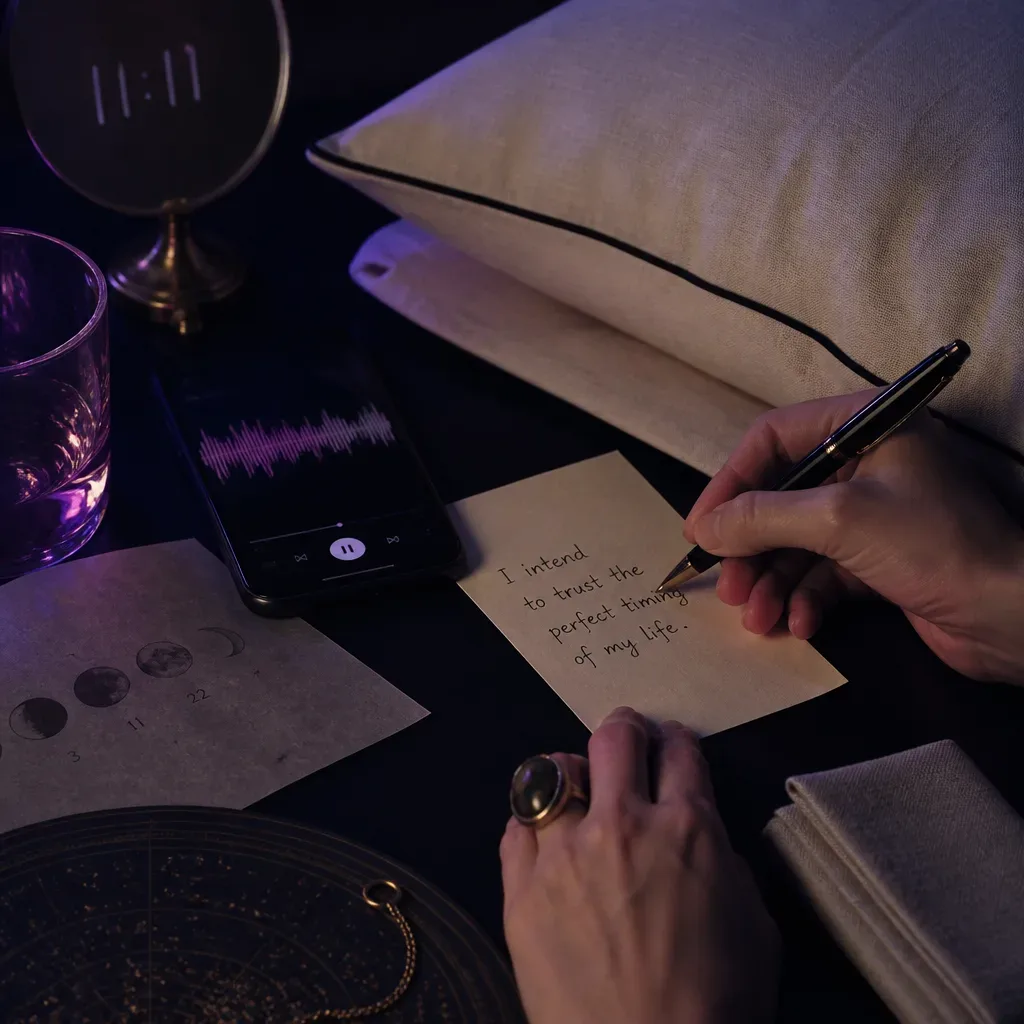
What should you write on the note under your pillow?
Write one present-tense sentence that names the identity you are practicing, not the fear you are trying to outrun.
This is where many people turn the pillow method into a complaint folded into paper. “I don’t want to be ignored anymore” may be honest, but it points the mind back to being ignored. Better: “I am received clearly by the rooms meant for me.” The sentence should feel like a door, not a courtroom transcript.
Good pillow notes have 3 traits:
- Specific: They name a clear area of life.
- Identity-based: They describe who you are becoming or claiming.
- Calm: They do not threaten the timeline.
Neville Goddard often taught the “state akin to sleep,” a drowsy condition in which the imagination impresses itself deeply. You do not have to accept every metaphysical claim to see the psychological sense of it. Bedtime is not the hour for argumentative language. It is the hour for clean instruction.
Try these examples:
| Intention area | Better pillow sentence | Avoid |
|---|---|---|
| Love | “I am loved with steadiness and clarity.” | “They finally text me.” |
| Work | “My work is seen by the right people.” | “I need proof now.” |
| Money | “I make calm, precise money decisions.” | “I am not broke anymore.” |
| Self-trust | “I keep the promises I make to myself.” | “I stop ruining everything.” |
If you already use affirmations, keep them as a complement. The Affirmations pillar is useful for understanding how repeated language shapes attention, but in this nighttime practice the audio leads. The note supports it. The note is the pinch of salt, not the whole pot.
The sentence under your pillow should be quiet enough to sleep beside and strong enough to meet you in the morning.
How does this connect to the AYA Method without making it complicated?
It connects by using the Dream-Self audio as the core practice and the pillow note as the physical anchor.
The AYA Method does not need to be rebuilt into a giant bedtime production. Its spine is already clear: listen daily to the personalized Dream-Self Moment. With pillow method manifestation, you simply move one listen into the pre-sleep window and add a written cue under the pillow.
Think of it like marinating. The marinade is not more powerful because you keep adding ingredients until the bowl panics. It works because the food rests inside a clear mixture over time. Your Dream-Self audio is the mixture. The pillow note is the covered bowl.
A useful 5-minute structure looks like this:
| Minute | Action | Purpose |
|---|---|---|
| 0:00-0:30 | Sit in bed, lower the lights | Cue the nervous system |
| 0:30-3:30 | Listen to Dream-Self audio | Rehearse identity |
| 3:30-4:00 | Read the pillow note once | Name the signal |
| 4:00-4:30 | Place it under the pillow | Close the ritual |
| 4:30-5:00 | Breathe slowly | Let the body agree |
Dr. Andrew Huberman often discusses the role of light exposure and circadian timing in sleep regulation; bright light late at night can delay sleep signals for many people. So yes, the phone matters. Use audio without wandering into messages. One accidental scroll can turn a 3-minute practice into a 27-minute séance with other people’s opinions.
This is also where synchronicity enters without taking over the room. You may see 11:11 the next day. You may not. Master number 11 is often associated with intuition and witnessing in modern numerology, while 22 is linked with building and 33 with service. Treat numbers as punctuation, not proof. The practice is what you repeat when no signal performs on cue.
For timing-minded readers, Astrology and manifestation can help you pair the ritual with lunar cycles. A new moon cycle is about 29.5 days, which makes it a clean container for longer work. Still, the moon is not a substitute for listening.
What can go wrong with pillow method manifestation?
The method goes wrong when you use it to monitor reality every 6 minutes instead of rehearsing a steadier identity.
There is a difference between devotion and surveillance. Devotion says, “I return to the practice.” Surveillance says, “I need evidence by breakfast.” The first builds capacity. The second makes the nervous system a courtroom.
Common mistakes are easy to spot:
- Changing the intention every night because the first one felt too quiet.
- Writing a sentence that secretly argues with your fear.
- Listening to the audio while scrolling.
- Treating angel numbers as a grading system.
- Using the method to avoid a practical action you already know to take.
The Princeton Engineering Anomalies Research program, often cited in consciousness discussions, reported small statistical deviations in random event generator experiments over decades; critics have debated interpretation and replication. That is a useful caution. Not every subtle result is fake, and not every subtle result is a commandment.
A grounded practice leaves you more available to act. If your intention is work, you still send the email. If it is love, you still tell the truth. If it is money, you still look at the numbers. Manifestation without behavior becomes theater with nice lighting.
I learned this from food before I had language for it. My grandmother never stirred mole while angry. Not because the sauce was mystical in a cartoon way, but because attention changes the hand. A rushed hand burns chiles. A resentful hand oversalts. A steady hand notices when the color turns from red-brown to almost black, the exact second the pot says now.
The pillow method is the same. The note is not there to control the night. It is there to train the hand that reaches for tomorrow.
How do you know if the method is working?
You know it is working when your attention, decisions, and emotional recovery begin to match the identity in your audio.
Do not measure only by whether the exact outer result arrived in 3 nights. That kind of tracking will make you brittle. Measure the smaller signals first: Did you speak differently? Did you pause before repeating an old pattern? Did you notice an opportunity you usually dismiss? Did the room feel less hostile because you entered it with a named self?
Use this 7-night review. It takes 4 minutes in the morning after the final night:
- What phrase from the audio stayed with me? Write the exact words if you remember them.
- What did I do differently this week? Count actions, not fantasies.
- What signal repeated? It could be a number, a conversation, a dream theme, or a bodily calm.
- What resistance appeared? Resistance is data. It names the edge.
- Do I repeat, revise, or release? Choose one. Do not keep the paper forever out of fear.
A 2022 Pew Research Center report found that 27% of U.S. adults described themselves as spiritual but not religious. That matters because many people now build small private practices outside formal containers. The pillow method sits in that modern category: intimate, repeatable, half symbolic and half behavioral.
If you need a broader foundation, return to the Manifestation pillar. If the sentence itself feels like the main medicine, pair this with the Affirmations pillar. If timing keeps calling your name, keep one eye on astrology and manifestation, especially around new moons and 11-day cycles.
But do not outsource your practice to signs. A sign can witness the moment, but it cannot do the listening for you.
The paper sleeps under the pillow. The voice keeps the door lit.