sleep hypnosis affirmations
Self Hypnosis for Confidence in 3 Minutes
Use self hypnosis for confidence with a 3-minute Dream-Self audio practice that trains attention, repetition, and belief without forcing certainty.

Self hypnosis for confidence works best when it is short, specific, and repeated daily. A 3-minute Dream-Self audio gives your attention one clear scene to rehearse: you, already steady, already speaking, already taking the next aligned action. The audio does not replace courage. It gives courage somewhere to land.
The first time I tested this, it was 7:11 in the morning. I know because the kettle clicked off, my phone lit up, and the number sat there like a small gate. I had a podcast interview at 9:00 with a guest whose books had lived on my shelf for years. My notes were ready. My confidence was not.
So I used a 3-minute recording. Not a grand speech. Not a glittering pep talk. Just a Dream-Self Moment, narrated from the version of me who had already asked the first clean question and waited through the pause. By 9:04, I was still nervous. But I was not negotiating with the room anymore.
Confidence is not the absence of tremor. Confidence is staying in the room while the tremor passes.
What is self hypnosis for confidence, exactly?
Self hypnosis for confidence is a focused attention practice that uses relaxation, suggestion, and mental rehearsal to strengthen a chosen confident response.
The word hypnosis makes people picture a swinging watch, which is theatrically useful and clinically misleading. The American Psychological Association’s Division 30 defines hypnosis as a state involving focused attention and reduced peripheral awareness, with an enhanced capacity to respond to suggestion. In ordinary language: the dial narrows. The room gets quieter. One signal becomes easier to follow.
For confidence, the suggestion needs to be specific. “I am confident” can help, but it is often too broad to reach the body. “I take one breath before answering the question” is better. “I hear my own voice stay low and steady during the salary conversation” is better still. Self hypnosis works by giving the mind a rehearsable scene, not a decorative slogan.
Research on mental rehearsal has been circling this point for decades. Albert Bandura’s work on self-efficacy in 1977 showed that people’s belief in their capability affects what they attempt, how long they persist, and how they recover after setbacks. Later performance psychology kept finding versions of the same signal: when people mentally rehearse a behavior, the behavior can become easier to access under pressure.
This is where the AYA Method becomes practical rather than ornamental. The AYA Method is a daily audio manifestation practice. Each day you listen to a short personalized recording, your Dream-Self Moment, narrated from the version of you who has already manifested the life you intend. Listening is the practice. Repetition is the work. The audio is the method.
A daily affirmation can sit beside it. A Manifestation Board can witness it. But the audio is the spine.
| Practice | Best use | Risk if used alone |
|---|---|---|
| Self hypnosis | Focused rehearsal in a relaxed state | Too vague without a scene |
| Dream-Self audio | Identity-based daily listening | Passive if no action follows |
| Affirmations | Short verbal cues | Can feel false if unsupported |
| Manifestation Board | Visual intention setting | Can become decor instead of decision |
A confident identity needs contact with reality. The recording names the version of you. The next action proves you heard it.
Why can 3 minutes be enough to shift confidence?
Three minutes can be enough because attention changes quickly, while identity changes through repeated contact with the same signal.
A 3-minute audio is not trying to rebuild your entire inner architecture before breakfast. That would be melodrama, and not even the useful kind. It is trying to create a small, repeatable state change: breath slower, attention narrower, body less braced, next action clearer. Dr. Andrew Huberman has often discussed how breathing patterns can influence arousal through the autonomic nervous system; even 1 to 3 minutes of slower breathing can change how ready the body feels for threat.
Short practices also survive ordinary life. A 2020 Pew Research Center report found that 85% of U.S. adults owned a smartphone, which means the delivery system is already in most pockets. The problem is not access. The problem is friction. A 22-minute recording may be beautiful, but if you only play it twice, it never becomes a gate you return to.
Three minutes is long enough to interrupt the old rehearsal and short enough that you cannot make a personality out of avoiding it.
There is also a numerological wink here, since this is Manifest 11 and we do notice when the dial lines up. Three is traditionally linked with expression, voice, and creative output in numerology. Master number 11 is associated with intuition and signal. You do not have to turn that into doctrine. Sometimes a number is simply a way to remember the rhythm: 3 minutes, 11 days, one chosen scene.
The practical point is repetition. In a study published in the European Journal of Social Psychology, Phillippa Lally and colleagues found that forming a habit took a median of 66 days, with wide variation from 18 to 254 days. That does not mean your confidence audio needs 66 days to matter. It means the nervous system respects return.
If you want the wider theory of intention and action, start with the Manifestation pillar. The useful manifestation question is not “How do I get everything?” It is “What am I willing to rehearse until my behavior recognizes it?”
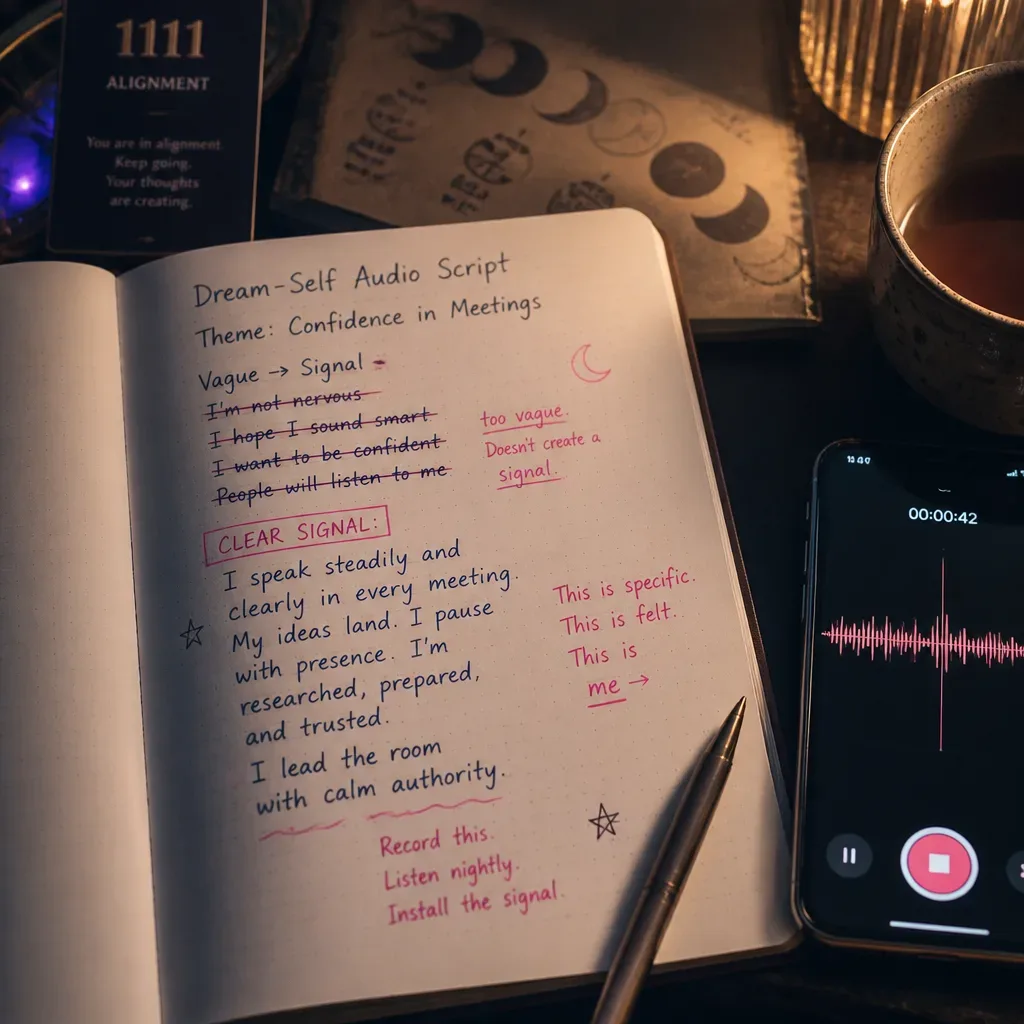
How do you write a Dream-Self script for confidence?
Write the script as a short scene from the version of you who already behaves with the confidence you are practicing.
The fastest way to ruin this kind of audio is to make it too grand. Your Dream-Self does not need to sound like a marble statue. They need to sound like you on a clear day. I usually begin with the scene, not the trait. Confidence for what? A pitch call. A first date. A boundary with your mother. A gym floor at 6:30 p.m. where everyone appears to understand machines invented by a minor villain.
Use 6 to 10 lines. That is enough for a 3-minute recording when read slowly with space. Milton Erickson, whose clinical hypnosis work shaped much of modern indirect suggestion, often used permissive language rather than force. In practice, that means your script can say, “I notice my shoulders drop,” instead of “I am completely fearless.” The body tends to trust observation more than command.
Try this structure:
- Name the moment. “I am standing outside the meeting room with my notes in my hand.”
- Name the body cue. “My feet are on the floor. My breath is slower than it was.”
- Name the identity. “I am the person who can speak before certainty arrives.”
- Name the action. “I ask the question clearly and let the silence do its work.”
- Name the return. “Afterward, I do not audit every sentence. I move on.”
That final line matters. Many people think confidence ends when the moment ends. It often fails afterward, in the replay. A good self hypnosis recording gives you an exit ramp from over-analysis.
Here is a simple 3-minute script seed:
I arrive at the moment with my breath still available. I do not need to become someone else to be heard. I feel my feet on the floor and let my voice take its natural pace. When there is a pause, I do not rush to fill it. I belong to my own timing. I ask for what is accurate. I let the room adjust.
The sentence that lands is the sentence your body can borrow.
If you want to pair the audio with a shorter spoken cue, use the Affirmations pillar as a companion, not a replacement. The affirmation is the match. The Dream-Self audio is the fire held long enough to warm the room.
What is the exact 7-minute routine?
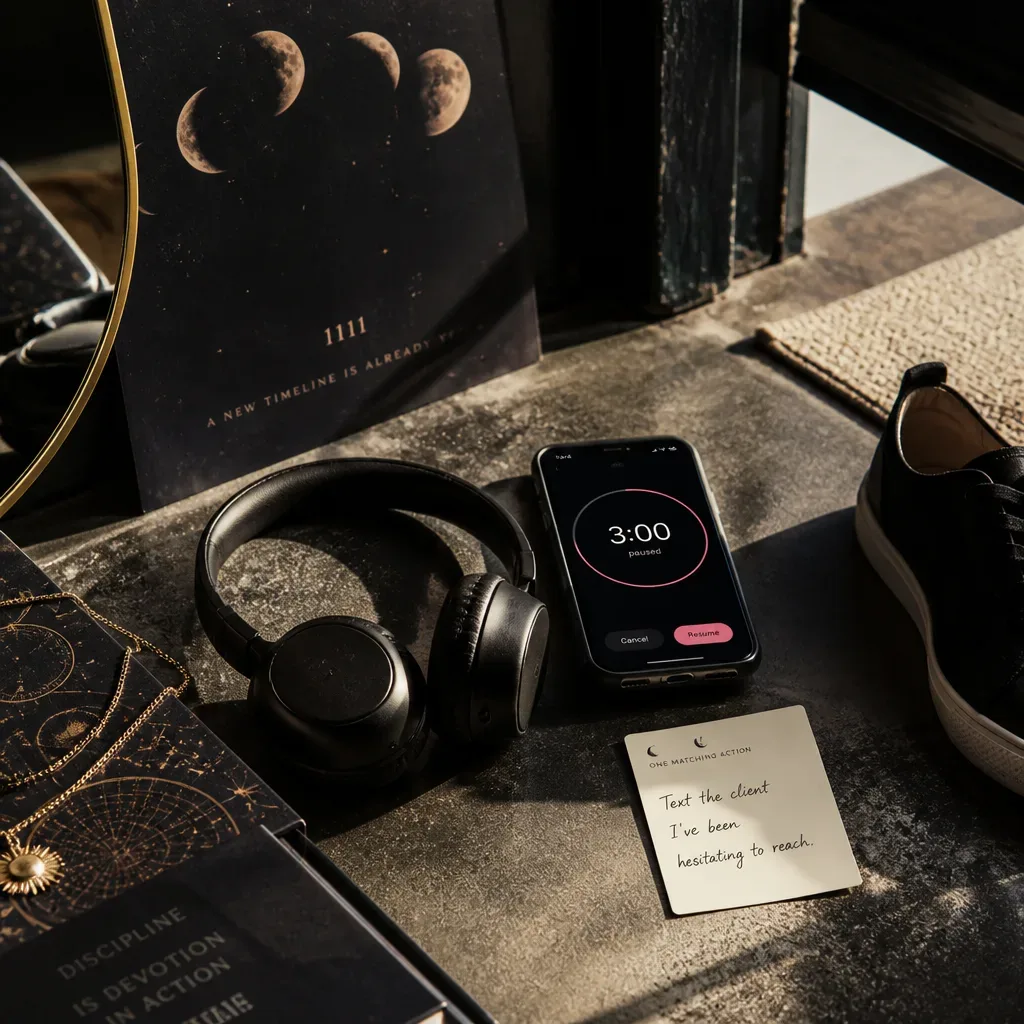
The routine takes 7 minutes total: 2 minutes to settle, 3 minutes to listen, and 2 minutes to act.
I know the topic says 3-minute audio. Good. Keep the audio sacredly short. But the whole confidence ritual needs a small runway and a small landing. Otherwise you float out of the recording feeling poetic and then open email like a raccoon in a pantry.
Use this sequence for 11 days before changing the script:
- Minute 0:00 to 2:00, settle the body. Sit or stand. Exhale longer than you inhale. A 2023 review in Cell Reports Medicine found that breathwork practices can reduce stress, with cyclic sighing showing notable mood effects in a randomized study from Stanford researchers.
- Minute 2:00 to 5:00, listen to the Dream-Self audio. Do not multitask. The practice is not background music. Let the words arrive without arguing with every sentence.
- Minute 5:00 to 7:00, take one matching action. Open the document. Send the message. Practice the first line out loud. Put the shoes by the door. Confidence needs a receipt.
The matching action must be small enough to do while your mind is still trying to negotiate. This is where people get theatrical and lose the thread. If the audio is about speaking up in meetings, your action might be writing one sentence you will say. If it is about dating confidence, it might be replying honestly instead of performing indifference.
A 2019 review in the Journal of Behavioral Medicine noted that self-hypnosis has been used as an adjunct in clinical settings for pain, anxiety, and stress-related symptoms, though results vary by training and context. That variability is the point. Hypnosis is not a vending machine. It is a condition you create, then use.
Your daily routine can look like this:
- Same time each day, preferably attached to an existing cue.
- Same audio for at least 11 days.
- Same confidence scene until your behavior changes.
- One tiny action immediately after listening.
- One note in your phone: “What shifted, if anything?”
Do not grade the practice by whether you felt majestic. Grade it by whether you returned.
How does this compare with affirmations, meditation, and sleep hypnosis?
Dream-Self audio sits between affirmation, meditation, and hypnosis because it uses language, relaxation, and identity rehearsal at once.
Affirmations are brief and portable. Meditation trains witnessing. Sleep hypnosis uses the threshold state before rest, when the mind is less defended and more symbolic. Self hypnosis for confidence borrows from all three but asks for one more thing: a specific future behavior. That is the hinge.
Neville Goddard called imagination a creative act and taught people to assume the feeling of the wish fulfilled. Joe Dispenza speaks in a more neuroscientific register about rehearsing future states until the body begins to recognize them. I keep a little editorial distance from anyone who promises too much too neatly. Still, both point toward a useful principle: the nervous system learns through repeated inner contact paired with outer evidence.
The Princeton Engineering Anomalies Research program, often cited in manifestation circles, ran experiments for nearly 28 years on human intention and random physical systems. Its conclusions remain debated, and mainstream science has not accepted them as proof that intention changes external reality on command. The more grounded takeaway is cleaner: attention changes the person attending. That is already a serious matter.
Here is the practical comparison:
| Method | Time needed | Best confidence use | What to watch |
|---|---|---|---|
| Affirmation | 10 to 30 seconds | Quick cue before action | Empty repetition |
| Meditation | 5 to 20 minutes | Less identification with fear | Avoiding the action |
| Sleep hypnosis | 10 to 45 minutes | Pre-sleep suggestion | Falling asleep too soon |
| 3-minute Dream-Self audio | 3 minutes | Rehearsing one confident identity | Listening without follow-through |
If timing is part of your practice, the Astrology and manifestation guide can help you choose a lunar or planetary cue without handing your agency to the sky. A new moon can be a clean start. A Mercury retrograde review can be a useful edit. The calendar is not the author. You are still holding the pen.
The signal is not magic because it is mysterious. The signal is magic because you answered it with behavior.
What mistakes make confidence hypnosis weaker?
Confidence hypnosis gets weaker when the script is vague, the practice is inconsistent, or the listener avoids the real-world action it points toward.
The first mistake is using borrowed language. If your recording sounds like a luxury candle label, start over. Say the actual thing. “I ask for the fee without apologizing.” “I record the episode even though my voice shakes for the first 40 seconds.” “I walk into the studio and let myself be new.” Specific language gives the mind coordinates.
The second mistake is editing too soon. People listen once, feel a flicker, then decide to improve the script, change the music, adjust the voice, and research microphones for 90 minutes. This is not refinement. It is escape wearing nice shoes. Run the same audio for 11 days. In numerology, 11 is the master number of intuition and signal. In behavior change, 11 days is simply long enough to notice whether you are returning or performing interest.
The third mistake is confusing calm with confidence. Calm is welcome, but many confident acts happen with adrenaline present. The goal is not to become a lake. The goal is to stay available while the weather moves through.
Watch for these weak points:
- The script promises a personality transplant.
- The scene includes no specific action.
- The recording is too long to repeat.
- You listen while scrolling.
- You wait to feel ready before taking the matching step.
- You use the practice to avoid feedback, rehearsal, or skill.
There is a clean line here. Self hypnosis can support mental health, but it is not medical care. If panic, trauma symptoms, or severe anxiety are driving the confidence issue, work with a qualified clinician. The National Center for Complementary and Integrative Health notes that hypnosis has been studied for conditions including pain and anxiety, but quality and outcomes vary. Context matters.
For a broader map of intention practice, read the Manifestation pillar alongside your audio work. Manifestation without behavior becomes theater. Behavior without inner rehearsal can become strain. The middle space is where the good material lives.
How do you know it is working?
You know confidence hypnosis is working when your next behavior changes before your self-image has fully caught up.
Do not wait for a cinematic arrival. The first sign is usually small and almost annoying. You speak 8 seconds sooner. You do not soften the ask. You recover in 2 minutes instead of 2 hours. You notice the old fear, but it no longer gets the final edit. That is movement. That counts.
Track three signals for 11 days:
- Body signal: Did my breath, posture, or voice change during or after listening?
- Behavior signal: What action did I take within 2 minutes of the audio?
- Recovery signal: How long did I replay, avoid, or self-correct afterward?
This is where my vision-board purist side becomes useful. I do not trust a desire until it has survived being written down. Keep a simple note, not a ceremonial document. Date, audio listened, action taken, one sentence of evidence. After 11 entries, patterns appear. On my own board, I once had a photo that took four years to make sense. When it arrived, it was not in the costume I expected. Still, there it was, on cue and slightly rude about timing.
Confidence often arrives first as reduced recovery time. That is not small. A 2010 meta-analysis on self-compassion by Kristin Neff and colleagues linked self-compassion with lower anxiety and depression markers across studies. When you stop punishing yourself after every imperfect attempt, you create more attempts. More attempts create more evidence. Evidence is the language confidence respects.
You can add a short written affirmation after listening if it helps, using the Affirmations pillar for structure. You can also place one image on a Manifestation Board as a visual witness. But keep the order clean: listen first, act next, decorate later.
The room changes when you stop asking fear for permission to enter it.
Return tomorrow. Same signal, same gate.