sleep hypnosis affirmations
Hypnagogic State Manifestation: 3-Minute Audio
Use hypnagogic state manifestation with a 3-minute Dream-Self audio before sleep, timed for the mind’s natural drift into suggestion.

Hypnagogic state manifestation uses the 3-minute edge before sleep to give your mind one clear signal: this is who I am becoming. You listen to a short Dream-Self audio while drowsy, let the body soften, and allow the final mental image of the day to be intentional.
What is hypnagogic state manifestation?
Hypnagogic state manifestation is using the threshold between waking and sleep to rehearse a chosen self-image through sound, imagery, and repetition.
The hypnagogic state is the strange little gate where the dial starts to blur. You are not fully awake. You are not yet dreaming. You may see flashes, hear fragments, or feel the room tilt slightly out of its daytime logic. Sleep researchers usually place this transition at the beginning of non-REM sleep, often called N1, which can last from roughly 1 to 7 minutes in a typical sleep onset sequence.
That timing matters. A 3-minute audio is not decorative. It fits the opening. The National Sleep Foundation has long noted that healthy adults usually need 7 to 9 hours of sleep, but the first few minutes of sleep onset often decide whether the nervous system feels safe enough to surrender. If your last input is panic-scroll economics at 11:47 p.m., the mind receives that as a briefing.
Hypnagogic practice asks for a cleaner briefing. You choose one Dream-Self scene, record it in a calm voice, and listen as the day closes. The point is not to control sleep. The point is to stop handing the final edit to whatever app shouted last.
The mind at bedtime is not weak. It is impressionable, which is a different kind of power.
If you already work with the AYA Method, this will feel familiar. The AYA Method is a daily audio manifestation practice. Each day you listen to a short personalized recording, your Dream-Self Moment, narrated from the version of you who has already manifested the life you intend. Listening is the practice. Repetition is the work. The audio is the method. Bedtime simply gives that audio a darker room and a softer doorway.
Why does the 3-minute window before sleep work so well?
The 3-minute window works because attention is loosening while suggestibility, imagery, and memory association are still active.
Dr. Andrew Huberman has described sleep onset as a shift in autonomic tone: the body moves away from alert sympathetic activation and toward parasympathetic settling. You can feel it. The jaw unclenches. The forehead stops reporting to management. The day loses its hard edges. In that state, a short audio can become the last named pattern before the subconscious begins its overnight sorting.
This is not new theater. Thomas Edison and Salvador Dalí both used the sleep edge for creative ideation, reportedly holding objects that would fall as they drifted off. A 2021 study from the Paris Brain Institute, published in Science Advances, found that people briefly awakened from the N1 sleep stage were about 2.7 times more likely to solve a math insight problem than those who stayed awake or went into deeper sleep. The gate is real enough to study.
For manifestation practice, the lesson is not that drowsiness grants wishes. It is that drowsiness changes access. Your critical editor is still in the building, but she has taken off her shoes. A believable Dream-Self audio can pass through with less argument than it might at 2:00 p.m. under fluorescent lighting.
Use the window this way:
- Get into bed before you are fully exhausted.
- Let the room go dim for at least 10 minutes.
- Start the audio when your thoughts begin to slow.
- Keep the recording under 3 minutes.
- Do not replay it six times to prove devotion.
One clean signal beats eleven anxious repetitions. That is the quiet math of the practice.
How do you create a 3-minute Dream-Self audio?
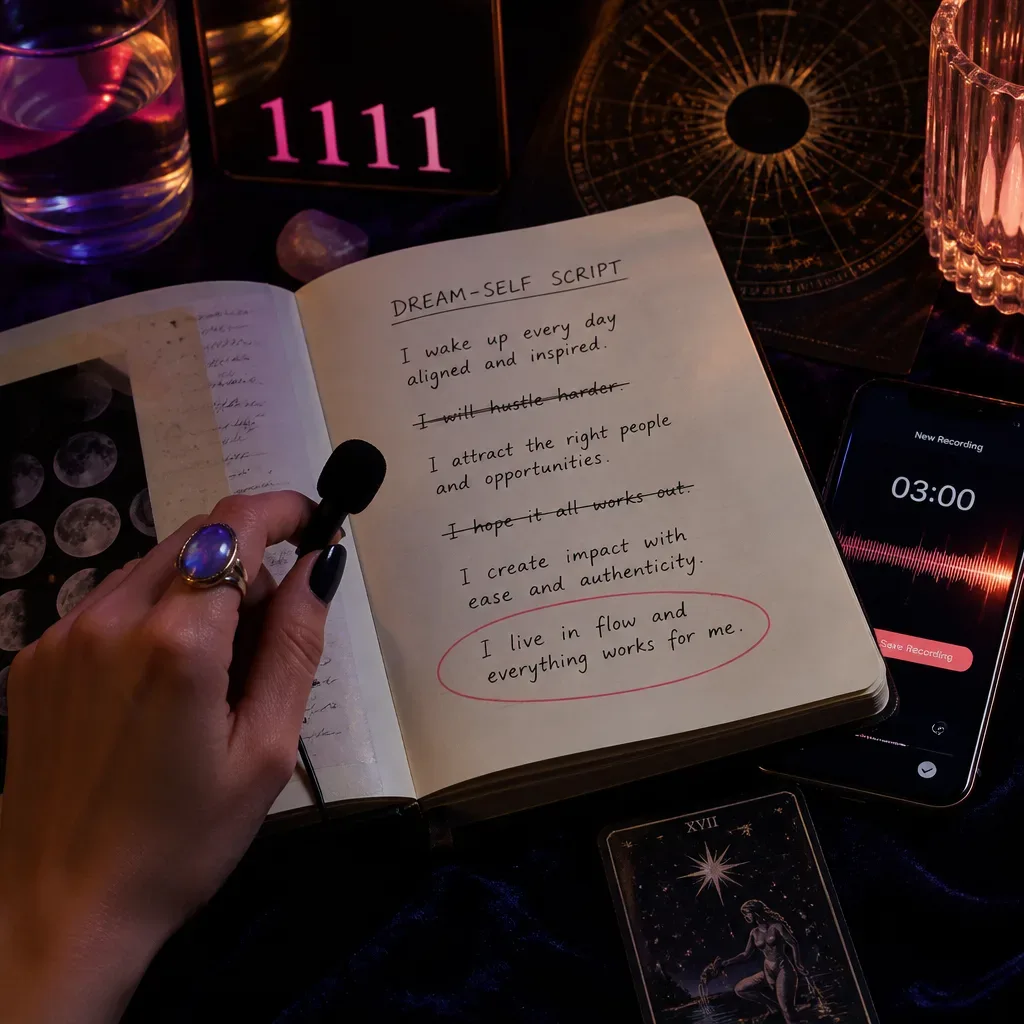
You create the audio by scripting one specific future moment, recording it in your own calm voice, and keeping it short enough to finish before the mind resists.
Start with one scene, not a life plan. The sleeping mind does not need a 42-slide deck. It needs an image with weight: the email received, the key turning, the calendar cleared, the body waking without dread. Neville Goddard called this kind of imaginal act a scene that implies fulfillment. His language came from another century, but the editorial note still lands: choose the moment after the arrival, not the begging before it.
A 3-minute recording usually equals about 390 to 450 spoken words if you speak slowly, since conversational speech averages around 130 to 150 words per minute. Do not fill every second. Pauses count. Silence lets the nervous system agree.
Here is a useful structure:
| Minute | What to say | Why it works |
|---|---|---|
| 0:00-0:40 | Settle the body and name the scene | Gives the mind a location |
| 0:40-1:40 | Speak from the Dream-Self as already living it | Builds identity rehearsal |
| 1:40-2:30 | Add sensory proof: light, texture, sound, posture | Makes the scene memorable |
| 2:30-3:00 | Close with one simple line of trust | Prevents mental bargaining |
Avoid grand claims your body rejects on contact. If your nervous system is recovering from burnout, I am a global icon by Tuesday may create static. Try: I wake with enough steadiness to choose the next right thing. In clinical psychology, implementation intention research by Peter Gollwitzer has shown that specific if-then plans can improve follow-through across dozens of studies; specificity helps the brain recognize the cue.
Your Dream-Self audio should feel like a message from someone who knows you, not a billboard shouting at a stranger. If you want language support before recording, read the Affirmations pillar, then edit the lines until they sound like your own mouth.
What should you say in the audio without sounding fake?
Say what your body can believe tonight, then let repetition make the next version feel possible.
The fastest way to ruin a bedtime recording is to make it too shiny. The hypnagogic state is not a stage for motivational theater. It is a room with the lights low. Speak plainly. Mention ordinary evidence. A clean kitchen. A steady invoice. A message answered without panic. The future self is more convincing when she has details under her nails.
Use present-tense identity language, but keep it grounded. Joe Dispenza often teaches mental rehearsal as a way to condition the body toward a future emotional state. You do not have to adopt all of his framework to see the useful piece: the body learns through repetition and feeling. In neuroscience terms, Hebbian learning is often summarized as neurons that fire together wire together, a phrase linked to Donald Hebb’s 1949 work.
Good lines for a 3-minute sleep audio:
- I recognize this room because I have been preparing for it quietly.
- I choose from steadiness, not urgency.
- My work fits my life instead of swallowing it.
- I receive the signal and do not chase the noise.
- I let sleep carry the instruction without needing to supervise it.
Do not pack the audio with twelve desires. In a 2010 paper in Psychological Bulletin, researchers found that mental imagery can influence emotion and motivation, but vividness and personal relevance matter. One clean scene with sensory texture will do more than a crowded wish list. The mirror needs one face at a time.
You can pair the audio with a single daily affirmation earlier in the evening, especially if the words need practice before bedtime. Just keep the hierarchy clear: in the AYA Method, the audio is the spine. Affirmations and the Manifestation Board are complements. Useful punctuation, not the sentence itself.
When is the best time to press play?
Press play after your body is already settling, ideally within the final 3 to 10 minutes before sleep.
Most people start too early. They climb into bed wired, press play, then wonder why the mind treats the audio like another tab. Give the nervous system a runway. Lower the lights first. Put the phone face down. If you use a sleep timer, set it before the practice begins. The fewer choices after the audio starts, the better.
Light exposure matters here. Research from Harvard and other sleep labs has shown that blue-enriched light in the evening can suppress melatonin and shift circadian timing. One widely cited study by Chang, Aeschbach, Duffy, and Czeisler in 2015 found that evening e-reader use before bed delayed circadian rhythm and reduced next-morning alertness compared with print reading. The signal before sleep is biological, not just poetic.
Try this 11-night timing experiment:
- Nights 1-3: listen after lights out, when you are already drowsy.
- Nights 4-6: listen 10 minutes before lights out, then observe sleep quality.
- Nights 7-9: listen with a 5-minute breathing buffer beforehand.
- Nights 10-11: choose the timing that felt least effortful.
Track only 3 things: sleep onset, emotional tone on waking, and whether the scene returned during the day. The American Academy of Sleep Medicine often recommends consistent sleep timing as part of healthy sleep hygiene; consistency reduces the drama. Manifestation practice also benefits from less drama than the internet sells.
The number 11 has its own little charge on Manifest 11: a master number, a signal, a pair of upright lines. Use 11 nights not because the cosmos sends invoices, but because it is long enough to see a pattern and short enough to actually do.
How do you combine this with the AYA Method?
Use the AYA Method as the core audio practice, then let bedtime be one of the day’s listening gates.
The cleanest approach is to listen to your Dream-Self Moment once in the morning or during a stable part of the day, then use the 3-minute sleep version at night. Morning listening names the direction while you are conscious and upright. Bedtime listening lets the same identity touch the hypnagogic edge. Same signal, two rooms.
If you are new to the wider practice, start with the Manifestation pillar to understand the difference between fantasy, intention, repetition, and action. Then come back to the audio. The practice is not wishing harder. It is training attention to recognize the self you keep rehearsing.
The AYA Method is precise about this: listening is the practice. Repetition is the work. The audio is the method. That matters because bedtime can easily become a cabinet of spiritual accessories. Crystals, candles, moon calendars, journals, boards, oils. Fine, if they help. But the method needs one thing to happen: press play and listen.
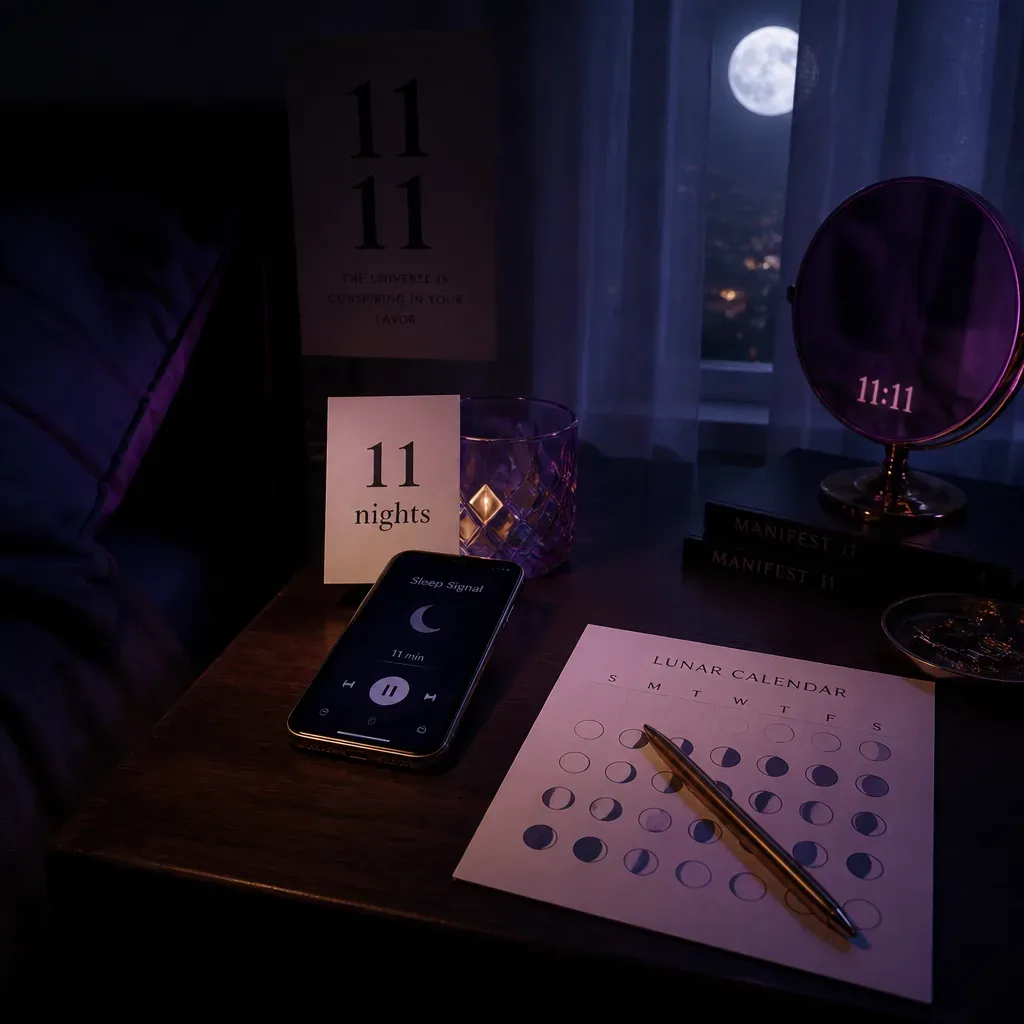
A simple nightly sequence could look like this:
- 9:55 p.m.: lights dim, phone on sleep mode.
- 10:05 p.m.: one line written in a notebook: what signal arrived today?
- 10:08 p.m.: 3-minute Dream-Self audio.
- 10:11 p.m.: no more input.
If lunar timing helps you stay consistent, you can place an 11-night cycle around a new moon or first quarter moon. The moon completes a full cycle in about 29.5 days, according to NASA, so an 11-night practice is a real slice of that rhythm without requiring you to become a full-time sky accountant. For more on timing without superstition, see Astrology and manifestation.
What mistakes make hypnagogic manifestation weaker?
The main mistakes are overstimulation, overlong recordings, unbelievable language, and checking for results too quickly.
The first mistake is using the phone like a casino until the second before practice. Pew Research Center reported in 2021 that 31% of U.S. adults say they are online almost constantly. If your nervous system has been fed alerts for three hours, one soft audio has to compete with a parade. Give it a chance. Close the gates before you ask for a signal.
The second mistake is making the recording too long. A 17-minute track can be beautiful, but if it keeps you awake, it has missed the assignment. Bedtime manifestation should lower cognitive load. In sleep hygiene research, stimulus control often asks people to associate the bed with sleep rather than effort. Your ritual should not turn the mattress into a productivity desk.
The third mistake is using language that insults your present life. I am grateful for the exact delay that taught me everything may be useful one day, but if you are furious tonight, your body may call it a lie. Tara Brach’s work on radical acceptance is helpful here: begin where you are actually standing. Acceptance is not resignation. It is accurate location.
Watch for these friction points:
- You keep editing the audio every night.
- You choose a different desire whenever you feel anxious.
- You replay the track because you think one listen did not count.
- You check your life the next morning like a tracking number.
- You use the practice to avoid a real conversation, email, or decision.
A signal is not a substitute for a step. The audio sets the inner posture; the next day still asks for your hands.
How will you know the practice is working?
You know it is working when the desired identity becomes easier to recognize, choose, and act from during ordinary moments.
Do not judge the practice only by dramatic arrivals. The early signs are often smaller: you pause before sending the reactive message, you notice the job listing you would have ignored, you dress like the person who expects to be seen, you stop explaining your boundary seven different ways. In behavior change research, self-efficacy, a term developed by Albert Bandura, predicts whether people persist through difficulty. The Dream-Self audio should increase that felt capacity.
Track evidence for 11 nights, then review it once. Not hourly. Not with a detective’s lamp. Once. Write down patterns in 3 columns:
| Signal | What happened | What I did next |
|---|---|---|
| Inner | Felt calmer before a hard email | Sent it without apology padding |
| Outer | Saw the same number three times | Used it as a cue to return to the scene |
| Practical | Found a relevant contact | Asked for the introduction |
The number itself is not the proof. The response is. Seeing 11:11 can be nothing, or it can become a bell that reminds you to stand inside the self you have been rehearsing. Synchronicity is most useful when it changes your next clean action.
If you want a daytime companion, keep a Manifestation Board as a visual reference, but do not confuse the board with the practice. The board is the witness. The audio is the rehearsal. The action is the receipt.
Return to the same 3-minute recording for at least 11 nights. If nothing shifts, revise the scene, not your worth. Make it more specific, more believable, closer to the life that is asking to arrive. The dial does not need panic. It needs contact.
Sleep with one clear signal in the room.