sleep hypnosis affirmations
Sleep Hypnosis for Manifestation: 3-Minute Audio
Sleep hypnosis for manifestation works best when you start with a short Dream-Self audio, then let sleep carry the suggestion without force.
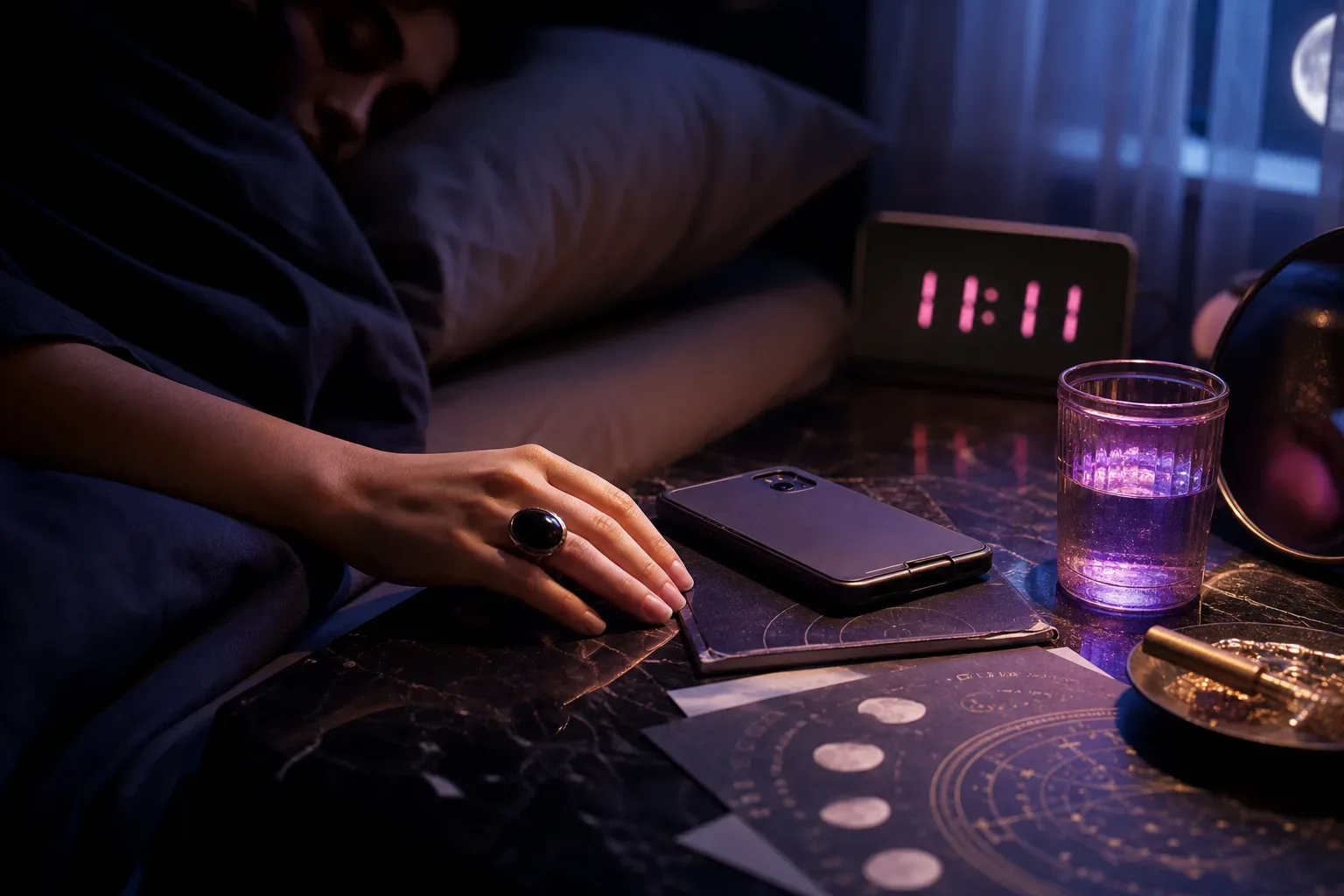
Sleep hypnosis for manifestation works best when it starts small: one 3-minute Dream-Self audio, played once before sleep, with the room dim and the phone face down. The method is not to strain for trance. The method is to give the mind one clear signal before the night closes.
I like the number 3 here. Not because it is mystical by itself, though numerology gives 3 the old assignment of expression and form. I like it because 3 minutes is short enough to repeat when you are tired, honest enough to fit a real life, and long enough for a voice to change the room.
The hour matters too. In the last 30 minutes before bed, your attention is already narrowing. The National Sleep Foundation has long recommended a consistent wind-down window, often 30 to 60 minutes, because the brain takes cues from repetition. A short audio placed inside that window becomes a gate. Not a performance. A gate.
The last thought of the day is not magic. It is a vote.
What is sleep hypnosis for manifestation, really?
Sleep hypnosis for manifestation is a bedtime suggestion practice that uses relaxation, focused attention, and future-self imagery to rehearse the identity you intend to live from.
Hypnosis is not stage drama with a velvet curtain. The American Psychological Association describes it as a state of focused attention and reduced peripheral awareness, often paired with greater response to suggestion. That definition is useful because it removes the spectacle. At night, you are not trying to disappear. You are letting the dial turn down.
Manifestation adds the direction: the life you are naming, claiming, and practicing from the inside. For a grounded overview of the concept, keep Manifestation pillar nearby. The clean version is not wishful thinking. It is attention, emotion, repetition, and behavior pointed at the same target often enough that the target stops feeling foreign.
Sleep makes this more interesting. Research on memory consolidation shows that sleep helps stabilize and reorganize what the brain has recently learned; Harvard sleep researcher Robert Stickgold has written for years about sleep as an active processing state, not a blank screen. If the final input before bed is panic, the nervous system has material. If the final input is a specific future-self scene, it has different material.
That does not mean sleep hypnosis controls your dreams or guarantees an outcome by Friday at 11:11. Useful practices do not need theatrical promises. They need repeatable conditions. A 3-minute audio gives the night one instruction: remember this version of me.
Why start with a 3-minute Dream-Self audio first?
Start with 3 minutes because consistency beats intensity, especially when the practice happens at the edge of sleep.
Most people fail bedtime practices because they design them for the person they wish they were at 9 a.m., not the person they are at 11:37 p.m. The tired self does not want a 42-minute ritual, seven journal prompts, and a candle that requires supervision. The tired self wants the light off. Respect her. She is the one who has to repeat this.
In behavior design, BJ Fogg of Stanford has argued that tiny habits work because they reduce friction and attach to existing routines. Three minutes is small enough to attach to brushing your teeth, putting the phone down, or turning onto your side. The smaller the gate, the more often you walk through it.
Here is the clean definition I use in my own practice: the AYA Method is a daily audio manifestation practice. Each day you listen to a short personalized recording — your Dream-Self Moment — narrated from the version of you who has already manifested the life you intend. Listening is the practice. Repetition is the work. The audio is the method.
That last sentence matters. The daily affirmation and the Manifestation Board can complement the practice, but they are not the spine. The audio is the method. The voice arrives before the old story gets the microphone.
A 3-minute spoken recording usually contains about 350 to 450 words, depending on pace. That is enough for a scene, a body cue, a decision, and one sentence that names the new identity. More than that, and the mind starts sorting. Less than that, and the signal may not land.
A short practice repeated nightly becomes more persuasive than a long practice performed once and admired from a distance.
How do you prepare the room without turning bedtime into a ritual production?
Prepare the room by removing friction: lower the light, lower the volume, and remove the sense that you are being graded.
The room does not need to become a temple. It needs to become legible. Sleep medicine guidelines from the American Academy of Sleep Medicine consistently emphasize regular timing, reduced light exposure, and fewer stimulating cues near bedtime. Blue light is not the villain in every story, but screens do keep the brain in conversation. Put the phone face down after you press play.
Use the same small sequence each night. The nervous system likes order more than drama. If the sequence is always water, bathroom, dim lamp, audio, sleep, the body starts to read the first step as a signal. In circadian science, light timing is one of the strongest cues for the body clock; Dr. Andrew Huberman often points to light exposure as a primary regulator of wakefulness and sleep timing. At night, you are doing the inverse: less light, less novelty, fewer decisions.
Try this 3-minute setup before you listen:
- Put the phone on airplane mode or sleep focus.
- Set volume low enough that the voice feels near, not commanding.
- Choose one position and stay there for the full audio.
- Let the room be imperfect. Perfection is stimulation in expensive shoes.
- Press play once.
Notice what is missing. No checking metrics. No hunting for angel numbers. No restarting because your mind wandered at second 41. Wandering is not failure; it is the mind shedding the day. Bring attention back to the voice when you notice. That is already the practice.
The timing can be simple: use the final 5 minutes before sleep, with 3 minutes for audio and 2 minutes for settling afterward. If you wake during the night, do not restart unless you are fully alert and unsettled. The practice is a gate, not a loop.
What should the 3-minute sleep hypnosis audio actually say?
The audio should speak from the Dream Self, in present-tense scenes, with one clear identity shift and one body-level cue.
A weak script sounds like a list of demands. A strong script sounds like evidence from a life already being lived. The difference is texture. “I am successful” may be useful as an affirmation, and the Affirmations pillar explains why repetition can matter. But a Dream-Self audio goes further: “I open the email calmly because I already know how I handle good news.” That sentence gives the body a role.
In a 2020 review in the journal Neuroscience of Consciousness, researchers noted that hypnosis involves changes in attention, absorption, and suggestion response, though individual responsiveness varies. That variance is important. You are not trying to copy someone else’s trance depth. You are creating a cue your own system can recognize.
Use this structure:
| Minute | Purpose | Example |
|---|---|---|
| 0:00–0:30 | Settle the body | “Your jaw softens. The day is no longer asking for proof.” |
| 0:30–1:30 | Enter the future scene | “You wake with the quiet certainty that the decision has already been made.” |
| 1:30–2:30 | Name the identity | “You are the person who answers from steadiness, not hunger.” |
| 2:30–3:00 | Close the gate | “Sleep carries this. Nothing else is required tonight.” |
A 3-minute script should not contain 19 desires. Pick one season. The new client. The calmer body. The move. The relationship pattern that no longer gets your signature. If the theme is love, do not stuff in money. If the theme is work, do not smuggle in revenge. The signal gets blurry when the room gets crowded.
There is room for numbers if they are genuinely part of your symbolic language. Master numbers 11, 22, and 33 are often read as intuition, building, and service in modern numerology. I treat them as punctuation, not proof. If 11:11 keeps appearing on the nights you practice, witness it. Then still press play.
How do you listen without forcing yourself into trance?
Listen as if you are being told something familiar, not as if you are trying to pass a spiritual exam.
The fastest way to ruin sleep hypnosis for manifestation is to monitor yourself. Am I relaxed enough? Did I visualize correctly? Was that a sign? This turns a soft practice into a fluorescent room. The mind loves a checklist because a checklist lets it stay in charge.
Clinical hypnosis research often separates hypnotic responsiveness from simple relaxation. In one often-cited sleep study by Cordi and colleagues, published in Sleep in 2014, hypnotic suggestion increased slow-wave sleep by about 81% in highly suggestible young women. That does not mean every listener gets the same result. It means suggestion can influence sleep architecture for some people under specific conditions. Specific conditions matter. So does not trying to wrestle the result to the floor.
Use the 4-line listening rule:
- Hear the voice.
- Let the image arrive or not arrive.
- Notice the body cue.
- Stop evaluating.
If you miss a sentence, do not rewind. If emotion rises, let it be present without making it the headline. If skepticism appears, it can sit in the back row. Skepticism is not the enemy; frantic control is.
This is where Astrology and manifestation can be a useful companion, not a command center. Lunar cycles, Saturn returns, and repeating numbers can help you name the season you are in. They should not replace the nightly action. The moon may mark the timing. You still have to listen.
The future self does not need you to believe perfectly. She needs you to show up repeatedly.
What does a simple 7-night practice look like?
A 7-night practice looks like one audio, one intention, and one small note each morning, repeated without changing the script midstream.
Seven nights is long enough to reveal patterns and short enough to avoid turning the practice into a personality test. Sleep researchers often use one-week sleep diaries because 7 days can show timing, waking, and consistency patterns better than a single night. You can borrow that logic without becoming a lab.
Here is the sequence:
- Night 1: Name the intention. Write one sentence: “I am practicing the version of me who…”
- Night 2: Keep the same audio. Resist editing because it did not feel dramatic.
- Night 3: Notice resistance. Write down the exact objection your mind raises.
- Night 4: Listen earlier if needed. If you fell asleep before pressing play, move the practice 10 minutes earlier.
- Night 5: Track one behavior. Did you answer, choose, rest, or speak differently today?
- Night 6: Watch the symbols. Repeating numbers, dreams, or timing can be noted without being inflated.
- Night 7: Decide whether to continue. Keep the audio if the signal feels clean. Rewrite only if the intention has sharpened.
This is where the Manifestation pillar becomes practical. Manifestation is not only the night practice. It is also the daytime evidence: the email you send, the boundary you keep, the application you finish, the conversation you stop rehearsing and actually have.
The morning note should be brief. One line is enough. “Dreamed of the old office.” “Woke calmer.” “Wanted to text him and did not.” “Saw 22 twice and paid the invoice.” The point is to witness the return of the signal in ordinary life.

How do affirmations and boards support the audio without taking over?
Affirmations and a Manifestation Board support the audio when they echo the same identity, not when they compete for attention.
This distinction is not cosmetic. The AYA Method places the audio at the center because listening creates a full scene: voice, pacing, emotional tone, and imagined memory. A daily affirmation can condense that scene into one sentence during the day. A Manifestation Board can give the eyes a visual cue. But the audio remains the nightly method.
A good affirmation is not a slogan taped over fear. It is a sentence your nervous system can almost believe today. For the science-minded, self-affirmation research by Claude Steele and later studies in social psychology suggest that reflecting on valued identity can reduce defensiveness under threat. The effect is not fairy dust. It is a measurable shift in how the self relates to pressure.
Use the support tools like this:
- Audio before sleep: the full Dream-Self scene.
- Affirmation in the morning: one sentence from the audio.
- Manifestation Board once daily: one image that matches the identity, not every desire you have ever had.
- Evening note: one line of evidence from the day.
If you want a clean companion piece, read Affirmations pillar and choose one line that matches your audio. Do not collect 33 affirmations because 33 is a master number and the internet said more is better. More is often just noise wearing a costume.
The board can point. The affirmation can remind. The audio carries the room.
When should you change the audio, and when should you stay with it?
Change the audio when the intention has become clearer, not when your mood wants novelty.
Novelty is seductive at bedtime. A new track feels like progress because the brain gets a fresh surface to touch. But the deeper work often starts after the script becomes familiar. Repetition lowers the need to analyze. The voice can pass the guard at the door because the guard has heard it before.
In meditation research, including work discussed by Tara Brach and clinical mindfulness teachers, repetition is often what reveals the pattern. The first sitting shows the noise. The tenth sitting shows the relationship to the noise. Sleep hypnosis follows a similar rhythm. The first night may feel pretty. The fifth may feel irritating. The seventh may show you the exact sentence you do not yet believe.
Change the audio if one of these is true:
- The desired identity has shifted in a specific way.
- The script contains language that now feels false or performative.
- You have completed the action the audio was designed to support.
- The body cue no longer matches the season you are in.
Stay with it if the only problem is boredom. Stay with it if the old story is complaining. Stay with it if you are checking for results every morning like a stock price. A practice cannot become a signal if you keep changing the frequency.
For a wider frame, the AYA Method keeps the daily practice anchored in audio while allowing the surrounding material to evolve. That is the balance: steady method, living content.
Three minutes before sleep is not small because it is weak. It is small because the right thing, repeated at the right gate, does not need to shout.
Leave the last word to the voice that arrived on cue.