vision boards
Vision Board Categories: 9 Life Areas for Audio
Vision board categories help you choose images that stay true to your daily audio practice, from home and love to work, health, and money.
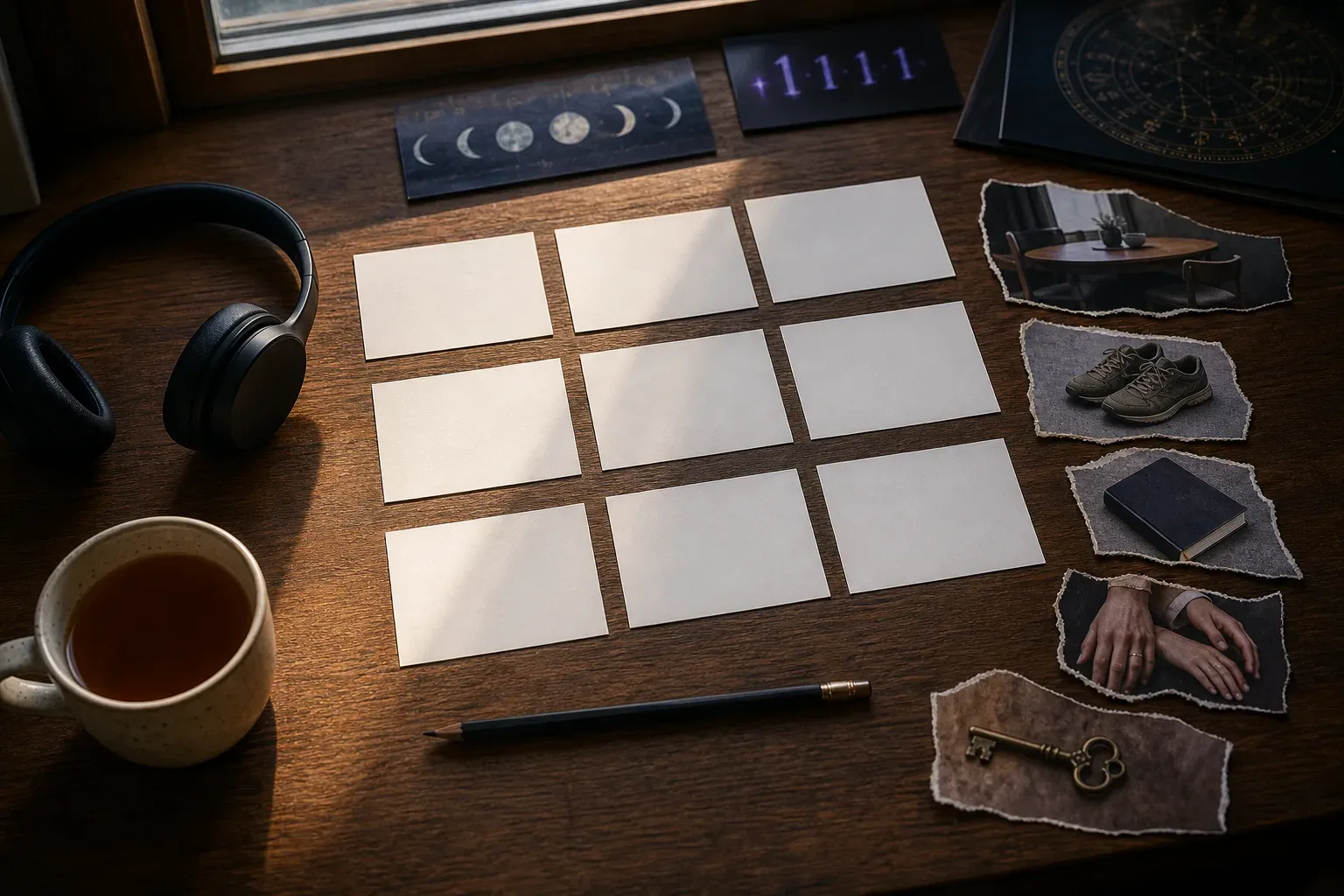
There is a square of paper on the table. A cup beside it. Headphones nearby. Vision board categories are the life areas you choose before you choose images, so your board supports your audio practice instead of becoming decoration. Nine categories are enough: self, body, home, love, work, money, creativity, learning, and service.
What should vision board categories do before you add pictures?
Vision board categories should give your attention a place to land before your eyes start collecting images.
A category is a small bowl for attention. Without it, a vision board can become a wall of attractive things that don’t know each other. With it, the board begins to speak in rooms: this is the body room, this is the work room, this is the home room. You can visit one room at a time.
That matters because the brain tends to respond better to specific cues than vague wanting. In a 2006 meta-analysis of 94 studies, psychologist Peter Gollwitzer and Paschal Sheeran found that implementation intentions, the simple practice of linking a goal to a clear cue and action, had a medium-to-large effect on goal achievement. A category is not a cue by itself, but it makes cues easier to choose.
The board is the visible complement. The audio is the practice. The AYA Method is a daily audio manifestation practice. Each day you listen to a short personalized recording — your Dream-Self Moment — narrated from the version of you who has already manifested the life you intend. Listening is the practice. Repetition is the work. The audio is the method.
So the question is not, “What looks aspirational?” It is softer and more exact: “What image helps me remember what I already heard?” The right category keeps you from choosing a picture because it pleased the internet. It asks whether the image belongs to your real life.
A vision board is a receipt, not a performance.
If you’re new to the wider practice, the Manifestation pillar can hold the larger frame. For this piece, stay close to the table. Nine bowls. One pair of headphones. A future that becomes easier to recognize because you return to it daily.
Which 9 vision board categories cover a whole life?
The nine clearest vision board categories are self, body, home, relationships, work, money, creativity, learning, service, and each one should point to a lived scene.
Here is the simple map. You can rename any category so it sounds like you.
| Category | What it holds | A quiet image to look for |
|---|---|---|
| Self | Identity, values, mood, inner voice | A mirror, a handwritten note, a calm morning |
| Body | Health, rest, movement, food | Walking shoes, broth, a clean bed |
| Home | Space, safety, rhythm, beauty | A kitchen table, fresh sheets, a window |
| Relationships | Love, friendship, family, repair | Two cups, a shared meal, held hands |
| Work | Calling, craft, structure, skill | A desk, tools, a finished page |
| Money | Stability, receiving, stewardship | A ledger, keys, a paid bill |
| Creativity | Making, play, taste, voice | Paint, dough, thread, a camera |
| Learning | Study, mentors, practice, reading | A notebook, class notes, a library card |
| Service | Giving, community, legacy, care | Soup pots, open doors, shared harvest |
Nine is not a magic number. It is just large enough to include most daily life and small enough to remember. Working memory research is often traced to George Miller’s 1956 paper on the “magical number seven, plus or minus two,” though later research suggests attention can hold fewer items at once. Nine categories sit at the edge, so the names need to be plain.
You may notice that some categories overlap. A dinner table can be home, body, relationship, money, and service. That is fine. Real life refuses tidy drawers. Choose the category by asking what the image is meant to remind you of today.
For example, a bowl of black beans on a blue plate could mean health if you’re feeding yourself well. It could mean home if you’re making a kitchen you want to return to. It could mean family if the recipe came from your grandmother. The image is less important than the meaning you give it.
The audio tells the body what the image is for.
How do you pair each category with a Dream-Self Moment?
You pair each category with audio by listening first, then choosing one image that matches a detail your future self seems to know.
Do not start with the magazine pile. Start with the recording. Sit down, press play, and listen for nouns. Door. Table. Hand. Name. Morning. Voice. Your Dream-Self Moment may not mention all nine categories, and it doesn’t need to. The category that feels warm after listening is the one to begin with.
Mental imagery has been studied for decades. A 1994 meta-analysis by Driskell, Copper, and Moran reviewed 35 studies and found that mental practice improved performance, especially when tasks had cognitive components and when the mental practice was paired with physical practice. Your board is not a substitute for living. It is a way of making the listened-to future more concrete.
Try this numbered sequence after one audio session:
- Listen once without touching your board.
- Write down 3 objects, places, or gestures you heard or sensed.
- Match each detail to one category.
- Choose one image only.
- Add one sentence under it in your own words.
- Leave the board alone for 24 hours before adding more.
That last step matters. Desire can get noisy when it is asked to decorate. A pause lets the image prove whether it is true. In goal research, clarity helps, but overloading yourself can make the practice feel like another obligation. A 2015 review in Health Psychology Review noted that self-regulation works best when strategies are specific and manageable.
If your audio gives you the sense of waking in a cleaner room, the category may be home. Do not add ten interiors. Add the one window that looks like morning. If you hear yourself speaking more gently to your body, the category may be body. Add the walking path, not the fantasy version of yourself.
For word-based support, Affirmations pillar can help you write language that doesn’t fight your nervous system. Keep the sentence small. “I keep promises to my body” is often more usable than a grand claim you cannot feel.
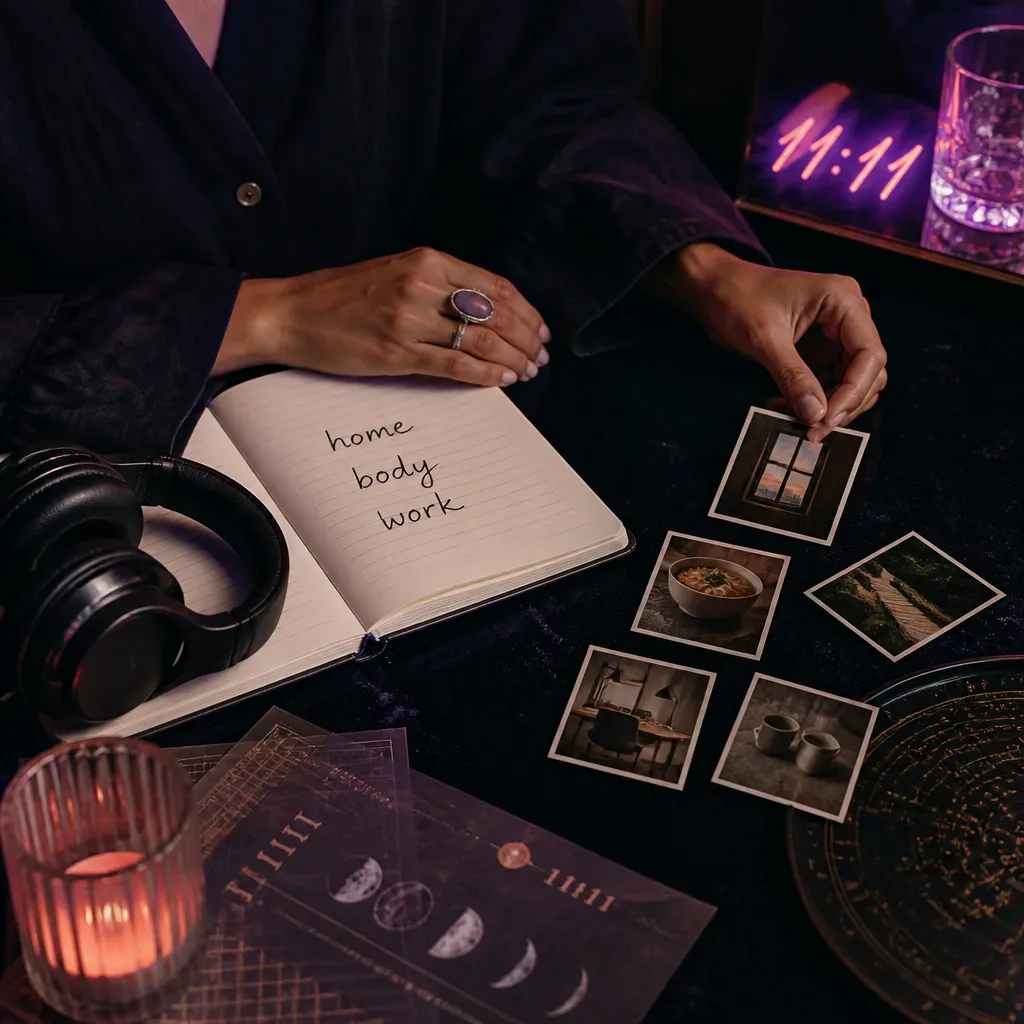
What belongs in the self, body, and home categories?
These three categories should show the conditions that make your future self feel believable from the inside.
Self is the category for identity. Not performance. Not costume. Identity. It might hold a photo of your hand writing calmly, a word like “steady,” or a small object that reminds you of your values. In self-affirmation research, including a 2013 PNAS study led by J. David Creswell, reflecting on core values helped buffer stress responses during problem-solving tasks. The self category is where values become visible.
Body is where you place rest, nourishment, movement, medicine, and care. As a food writer, I trust images of meals more than images of bodies. A pot of caldo tells the truth. A cutting board with limes. A glass of water beside the bed. The body category should not shame you into obedience. It should remind you that you live through flesh and breath.
Home is where the nervous system learns whether it can soften. This does not require a perfect house. The U.S. Bureau of Labor Statistics reported that Americans spent an average of about 1.8 hours per day on household activities in the 2023 American Time Use Survey. Home is made in small repetitions: washing a cup, opening curtains, putting keys in the same bowl.
These three categories often come before the outer ones because they change how the rest of the board is read. A work image seen from exhaustion can become pressure. The same image seen from a held body can become a clean next step.
If a picture makes you perform for an imaginary audience, it doesn’t belong.
Use these filters:
- Does this image make me feel more honest?
- Does it match something I heard in my Dream-Self Moment?
- Can I imagine touching, eating, wearing, or walking near it?
- Would I still choose it if no one ever saw my board?
The self, body, and home categories are not small. They are the ground. A future that has nowhere to sleep will not stay.
What belongs in relationships, work, and money?
Relationships, work, and money should show patterns of exchange: how you give, receive, speak, repair, earn, and choose.
The relationships category is not only romance. It includes friendship, family, chosen family, and the tender skill of repair. Pew Research Center reported in 2023 that 61% of U.S. adults said having close friends is extremely or very important for people to live a fulfilling life. Put the evidence of closeness here: two bowls on a table, a text that says “home safe,” a porch with enough chairs.
Work is the category for craft and contribution. Not just job title. Not just applause. Work might be a clean calendar, a sharpened knife, a studio key, a finished invoice, a manuscript with coffee rings. Research by Edwin Locke and Gary Latham, summarized across decades of goal-setting studies, shows that specific and challenging goals tend to improve performance more than vague goals, especially when feedback is present. A work image should know what done looks like.
Money is where many boards get loud. Keep it quiet. Money can be rent paid early, debt reduced by a named amount, savings with a purpose, tools bought without panic, groceries chosen without fear. If you use numbers, use real ones. “Save $1,200 by December” gives the mind a clearer instruction than a pile of symbols that don’t touch your life.
There is also timing. In astrology-based planning, some people like to place financial reviews near a new moon or personal transit. If that is part of your language, read Astrology and manifestation with discernment. The calendar can be a container. It should not become a ruler.
Here is the quiet test for these three categories: can the image survive ordinary Tuesday? A relationship image should survive laundry. A work image should survive email. A money image should survive the bank app.
What is true will usually look less shiny than what is borrowed.
What belongs in creativity, learning, and service?
Creativity, learning, and service should show what wants to move through you and what you are willing to practice over time.
Creativity is not only art. It is making. A sauce. A sentence. A garden bed. A birthday altar. A better spreadsheet. The category should include evidence of your hands. Teresa Amabile’s research on creativity at work has long pointed to progress in meaningful work as a key source of motivation; even small wins can change how a person returns to a task. Put one small win where you can see it.
Learning is the category for humility. It holds classes, books, teachers, repetition, correction. A 2011 study by Karpicke and Blunt in Science found that retrieval practice improved long-term learning more than repeated studying or concept mapping for many students. So choose images that show active learning: flashcards, a practice room, a marked-up page, a language notebook with mistakes still visible.
Service is the category that keeps the board from becoming a closed fist. It asks: who is fed by the life I am practicing? This does not mean self-erasure. It means connection. In a 2020 report, the Corporation for National and Community Service noted that formal volunteering in the U.S. was associated with better reported health and life satisfaction, though cause and effect are complex. Giving often changes the giver, too.
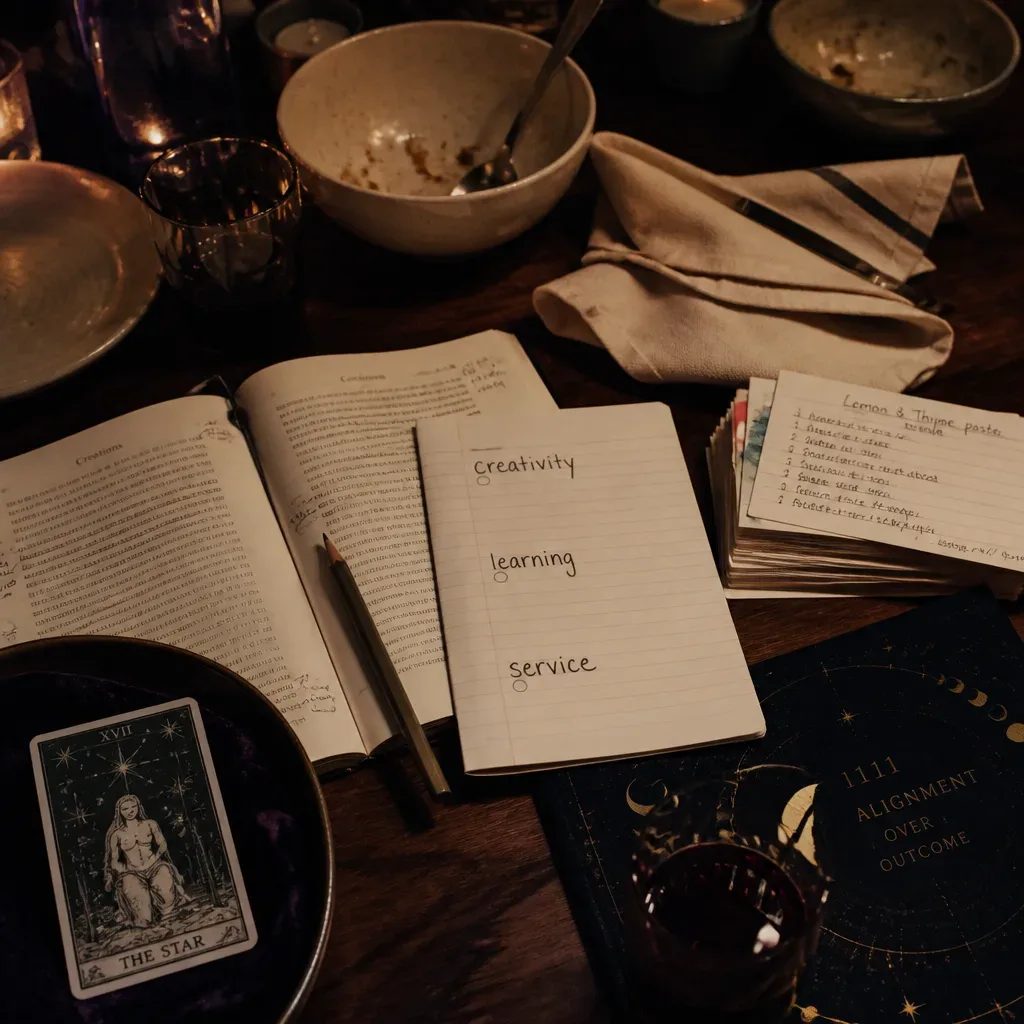
These three categories can be especially tender because they are less about possession and more about expression. The image may not be a trophy. It may be a table after everyone has eaten. A stack of books by the bed. A song draft with one good line.
This is also where a Manifestation Board inside an app can help, if it keeps you close to the audio rather than pulling you into endless collecting. The app may also include a daily affirmation as a complement, but the listening remains the center. The board is not asked to carry the whole practice.
Creativity, learning, and service remind you that the future self is not a statue. She is someone who keeps making, keeps studying, keeps feeding what is hers to feed.
How do you keep your board useful after the first week?
You keep a vision board useful by reviewing it lightly, editing it honestly, and returning to the audio every day.
Most boards do not fail because the images are wrong. They fade because they stop being related to practice. The daily return matters. In the often cited Dominican University goal study led by Gail Matthews with 267 participants, people who wrote goals, committed to action steps, and sent weekly progress updates reported higher achievement than those who only thought about goals. The details are debated because it was not a large medical trial, but the pattern is useful: written and repeated contact helps.
Set a small review rhythm. Ten minutes each Sunday. Or the first morning of each month. Do not rebuild the whole board unless your life has truly shifted. Instead, ask three questions:
- What image still feels true after listening this week?
- What image has become decoration?
- What category needs one more ordinary detail?
Then make one change. Only one. The nervous system often trusts small proof more than dramatic renewal. James Clear popularized the 1% improvement idea in habit writing, but the underlying behavioral point is older: repeated, low-friction cues are easier to maintain than heroic bursts.
If you want a fuller foundation for the visual side, keep Manifestation pillar nearby, then return to your recording. If words are becoming harsh, revisit Affirmations pillar and soften the language. If timing helps you stay devoted, Astrology and manifestation can offer a calendar without taking over.
The practice is not to stare harder. The practice is to listen, recognize, and act in small ways. A board can remind you to send the email, cook the soup, take the walk, save the receipt, say the clean sentence. That is enough work for one day.
Leave the image where your quieter self can find it.