vision boards
Vision Board App Setup With Dream-Self Audio
Set up a vision board app that pairs chosen images with Dream-Self audio, so your board becomes a quiet cue for daily manifestation practice.

Your phone is face down beside your tea. To set up a vision board app well, choose a few true images, pair them with Dream-Self audio, and return to them daily. The image gives your mind a door; the audio teaches it what it sounds like to walk through.
What should a vision board app actually do?
A vision board app should help you see one desired life clearly and practice the inner state that belongs to it.
A board is not meant to become another place to perform. It is not a scrapbook for strangers. It is a cue. Cognitive psychologist Nelson Cowan’s 2001 work on working memory suggested that people often hold about 4 chunks of information in active attention, not endless detail. That is why a quiet board works better than a crowded one.
A good setup has 3 parts: images, words, and a repeatable moment. The images give shape. The words name the self. The repeatable moment makes the board part of your day, not just a thing you built on a Sunday night. A vision board is not a wish; it is a rehearsal cue.
The AYA app includes a Manifestation Board as a complement to the listening practice. That distinction matters. The board is what you can see. The audio is what you practice. In behavior research, cues matter because they reduce the decision load. A 2010 study by Stadler, Oettingen, and Gollwitzer found that mental contrasting with implementation intentions helped participants improve fruit and vegetable intake over a 2-year period. Specific cues made follow-through easier.
If you are new to this, start smaller than you think. One board. One life area. Six to twelve images. One line of self-recognition. One daily listen. You are not trying to prove desire. You are trying to make the desired self familiar enough to act from.
For wider context, the Manifestation pillar explains the practice of rehearsing a chosen reality with attention and repetition. Your vision board app belongs there, but it should not carry the whole practice alone.
How do you choose images that feel true?
Choose images that create recognition in your body, not images that impress your mind.
The best images are often plain. A desk with morning light. A child’s shoes by a calmer doorway. A bank app with a number that lets you breathe. A kitchen table with space on it. These are not random details. They are sensory proof. The brain responds strongly to visual cues; MIT researchers reported in 2014 that the human brain can process entire images seen for as little as 13 milliseconds. That does not mean every image changes you. It means your eyes take in more than you think.
Use the question, “Would I know how to live one small minute inside this picture?” If the answer is no, the image may be too vague. If the picture only says rich, loved, successful, or free, it needs more truth. What time is it? What are you wearing? Who is not demanding anything from you? What has already been handled?
Try this simple filter:
- One image for place: the room, city, office, home, or natural setting.
- One image for rhythm: the way a normal day moves.
- One image for body: posture, rest, strength, softness.
- One image for relationship: how you are met or how you meet yourself.
- One image for work or money: the evidence of enoughness in ordinary form.
- One image for devotion: the thing you keep returning to.
If an image makes you tense because it feels like a test, remove it. If an image makes you quiet because part of you already knows it, keep it. Your future self has to sound familiar before it feels reachable.
You can read the Affirmations pillar if you want help making the words around the board feel clean and believable. Words should not bully the image. They should steady it.
How do you pair images with Dream-Self audio?
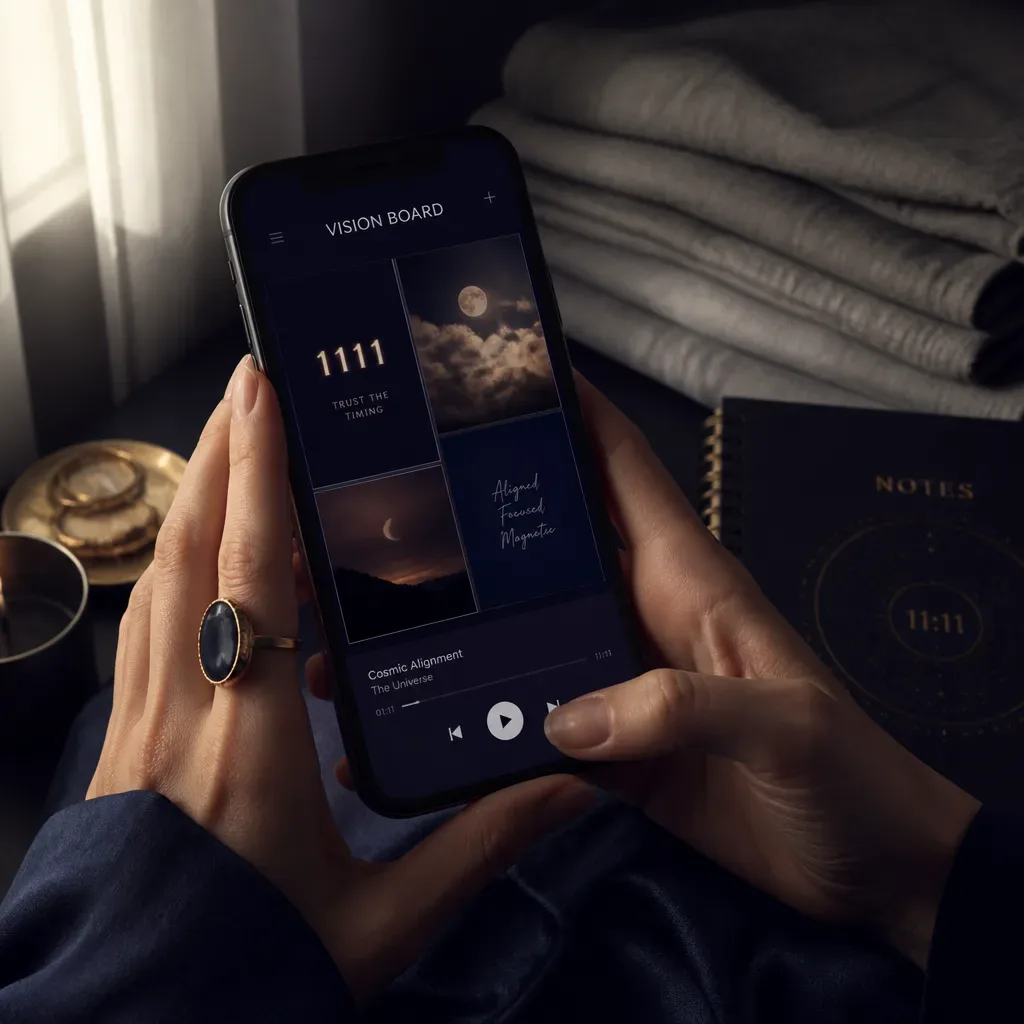
Pair the images with audio by letting the listening practice lead, then using the board as a visual anchor before or after the recording.
The AYA Method is a daily audio manifestation practice. Each day you listen to a short personalized recording — your Dream-Self Moment — narrated from the version of you who has already manifested the life you intend. Listening is the practice. Repetition is the work. The audio is the method.
That is the order. First, you listen. Then, if it helps, you look. The board supports the audio the way a candle supports prayer. It gives the eye somewhere to rest while the self learns a new sentence. Dr. Andrew Huberman has often described neuroplasticity as requiring focused attention, repetition, and the right state for learning. In plain terms: what you repeat with attention has a better chance of becoming available when life gets loud.
Here is a clean setup:
- Open your vision board app.
- Look at the whole board for 20 to 30 seconds.
- Start your Dream-Self Moment.
- Put the phone down or keep the board open, whichever feels calmer.
- After listening, choose one image and ask, “What is the smallest action that belongs to this?”
The smallest action matters. A board becomes useful when it asks for one small move before lunch. Send the email. Drink the water. Clear the one corner. Price the offer. Apologize. Rest for 10 minutes without earning it.
In small studies of mental rehearsal, athletes and performers often show gains when imagery is paired with physical practice, not used instead of it. The same principle belongs here. The board does not replace your life. It helps you meet your life as the person you are practicing becoming.
What setup steps keep the board from getting noisy?
A quiet setup uses fewer categories, fewer images, and one clear daily ritual.
Noise often enters when you try to include every possible want. Career. Love. body. house. passport. savings. hair. friendship. softness. revenge. proof. Suddenly the board is not a self you can inhabit. It is a wall of pressure. Pew Research Center reported in 2021 that 85% of U.S. adults owned a smartphone. That means the board is always near you, which is useful, but also risky. Anything always near you can become a place to check, compare, and edit.
Use this table before you build:
| Setup choice | Quiet version | Noisy version |
|---|---|---|
| Life area | One focus for 14 days | Five unrelated desires |
| Image count | 6 to 12 images | 30 or more images |
| Text | One present-tense line | A paragraph of pressure |
| Audio use | Daily Dream-Self Moment | Random listening when anxious |
| Review | Weekly, 10 minutes | Constant editing |
The 14-day container is not magic. It is practical. Many habit studies use short windows to observe consistency, and 2 weeks is long enough to notice avoidance without turning the practice into a personality test. You are giving your attention a room with walls.
For a first board, name it after the self, not the outcome. Try “The mother who is resourced,” “The writer who is paid,” or “The woman who sleeps.” This shifts the board away from object collecting and toward identity rehearsal. Neville Goddard often taught from the feeling of the wish fulfilled. You do not have to take that as doctrine to see the useful part: practice the state, not just the symbol.
If astrology is part of how you time reflection, keep it gentle. The Astrology and manifestation page can help you use timing as a mirror, not a rulebook. Your board still belongs to you.
Where should affirmations fit in the app?
Affirmations should act as small supporting lines, not as the center of the method.
One good line is enough. You do not need 27 statements fighting for your attention. In the AYA app, the daily affirmation can sit beside the Manifestation Board as a complement. It can help name the mood of the board. But the audio remains the practice. If you only have 3 minutes, listen.
The strongest affirmation is often a sentence your body does not reject. “I am a millionaire by Friday” may make part of you roll your eyes. “I know how to receive steady money” may create less resistance. That matters. A 2009 study in Psychological Science by Wood, Perunovic, and Lee found that positive self-statements could make some people with low self-esteem feel worse, especially when the statement felt too far from their current belief. Softer is not weaker. Softer can be more usable.
Use this 3-line structure beside your board:
- Identity: “I am the one who returns to what is true.”
- Evidence: “I notice proof in small, ordinary forms.”
- Action: “I take the next honest step today.”
These lines work because they do not demand a mood. They give direction. You can be tired and still return. You can be unsure and still listen. You can be busy and still take one step.
If you want more language examples, the Affirmations pillar gives a fuller way to write statements that meet the nervous system instead of arguing with it. Keep the board beautiful if you like. But make the words livable.
How should you review and update the board?
Review the board weekly by checking what still feels true, what has become complete, and what now feels like performance.
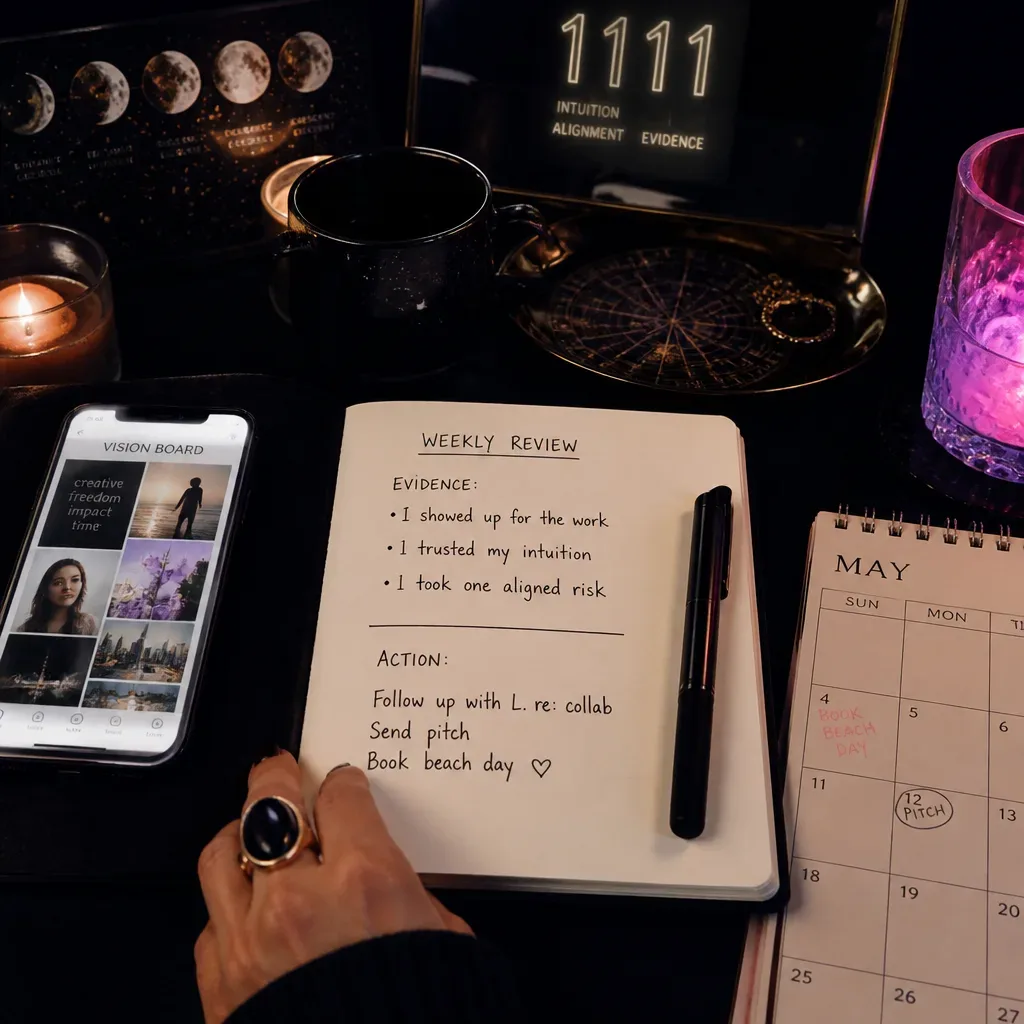
Set a 10-minute review. Put it on the same day if you can. Sunday night. Friday morning. The first quiet school pickup window. The timing is less important than the return. In habit research, consistency of context is often linked with stronger automaticity; a 2009 study by Lally and colleagues found habit formation averaged 66 days, with wide variation. Your board is not a habit by itself, but the act of returning can become one.
Ask 4 questions:
- What image still feels like home?
- What image feels like pressure?
- What image has become real in some small way?
- What action did the audio keep asking me to take?
Do not delete an image just because it has not arrived yet. Delete it if it no longer tells the truth. There is a difference. Some desires need time. Some were borrowed. Some were costumes for a need you can now name more directly.
You can also keep a tiny evidence note under the board. Three bullets per week. No essay. “I sent the invoice.” “I slept before midnight twice.” “I told the truth in the meeting.” This teaches your attention to see movement. Princeton’s Global Consciousness Project reported small statistical anomalies in random number generators during major world events, though the interpretation remains debated and is not proof of personal manifestation. I mention it carefully because people often want mystery to do the work. Your daily evidence is less glamorous. It is also more useful.
For visual structure, the vision boards hub can help you think about board types, while the Manifestation pillar can hold the wider practice. Let the board be a place of return, not a place of judgment.
What does a simple daily routine look like?
A simple routine takes 3 to 7 minutes and ends with one ordinary action.
You do not have to wake earlier. I am a mother. I have tried to build practices that require a silent house and a better version of me. They do not last. What lasts is small enough to survive toast crumbs, calendar alerts, and the child asking where her purple socks went. The National Center for Health Statistics has reported that many adults sleep less than the recommended 7 hours, so a practice that steals sleep is not kind.
Try this:
- Minute 1: Open the vision board app and look at the board without fixing it.
- Minutes 2 to 4: Listen to your Dream-Self Moment.
- Minute 5: Choose one image and name one small action.
- Minute 6 or 7: Do it, schedule it, or write the first step.
That is enough. Not because your desire is small. Because your attention is human. The app can hold the image. The audio can hold the future-self voice. You only need to return.
If you miss a day, do not punish the practice by making the next day dramatic. Just listen again. Repetition is quieter than self-blame, and it works better. In behavior change research, missing once is less damaging than the story you attach to missing. The return is the skill.
A vision board app becomes sacred in the old sense: set apart. A few minutes where you remember what you are practicing. A few images that do not shout. A voice from the self who already knows.
Put the phone down softly.