vision boards
Pinterest Vision Board: Add 3-Minute Audio
Make your pinterest vision board more concrete by pairing your pins with a 3-minute Dream-Self audio practice you can repeat daily.
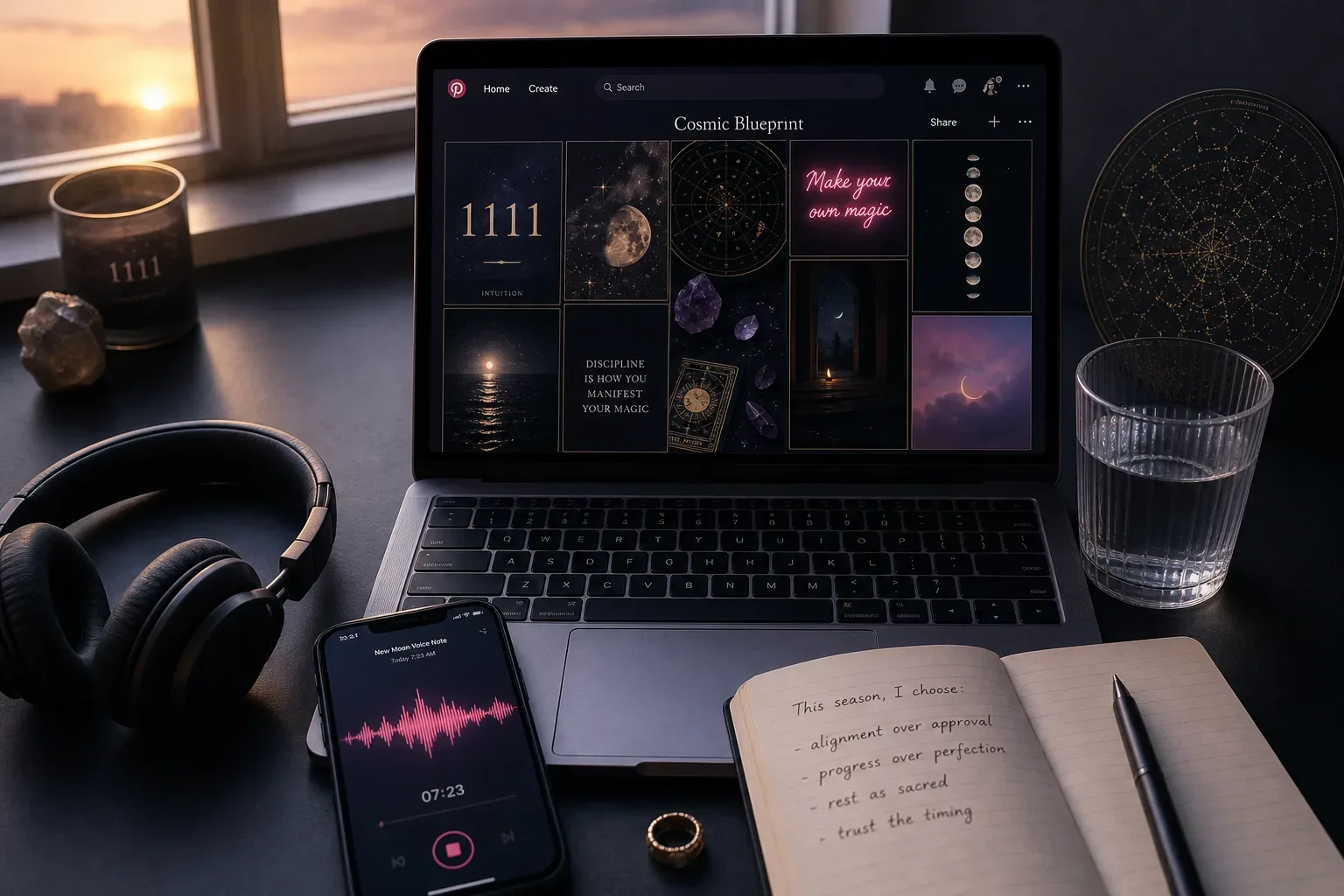
A pinterest vision board becomes stronger when you pair the images with a 3-minute Dream-Self audio you can listen to every day. The board gives your desire a visual signal; the audio gives it voice, sequence, and felt identity. Pinterest collects the signal; audio makes it return.
Why should a pinterest vision board include audio?
A pinterest vision board should include audio because pictures cue desire, but sound rehearses identity.
Pinterest is brilliant at collecting signs. A kitchen with the exact marble tilt. A linen suit that says new calendar. A desk facing morning light. The platform reported 553 million monthly active users in its 2024 annual report, which tells us something simple: humans still gather images when they are trying to name a future.
But a board can become a beautiful waiting room. You visit, admire, save another pin, and leave with no new instruction for your nervous system. That is where a 3-minute Dream-Self audio changes the room. It tells the image what it means.
A vision board is a map, not a motor. The image names the room; the audio teaches your nervous system how to enter it.
This is the reason I like pairing Pinterest with the AYA Method. The AYA Method is a daily audio manifestation practice. Each day you listen to a short personalized recording — your Dream-Self Moment — narrated from the version of you who has already manifested the life you intend. Listening is the practice. Repetition is the work. The audio is the method.
That matters because mental rehearsal has a paper trail. A 1994 Psychological Bulletin meta-analysis by Driskell, Copper, and Moran reviewed 35 studies and found mental practice had a positive effect on performance, with stronger results when the task had cognitive components. Your future is not a sport, obviously. Still, your calendar, choices, spending, posture, and speech all have cognitive rehearsal built into them.
So the board becomes the visual gate. The audio becomes the daily crossing.
What belongs on the board before you record?
Only pins that carry a clear signal belong on the board before you record.
Start smaller than Pinterest wants you to. The algorithm loves excess; your attention does not. For a 3-minute audio, choose 8 to 20 pins. That is enough range to create atmosphere and enough restraint to avoid a decorative fog. If you save 200 images, you have not made a board. You have made weather.
Use one outcome per board. Not the entire life. One season. The calmer job. The apartment after the move. The studio where you finish the book. The body that trusts rest. In goal-setting research, specificity matters. Locke and Latham’s goal-setting theory, developed across decades of workplace studies, consistently found that specific and challenging goals tend to improve performance more than vague goals.
Before you write the audio, sort pins into four roles:
| Pin type | What it does | Example |
|---|---|---|
| Anchor image | Sets the main outcome | A sunlit desk in your future studio |
| Evidence image | Shows daily proof | Calendar blocks, invoices, packed gym bag |
| Feeling image | Names the emotional climate | Quiet bedroom, clean table, evening walk |
| Identity image | Shows who you are becoming | Confident posture, finished work, steady face |
This is also the moment to be honest. If every image says luxury but the real desire is safety, name safety. If every image says travel but the real desire is sovereignty over your mornings, name the morning. Manifestation gets cleaner when the stated desire and the hidden desire finally agree.
Your future self should sound specific enough to interrupt your excuses.
Use these filters before recording:
- Keep pins that make you sit up straighter.
- Remove pins that only perform status.
- Keep images with sensory detail: light, texture, place, posture.
- Remove duplicates unless they reveal a pattern.
- Choose one pin that feels like the gate into the whole board.
When the board is edited, the audio has something to answer.
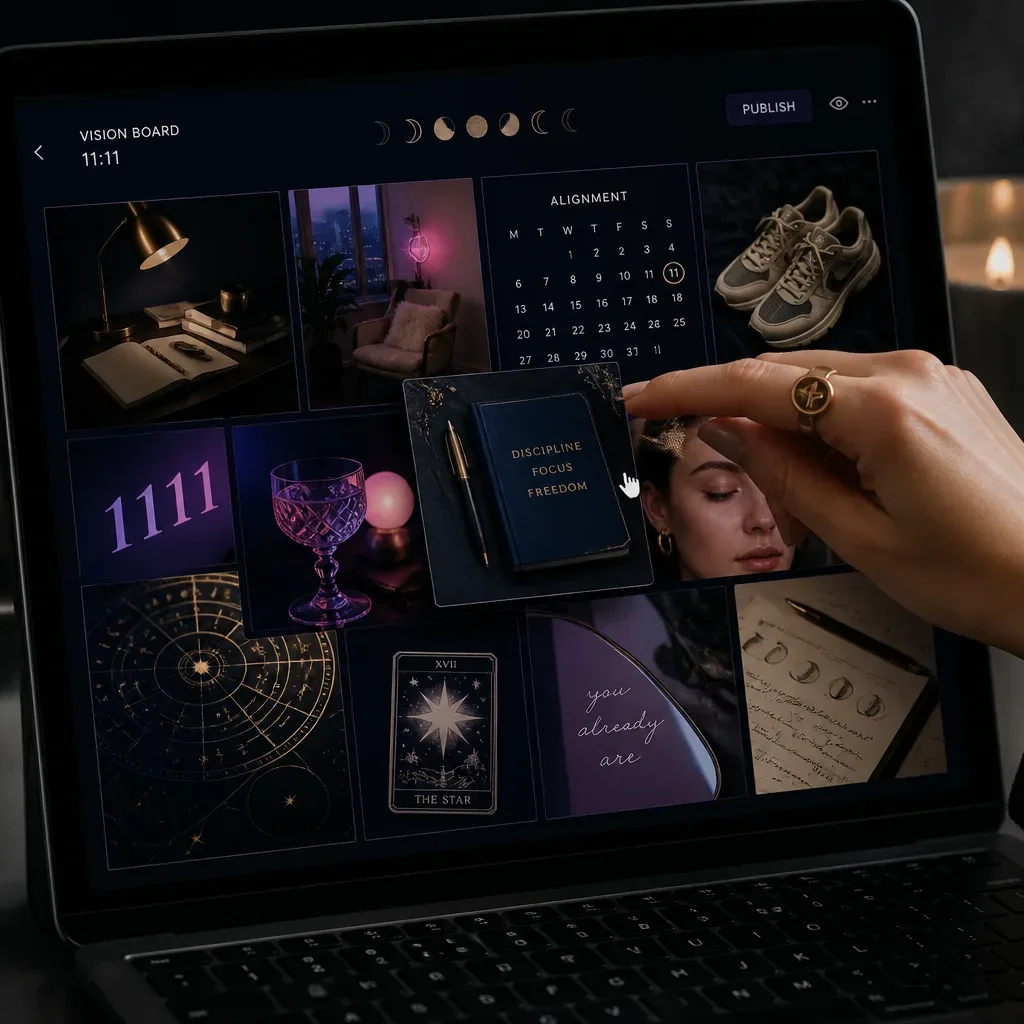
How do you write a 3-minute Dream-Self audio script?
You write a 3-minute Dream-Self audio script in first person, present tense, from the version of you already living the board.
Three minutes is usually 300 to 450 spoken words. Most people speak at 125 to 150 words per minute, according to common presentation coaching benchmarks used by universities and broadcasters. Go slower than your normal pace. This is not a pitch meeting. It is a return.
Open with one scene. Not a manifesto. Scene beats slogan almost every time because the brain can locate itself inside concrete detail. Neuroscientist Dr. Andrew Huberman often points to the role of attention and autonomic state in learning; whether or not you follow his protocols, the practical point is useful. Your system pays differently when detail feels real.
Use this structure:
- Arrive in the scene. Name the place, time, and physical cue. For example: It is 7:11 on a Tuesday, and I am opening the studio door before my first call.
- Name what has changed. Say the outcome plainly. For example: My work now has room around it, and my calendar shows it.
- Give evidence. Mention 3 to 5 ordinary proofs. Paid invoice. Clear inbox. Dinner with no laptop. Morning walk.
- Speak as the self who can hold it. Use identity language that feels believable, not inflated.
- Close with one line you can carry. Make it simple enough to remember at noon.
Here is a compact sample:
It is 7:11 in the morning, and the apartment is quiet before the day asks anything from me. I can see the table by the window, the notebook open, the first glass of water already poured. I have become someone who does not abandon herself to be chosen. My work is clear. My body believes me. The right people know where to find me because I have stopped hiding inside overwork. Today, I move like a woman whose life has already received her answer.
Notice the scale. No fireworks. No grand speech. The sentence works because it is precise enough to enter.
If you use affirmations, place one after the audio, not instead of it. The affirmation can be the small card you carry out of the room. The audio is the room.
How do you record it so you will actually listen?
Record it plainly, warmly, and slowly enough that your future self sounds believable.
You do not need a studio. A phone voice memo is enough. Stanford’s BJ Fogg has written extensively about tiny habits and the value of making a behavior easy to repeat; the same principle applies here. The more production you require, the less likely you are to press play on a random Wednesday.
Still, give the recording a little ceremony. Close the door. Put the phone 6 to 8 inches from your mouth. Sit upright so your breath has space. Record once as a test, then record again without trying to sound impressive. If you stumble and the feeling stays true, keep going. Human texture is not a flaw.
There are three tones to avoid:
- The influencer voice, too polished to be trusted.
- The command voice, as if you are scolding yourself into a future.
- The fantasy voice, all sparkle and no evidence.
Aim for witness. The self ahead of you is not selling. She is reporting back.
Repetition is not glamorous. It is how the dial learns where to stop.
If recording your own voice feels strange, that is normal. A 2020 survey from The Harris Poll found that many adults report discomfort hearing recordings of themselves, often because bone conduction makes our live voice sound different from playback. Do not turn that discomfort into a verdict. The first few listens are simply calibration.
Name the file clearly: Dream-Self Moment — October Board, or Studio Life — 3 Minutes. Put it where you can reach it without hunting. If you are using the AYA app, the personalized Dream-Self Moment holds this role directly. If you are doing it yourself, keep the file beside your morning alarm or pinned in your notes.
The board is the signal. The recording is the appointment.
What is the daily practice with Pinterest and audio?
The daily practice is to open the board briefly, choose one anchor image, and listen to the 3-minute audio without multitasking.
Keep the ritual short. Five minutes is enough: one minute with the board, three minutes listening, one minute writing or naming the next aligned action. In behavior design, repeatability beats intensity. A 2010 study in the European Journal of Social Psychology by Lally and colleagues found habit formation averaged 66 days, with wide variation from 18 to 254 days depending on the behavior and person.
Here is the simple sequence:
- Open your Pinterest board.
- Pause on one image that feels active today.
- Press play on your Dream-Self audio.
- Do not scroll while listening.
- Write one sentence: Today I act like this by…
- Take one small action within 11 minutes if possible.
The 11-minute cue is not magic math. It is a clean gate. Master number 11 is often read in numerology as intuition, sensitivity, and signal. Doreen Virtue popularized angel numbers in the 2000s, though many people now use the language more loosely and with appropriate distance. I treat 11 as punctuation: a way to notice the moment and move before the mind negotiates.
This is where astrology and manifestation can be useful if you like cycles. A new moon can mark a board refresh. A full moon can mark what needs removing. A 28 to 30 day lunar cycle gives the practice a natural review rhythm, whether you read the sky symbolically or simply appreciate a calendar that breathes.
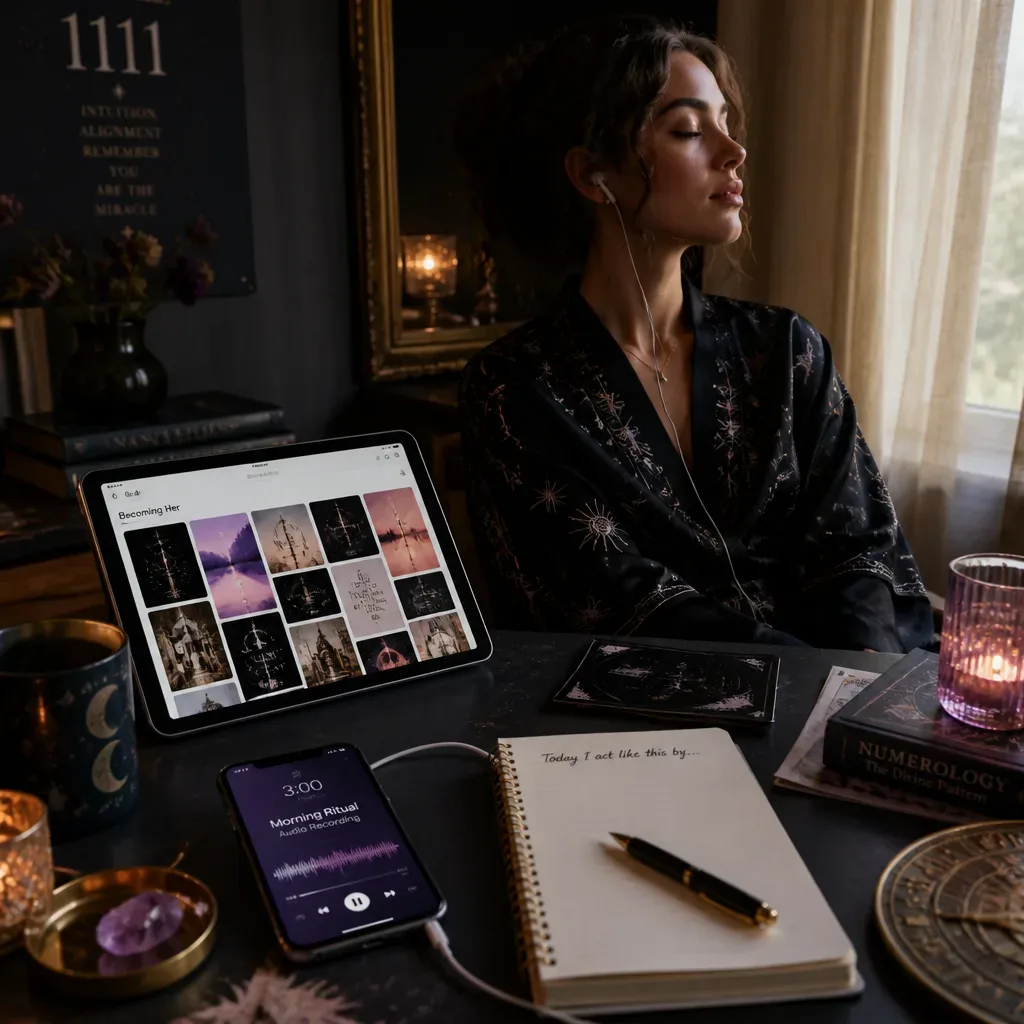
The daily affirmation and the Manifestation Board can complement the audio, but they are not the spine. The audio is the method. The board and sentence support the return.
A practice works when it has somewhere to live in the day.
How do you revise the board and audio over time?
Revise the board and audio monthly, or whenever the desire becomes more honest than the first draft.
A Pinterest vision board is not a contract carved into stone. It is a living editorial board. Any good editor knows the first layout reveals what the story is trying to become. Then you cut. Then the real piece arrives.
Set a 30-day review. Look at the board and ask three questions: What still feels alive? What was borrowed from someone else’s life? What has already arrived in small form? The last question matters. The Reticular Activating System is often discussed in popular self-help as a filter for attention; the neuroscience is more complex, but the practical point holds. What you repeatedly attend to becomes easier to notice.
Use this revision table:
| If you notice… | Change the board | Change the audio |
|---|---|---|
| The images feel performative | Remove status pins | Add ordinary proof |
| The desire feels too broad | Split into one season | Name one outcome |
| You feel resistance every listen | Check for exaggeration | Lower the claim until believable |
| Part of it has arrived | Move that pin to evidence | Record gratitude as fact |
| You avoid the board | Reduce to 8 pins | Shorten to 2 minutes for a week |
This is not about lowering desire. It is about making the signal clean. Joe Dispenza often teaches mental rehearsal as a way to condition the body toward a future state; whether his larger framework is your style or not, the useful piece is repetition with emotional coherence. The claim has to be felt, not merely admired.
For broader structure, keep a separate vision board hub or seasonal board, then make one focused Pinterest board for the audio. One board can hold the whole constellation. The daily board should show the next gate.
Revision is devotion with a red pen.
What mistakes make a Pinterest board stay decorative?
A Pinterest board stays decorative when it collects aesthetic desire without asking for a daily behavioral signal.
The most common mistake is over-pinning. More images can feel like more faith, but often it is avoidance in a very good outfit. Pinterest is built for discovery, not completion. If your board keeps expanding but your mornings stay identical, the dial is spinning without landing.
The second mistake is using someone else’s symbols. A white kitchen might mean peace to one person and sterile pressure to another. A passport pin might mean freedom, escape, status, or exhaustion. The board only works when you know what the image means to you.
The third mistake is confusing intensity with practice. Listening once while emotional is not the same as returning for 30 days. Tara Brach’s work on meditation often returns to the idea of gentle repetition: coming back is the practice, not a failure of it. Manifestation practice needs the same humility.
Before you finish, check for these quiet errors:
- The board has no single outcome.
- The audio sounds like a stranger wrote it.
- The pins are beautiful but not instructive.
- The daily practice takes too long.
- There is no next action after listening.
- You never remove what no longer fits.
A board becomes potent when it stops decorating the future and starts cueing the next choice.
That is why the 3-minute Dream-Self audio matters. It turns the board from a collage into correspondence. The self ahead speaks back. The self at the desk hears the instruction. The morning has a gate.
Let the image point. Let the voice answer.