vision boards
Vision Board Examples to Turn Into Dream-Self Audio
Vision board examples for love, money, home, health, and career, translated into Dream-Self audio scripts you can listen to daily.
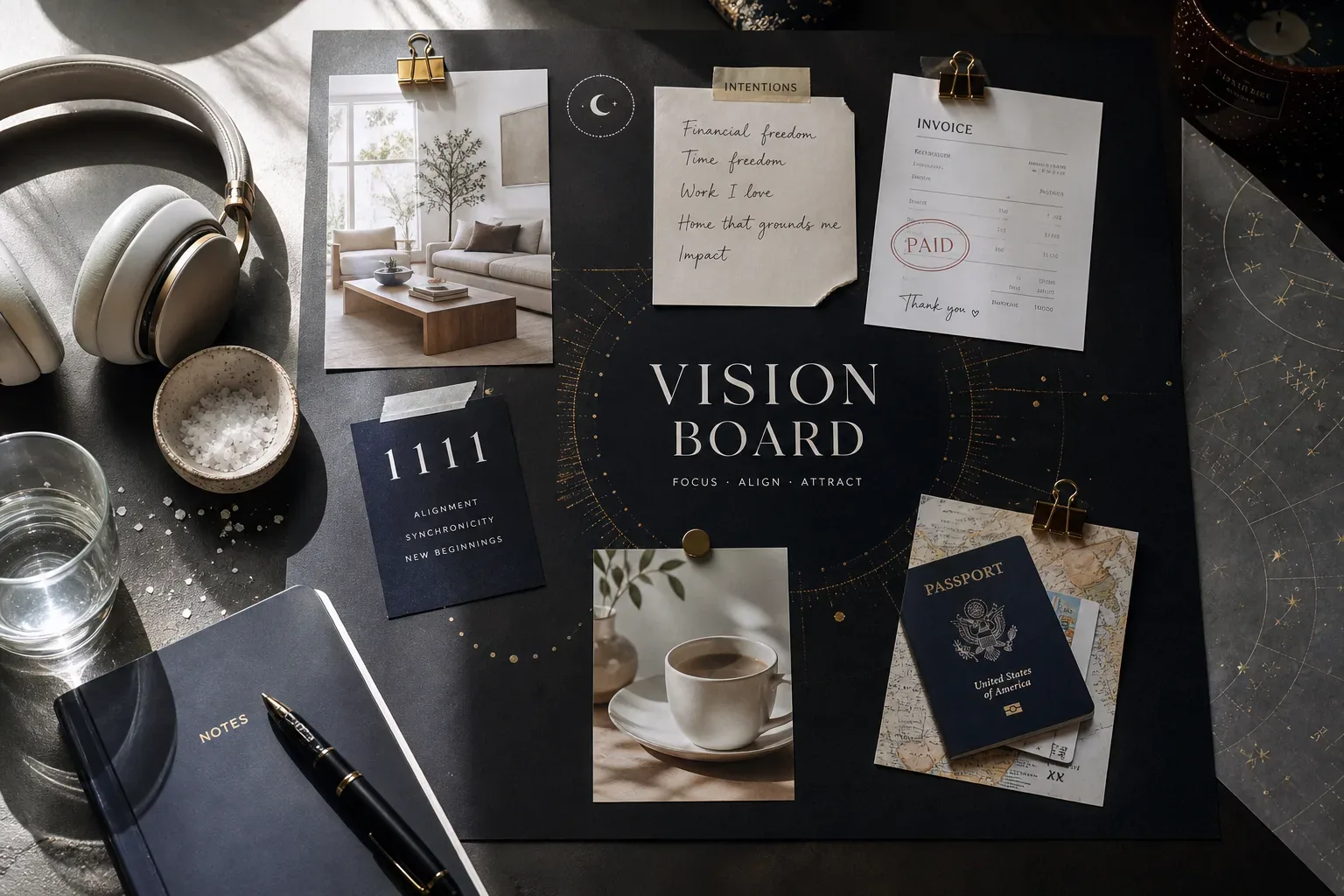
Vision board examples become Dream-Self audio when you translate each image into a present-tense scene your future self can narrate. The strongest examples are specific: the invoice paid, the kitchen calm, the body rested, the calendar protected. The image is the signal. The audio is the return.
What makes a vision board example strong enough to become audio?
A vision board example works as audio when the image implies a lived scene, not a vague wish.
A photograph of a beach can mean six different things. Rest. Escape. A honeymoon. A writing sabbatical. A nervous system that finally stopped buzzing. Audio needs the one meaning you actually intend. If you cannot say what the image proves, it is not ready for your Dream-Self Moment.
This is where the board becomes more than a collage. In psychology, mental imagery has been studied for decades in sport, behavior change, and anxiety treatment. A 2018 review in Psychology of Sport and Exercise noted that imagery tends to work best when it includes sensory detail and first-person perspective. Translation: the mind responds better when it can stand inside the scene.
A useful vision board example has 3 parts:
- A visible outcome: the check cleared, the suitcase packed, the studio booked.
- A bodily cue: the shoulders drop, the breath slows, the hand stops shaking.
- A daily proof: the calendar shows protected time, the phone is silent, the account balance has a specific number.
The board is not the practice by itself. It is the wall speaking in pictures. For a wider foundation, the Manifestation pillar explains how intention, repetition, and attention work together without turning the process into superstition.
Here is the clean rule: if the image can become one ordinary sentence, it can become audio. If it only looks pretty, let it stay pretty. Not every signal needs a microphone.
A vision board names the room. Dream-Self audio teaches you to walk into it on cue.
Which life-upgrade vision board examples translate cleanly into Dream-Self audio?
The cleanest life-upgrade boards show one ordinary day after the change has arrived.
I like these boards because they do not perform drama. They show proof. A white plate stacked with warm tortillas. A passport beside a pen. A calendar with 3 blocked mornings. A receipt from the dentist. A small apartment with the rent paid before the first of the month. Nothing sparkles. Everything lands.
In the AYA Method, the audio is the center: The AYA Method is a daily audio manifestation practice. Each day you listen to a short personalized recording, your Dream-Self Moment, narrated from the version of you who has already manifested the life you intend. Listening is the practice. Repetition is the work. The audio is the method.
Use this 5-part list to turn a general life board into a short recording:
- Choose 7 images. Seven is enough to create a pattern without making the room noisy.
- Name the proof. Write what each image proves in plain language.
- Write in the present tense. Not “I will be calm,” but “I move through the morning without rushing.”
- Add one sensory detail. The mug is warm. The email is sent. The door clicks shut.
- Record under 5 minutes. A short recording heard 30 times beats a perfect recording ignored after day 3.
A life-upgrade board might become audio like this: “I wake before the alarm because my body trusts the day. My counter is clear. My coffee is hot. The first payment has arrived, and I do not need to grip it. I know what gets my attention before noon.”
That last sentence matters. Desire gets sharper when it enters a schedule. Researchers at University College London found in a 2009 habit study that automaticity took a median of 66 days to form, with wide variation. So the board does not need to hypnotize you by Friday. It needs to keep the dial steady long enough for the body to recognize the new pattern.
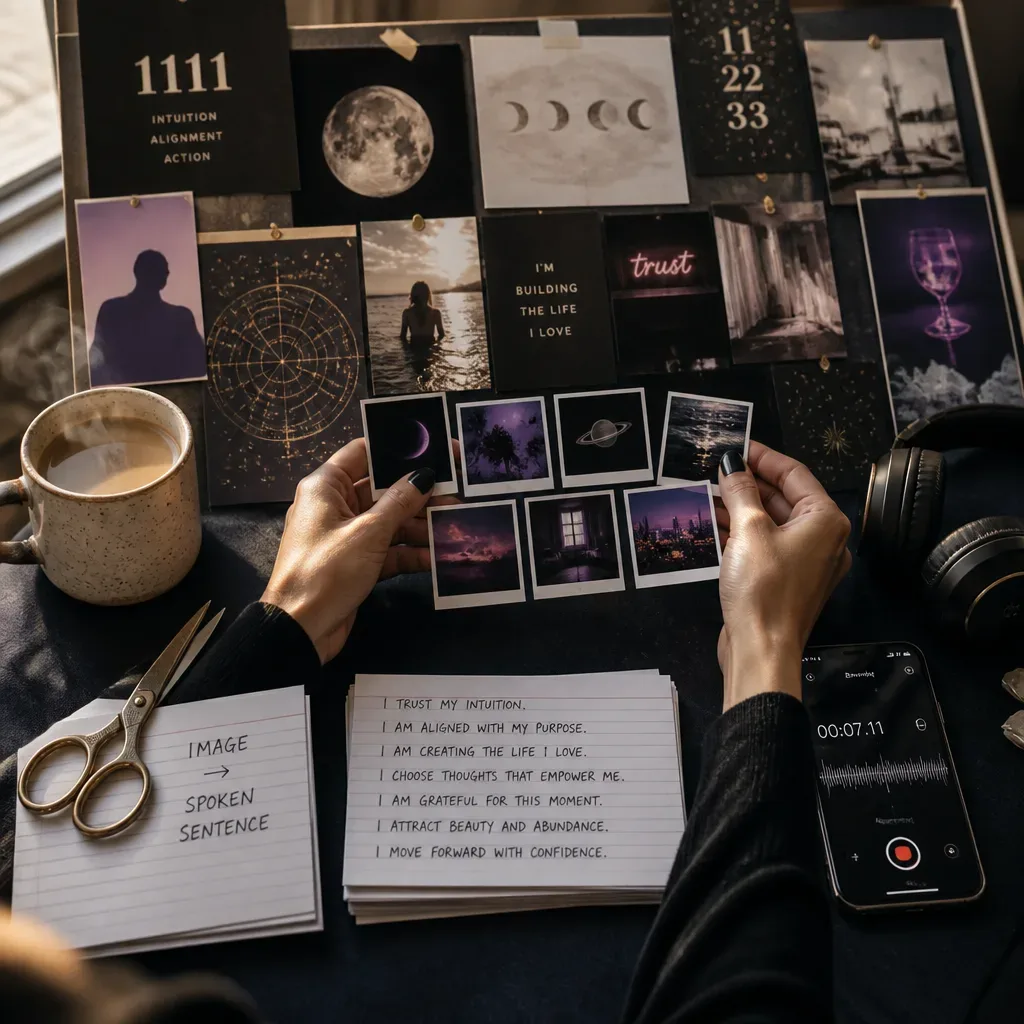
Can career and money vision board examples sound grounded instead of forced?
Yes, career and money boards become grounded when they focus on evidence, capacity, and behavior rather than fantasy numbers alone.
Money images can get loud quickly. Stacks of bills. Luxury kitchens. A watch photographed at the exact angle of insecurity. There is nothing wrong with wanting beauty, but audio needs a truer witness. A bank balance can be part of the board. So can a paid tax estimate, a clean invoice system, a steady client roster, or a Tuesday afternoon with no panic in it.
The Federal Reserve’s 2023 report on the economic well-being of U.S. households found that 63% of adults said they could cover a hypothetical $400 emergency expense with cash or its equivalent. That number is not romantic, but it is useful. Many money intentions are not really about excess. They are about breathing room.
Here are career and money vision board examples with audio translations:
| Vision board image | What it really signals | Dream-Self audio line |
|---|---|---|
| Signed contract | Clear value exchange | “I read the terms slowly, and my yes is clean.” |
| Paid invoice | Receiving without apology | “The payment arrives on time, and I let it land.” |
| Calendar with 4 focus blocks | Protected attention | “My best work has a place to happen.” |
| Simple desk with one lamp | Less noise | “I begin before the room asks anything from me.” |
| Savings goal written as a number | Stability | “I know the number, and I meet it with steady hands.” |
For career boards, avoid making the audio sound like a press release. Your Dream Self does not need to brag. She needs to sound like she has nothing to prove. That is the difference between claiming a signal and trying to impress the mirror.
If your money board uses written statements, pair it with the Affirmations pillar for language that is concise, believable, and repeatable. Affirmations are useful complements here, especially as one-line anchors. But they are not the whole structure. The audio carries the repetition.
The most convincing money audio does not shout wealth. It sounds like a person who checked the numbers and stayed in her body.
How can home, health, and kitchen boards become Dream-Self scenes?
Home and health boards work best when they describe the atmosphere your daily habits create.
This is my bias as a food writer, but the kitchen is the original manifestation room. Flour becomes bread because someone measures, waits, returns, and pays attention to heat. No one calls it mystical when dough rises. They call it timing.
A home board might show a wooden table, folded linen, a bowl of citrus, sunlight on tile, a sleeping dog, and a door that closes properly. Turn that into audio by naming how life behaves there: “My home receives me without asking me to perform. The table is clear by evening. I cook enough for tomorrow because I am no longer negotiating with my own care.”
Health boards need the same honesty. A picture of a runner may not mean a marathon. It may mean lungs that feel open after a 20-minute walk. The Centers for Disease Control and Prevention recommends at least 150 minutes of moderate-intensity aerobic activity per week for adults, plus 2 days of muscle-strengthening activity. That is less theatrical than a total reinvention, and much more usable.
Try this small structure for home and health audio:
- Home image: “The sink is empty before bed.”
- Body image: “I stretch for 8 minutes while the kettle heats.”
- Food image: “I eat breakfast seated, not standing over the counter.”
- Rest image: “At 10:30, the room gets darker and my phone is away.”
- Care image: “I make appointments before urgency has to raise its voice.”
A kitchen board especially benefits from sensory detail. Salt. Steam. The weight of a knife handle. The first crackle of onion in oil. Sensory language gives the audio somewhere to live. Joe Dispenza often speaks about rehearsing a future state until the body begins to recognize it; even if you take that with a practical grain of sea salt, the mechanism is familiar. Repeated attention changes what feels normal.
For a broader view of turning symbols into lived intention, keep the Manifestation pillar nearby. The point is not to decorate your life with outcomes. The point is to practice receiving the daily proof.
What relationship and self-worth vision board examples should you use carefully?
Relationship and self-worth boards should focus on patterns you can embody, not on controlling another person’s role.
This is the gate where many boards get messy. A wedding dress image may be clean if it represents devotion, family, timing, and a shared table. It gets distorted if it is secretly a photograph of one specific person behaving according to your script. Dream-Self audio should not become remote control. It should become a clearer mirror.
Relationship researcher John Gottman’s work popularized the 5-to-1 ratio: stable couples tend to have about 5 positive interactions for every 1 negative interaction during conflict. Whether you use that exact ratio or simply treat it as a useful signal, it points toward behavior. Warmth is not an aesthetic. Repair has a rhythm.
Strong relationship board images include:
- Two mugs on a table after an honest conversation.
- A family meal where no one rushes the first 10 minutes.
- A message that says, “I can talk tonight at 7.”
- Hands washing dishes together after guests leave.
- A single chair by a window, because solitude is also part of love.
The audio might say: “I choose people who meet me in daylight. I do not audition for basic tenderness. My home has laughter in it, and also clean boundaries. When repair is needed, I name it before resentment seasons the whole pot.”
That last line is not decorative. In my grandmother’s kitchen, no one stirred a pot while angry. The rule was not superstition. It was emotional hygiene with a spoon in its hand.
Self-worth boards can include mirrors, clothing, posture, handwritten names, or a photograph from a year when you forgot yourself and survived anyway. Keep the audio plain. “I speak to myself as someone I am responsible for feeding.” One sentence can do more than 40 slogans if the body believes you might mean it.
A relationship board is mature when it stops asking who will choose you and starts showing how you choose yourself on schedule.
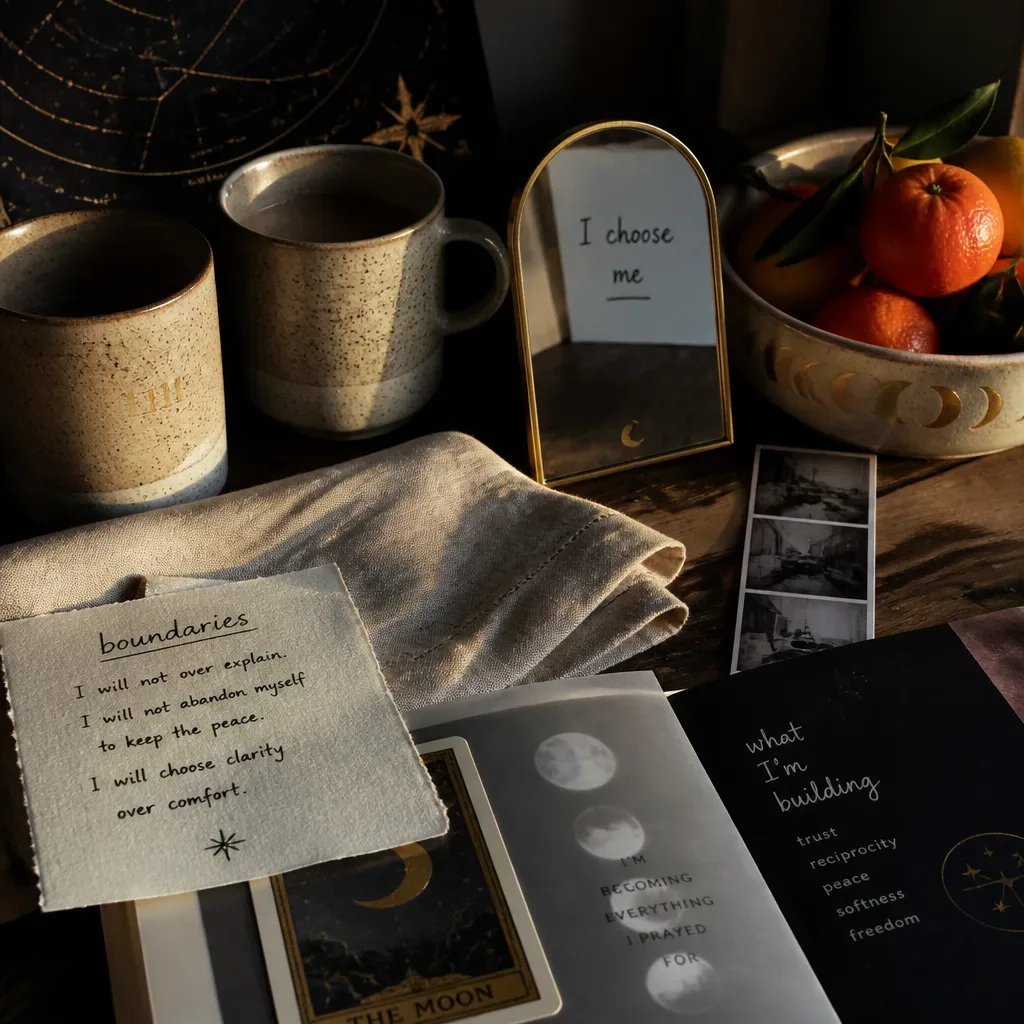
How do angel numbers, astrology, and timing belong on a vision board?
Angel numbers and astrological timing belong on a vision board when they help you mark a cycle and return to the practice.
Seeing 11:11 twice in one day can feel like the dial lined up. Maybe it did. Maybe your attention was simply primed. Either way, the useful question is the same: what will you do with the signal by 11:12?
Master numbers have long had symbolic weight in modern numerology: 11 is often linked with intuition, 22 with building, and 33 with service. Doreen Virtue helped popularize angel-number language in the 2000s, though she later publicly distanced herself from that work. That history matters. Symbols move through culture. We can use them without handing them the steering wheel.
On a board, a number can act like a pin in time:
- 11:11 for the moment you notice your attention returning.
- 22 for building something tangible, like savings, a home, or a body of work.
- 33 for service, teaching, caregiving, or being seen in your contribution.
- 28 or 29.5 days for lunar-cycle tracking, since the synodic month is about 29.5 days.
If you work with lunar timing, link the board to action. New moon: choose the image. First quarter: record the line. Full moon: listen and notice resistance. Last quarter: remove what was only noise. For a grounded primer, read Astrology and manifestation and keep your feet on the floor while you look at the sky.
Audio translation makes the symbol practical: “When I see 11:11, I return to my breath and choose the next aligned action.” That is stronger than “The number means everything is coming.” The first sentence gives you a gate. The second leaves you waiting outside it.
The vision boards guide can help you build the visual side, but the daily listening is what keeps the signal from fading into wallpaper.
How do you keep vision board examples from becoming decoration?
You keep a vision board alive by making it feed a daily listening practice, not by expecting the image to work while you ignore it.
A board on the wall is easy to admire and easier to stop seeing. This is called habituation: repeated exposure to the same stimulus can reduce response over time. It is why you stop noticing a smell in a room after a few minutes, and why the most beautiful board can become furniture by week 3.
Audio interrupts that fade because it enters through time. You press play. You hear the future self speak in sequence. You return to the same words while your day is still unformed. Dr. Andrew Huberman has often emphasized the role of repeated cues and nervous system state in habit formation; whether your cue is light, breath, or sound, consistency matters more than intensity.
Use this simple weekly rhythm:
- Monday: Listen to the Dream-Self audio before checking messages.
- Tuesday: Choose one board image and take one matching action.
- Wednesday: Write down 1 piece of evidence, however small.
- Thursday: Repeat the audio without editing it.
- Friday: Remove any image that now feels performative.
- Saturday: Let the board rest. Do not squeeze it for signs.
- Sunday: Add one sentence if the week revealed a truer one.
The daily affirmation and Manifestation Board can support the work. They are complements. The spine is still the recording you hear again and again, because repetition teaches the body what the eyes only introduced.
If you want a sentence to begin with tonight, use this: “I recognize the life I asked for because I have practiced hearing it.” Put it beneath the board. Then record it in your own voice, or in the voice you can receive without flinching.
The board is the altar. The audio is the appointment.
Set the phone face-down, press play, and let the room hear who arrived.