vision boards
Vision Board Questions for Dream-Self Audio
Use these vision board questions to make a board that supports your Dream-Self audio practice with clearer images, truer wants, and daily listening.
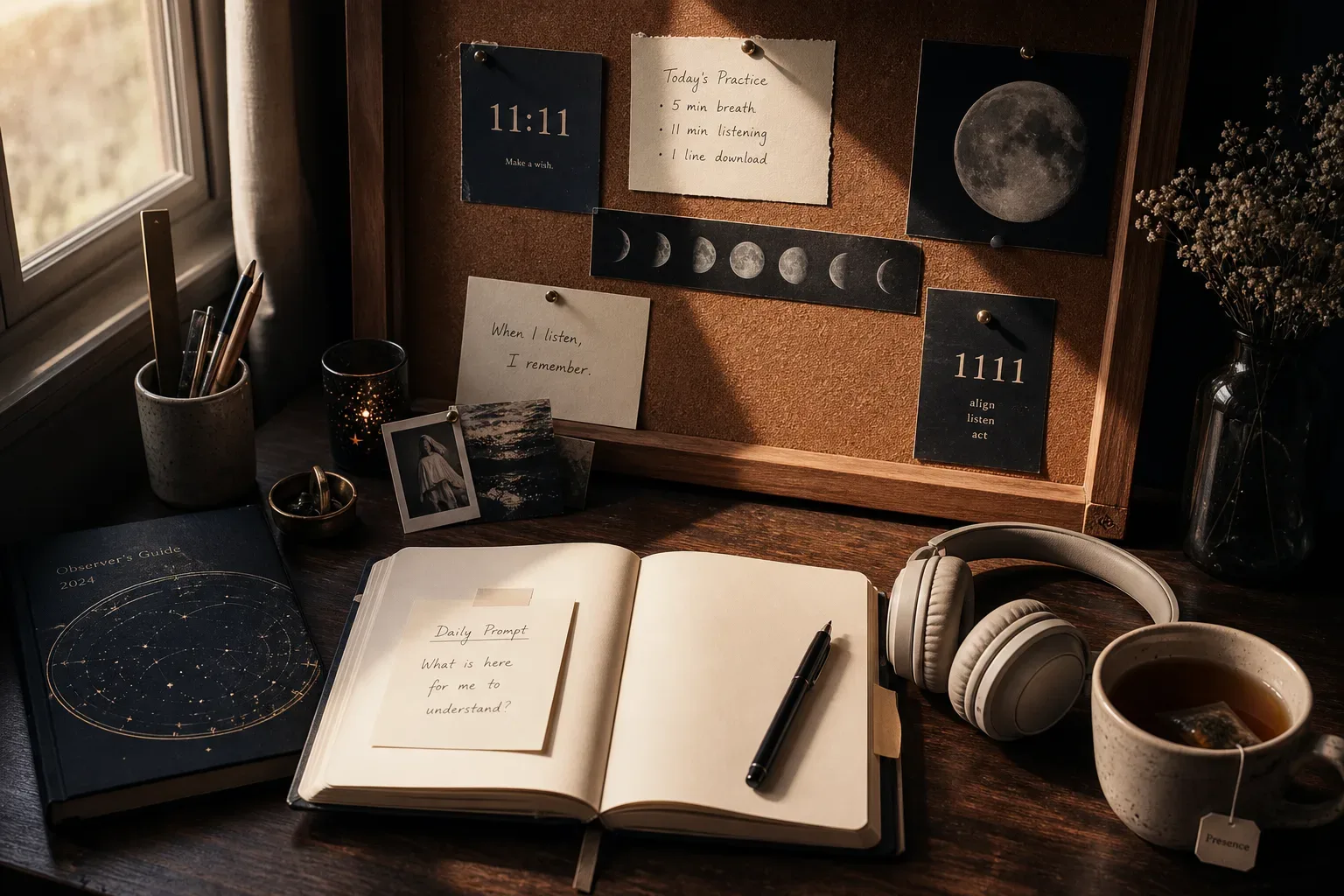
A blank board on the table can feel too loud. The best vision board questions make it quieter. They help you choose images that support your Dream-Self audio practice, name the future self you are listening to, and keep the board as a complement, not the center of the work.
What should vision board questions actually do?
Vision board questions should turn a vague want into a scene you can recognize, repeat, and live toward.
A board is not a wish list with better lighting. It is a set of cues. In cognitive psychology, cue-based memory is old news: a specific visual cue can bring back an associated thought or feeling faster than a general one. A 2006 meta-analysis by Peter Gollwitzer and Paschal Sheeran looked at 94 studies on implementation intentions and found strong effects when people linked an intention to a specific situation. That is the kind of clarity you want here.
So the question is not only, what do I want? It is also, when would I notice it has begun? Maybe you see a calendar with two blank evenings a week. Maybe you see a kitchen table with unopened mail sorted into one small tray. Maybe you see your own hand sending the email you have avoided for 19 days. The image needs a door into action.
The Manifestation pillar gives the wider frame: manifestation is not pretending. It is returning to a chosen inner picture until your choices begin to meet it. A vision board can help with that, but only when the questions are honest enough to make the picture usable.
A good question has three qualities:
- It brings you into a real day, not a fantasy room.
- It asks for evidence, not decoration.
- It leaves room for your nervous system to believe you.
The board should not shout at you from the wall. It should remind you, quietly, of what you already said was true.
Which questions help you hear your Dream-Self Moment more clearly?
The most useful questions are the ones that give your future self a voice, a room, a calendar, and a body.
The AYA Method is a daily audio manifestation practice. Each day you listen to a short personalized recording — your Dream-Self Moment — narrated from the version of you who has already manifested the life you intend. Listening is the practice. Repetition is the work. The audio is the method.
That means your board is not trying to do the work of the audio. It is there to help you see what you are hearing. In studies on mental imagery, athletes and musicians have long used sensory rehearsal to prepare for real action. A 1995 review in the Journal of Applied Sport Psychology found that imagery tends to work better when it includes vivid sensory detail and a clear task. You can borrow that without making the practice stiff.
Start with these 10 questions. Write fast. Do not edit for beauty.
- What does my Dream-Self do in the first 30 minutes after waking?
- What does my body know before my mind catches up?
- What kind of room does this self come home to?
- What is no longer taking up space in my day?
- What kind of work feels clean, focused, and mine?
- What relationship feels safer because I have changed my part?
- What money choice proves I trust myself more now?
- What sentence would my Dream-Self say on an ordinary Tuesday?
- What small object belongs in this life?
- What evidence would make me whisper, yes, this is happening?
If a question makes you perform, skip it. If it makes you breathe slower, keep it. One honest image is worth more than 40 borrowed symbols.
How do you choose images without making the board performative?
Choose images that feel like evidence, not images that ask to be admired.
There is a difference between a picture that impresses you and a picture that returns you to yourself. Social comparison research has been tracing that difference for decades. In a 2014 Pew Research Center report, 74% of online adults used social networking sites, and later studies have linked heavy visual comparison with lower mood for some users, especially when the images feel unattainable. A vision board can quietly become another feed if you are not careful.
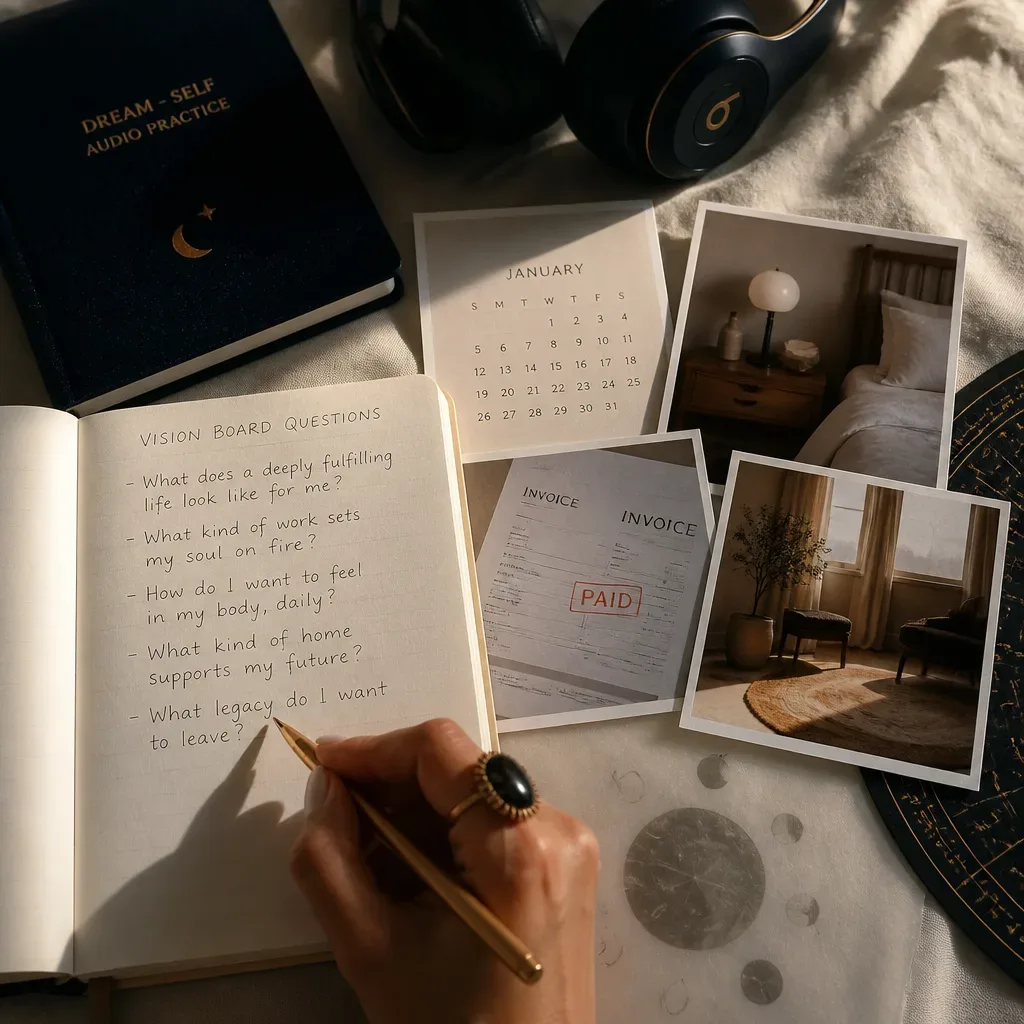
Use the questions as a filter. If you answered, my Dream-Self sleeps without checking her phone, you may not need a luxury bedroom. You may need a photo of a bedside table with a glass of water and one book. If you answered, my Dream-Self earns steadily, you may not need a yacht. You may need a clean invoice template, a paid bill, or a calendar with recurring client days.
Try this small rule: every image must answer at least one question in writing. If it cannot, it does not go on the board. This keeps the practice from becoming mood-based only. It also protects the board from other people’s desires, which often arrive wearing very good clothes.
Here is a simple test:
| If the image says | Ask this instead | Keep it if |
|---|---|---|
| Look how impressive this is | What would this change in my day? | You can name one real behavior |
| Everyone wants this | Do I want the life around it? | The answer is yes in your body |
| This proves I made it | What is the proof I need now? | It feels calm, not frantic |
| This looks like success | What does my Dream-Self actually repeat? | It connects to listening |
A true board may look plain. That is not a failure. Plain is often where your real life can enter.
What questions make the board useful after it is made?
The best after-questions turn the board into a daily cue instead of a finished craft project.
A lot of boards lose their charge after the glue dries. That is normal. Novelty fades. In habit research, repetition and context matter more than initial intensity. A 2009 study in the European Journal of Social Psychology by Phillippa Lally and colleagues found that habit formation took an average of 66 days, with a wide range from 18 to 254 days. So the question is not, did the board feel moving on day one? The question is, can it still speak on day 19?
Place the board where it can meet your listening practice. Not necessarily above your bed. Not necessarily where guests can see it. It might live inside a journal, on the inside of a closet door, or as a quiet digital board you open before your audio. The app also includes a Manifestation Board, but remember the order: listening comes first. The visual board supports the sound.
After you make it, ask these questions once a week:
- Which image still feels true?
- Which image feels borrowed?
- What has become more specific since I first made this?
- What action did I take this week that belongs on the board?
- What does my Dream-Self no longer need to prove?
- Which part of the board makes listening easier?
This is where Affirmations can help as a complement. If one phrase keeps returning, write it down. Keep it short enough to say without bracing. For example: I keep my promises in small ways. Or: I can be seen and still be safe. A 2016 review in Social Cognitive and Affective Neuroscience noted that self-affirmation can affect brain systems tied to self-related processing, especially when the statement feels personally meaningful.
Your board is alive only if you are allowed to change it.
How can timing, astrology, or seasons shape your questions?
Timing can give your questions a container, as long as it does not take away your agency.
Some people like to make boards in January. Some make them near a birthday, a new moon, or after a hard ending. There is no single correct date. Research on temporal landmarks, including a 2014 paper by Dai, Milkman, and Riis on the fresh start effect, found that people are more likely to pursue goals after dates that feel like a new beginning. The date does not save you. It simply gives the mind a clean line.
If you use astrology, keep it grounded. Astrology and manifestation can be a reflective frame, not a command. You might ask different questions during a new moon than at the end of a season. Not because the sky is doing the work for you, but because rhythm helps you listen.
Try matching your questions to timing:
| Moment | Question to ask | Board cue |
|---|---|---|
| New month | What am I ready to practice for 30 days? | A calendar, repeated phrase, small ritual |
| Birthday | What age am I ready to stop performing? | A self-portrait, old letter, chosen word |
| After burnout | What pace can my body trust? | Open space, rest cue, fewer commitments |
| Before a change | What proof will I need when I get scared? | A note, map, signed form, steady object |
Talia note, from the months after I left magazine work: I did not need a grand board. I needed a picture of a desk with nothing on it by 6 p.m. That image did more for me than any glossy symbol of arrival.
The truest question is often smaller than the one you expected.
What is a simple 20-minute process for using these questions?
Use 20 minutes to ask, choose, place, listen, and revise, without turning the practice into a project.
Set a timer. A study published in Psychological Science in 2011 by Oettingen and Mayer found that positive fantasies alone can sometimes reduce effort when they replace planning. That does not mean you should stop dreaming. It means the dream needs contact with the next small behavior. This process keeps both.
Here is the 20-minute version:
- Minutes 0 to 3: Choose one life area. Pick work, love, home, body, money, or time. One area is enough.
- Minutes 3 to 8: Answer five questions. Use the ones that make the future feel specific. Write in fragments if that is easier.
- Minutes 8 to 13: Find three to seven images. Choose evidence images, not applause images.
- Minutes 13 to 16: Add one sentence. Make it something your Dream-Self could say without trying too hard.
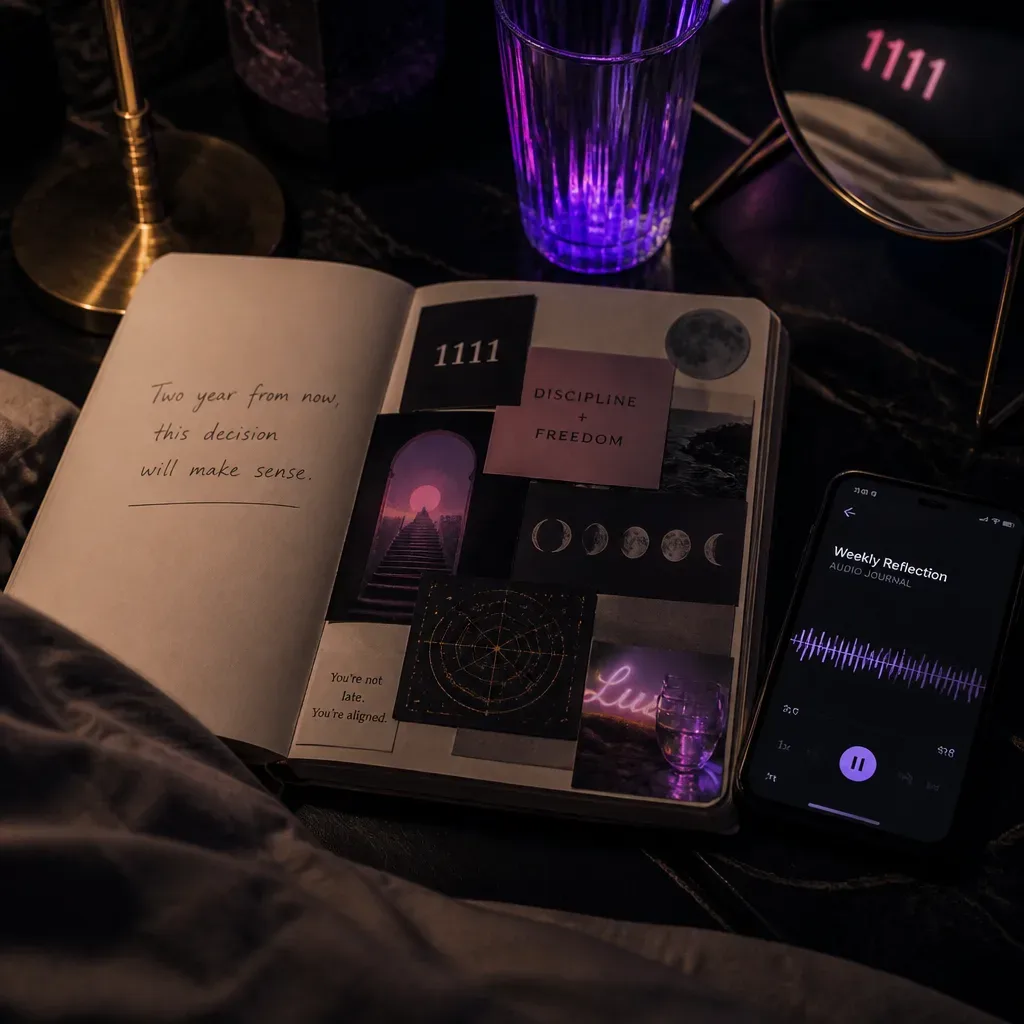
- Minutes 16 to 20: Listen. Play your Dream-Self Moment. Look at the board only if it helps you hear.
If you are using the AYA Method, let the recording lead. The board is a companion to the Dream-Self Moment. The daily affirmation and Manifestation Board can support the practice, but they are not the center. The center is the repeated audio, heard by you, day after day.
You can repeat this process weekly, monthly, or when a board starts to feel false. There is no prize for keeping an old image out of loyalty. If your life has moved, let the board move too.
A manifestation practice becomes believable when it survives ordinary days.
Which questions should you return to when you feel stuck?
When you feel stuck, return to questions that lower the pressure and restore contact with one next true thing.
Stuck is often not a lack of desire. It can be too much noise. Decision research has shown that too many options can slow action; a well-known 2000 study by Iyengar and Lepper found shoppers were more likely to buy jam when offered 6 choices than when offered 24. Your board can have the same problem. Too many images. Too many selves. Too many borrowed lives.
When the board feels crowded, ask only these five questions:
- What do I still know, even if I am tired?
- What image makes my shoulders drop?
- What am I trying to prove with this board?
- What would be enough for the next 7 days?
- What does my Dream-Self repeat when nobody is watching?
Then remove one image. Not ten. One. The act of editing can be as revealing as the act of choosing. In therapy-adjacent writing practices, small expressive writing studies, including James Pennebaker’s work beginning in the 1980s, have found that naming inner material can support emotional processing for some people. Your board questions can do a version of that, gently.
If you need one final prompt, use this: What part of my future self is already here? This question matters because it stops the future from becoming a place you are always late to. It asks you to notice evidence in your current life: the boundary you kept, the water you drank, the invoice you sent, the softer voice you used with yourself.
You are not trying to become a stranger. You are learning to recognize yourself sooner.
The board can stay small. The listening can stay true.