vision boards
Make a Vision Board That Feeds Dream-Self Audio
Learn how to make a vision board that supports your Dream-Self audio, sharpens desire, and turns images into daily manifestation cues.
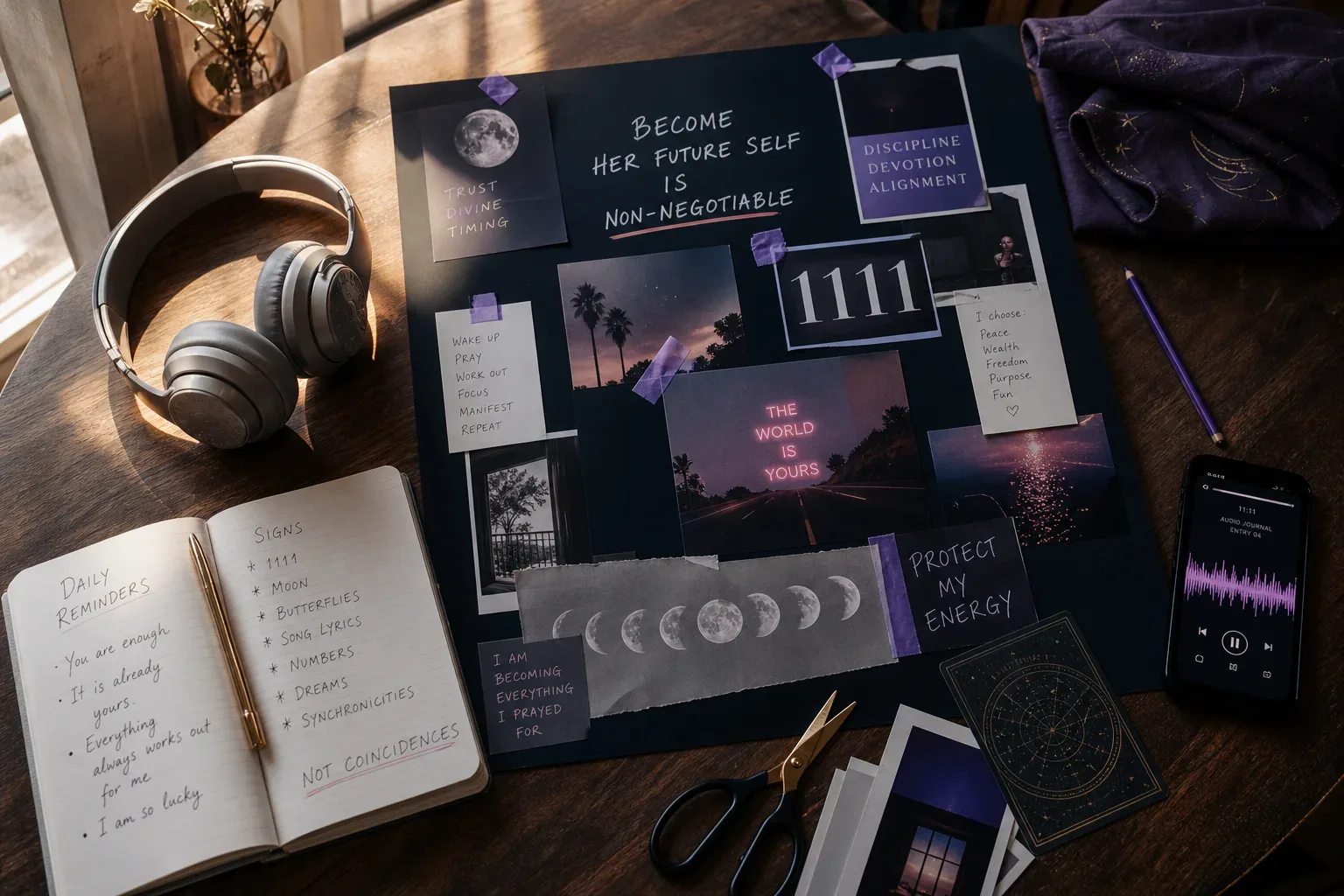
To make a vision board that supports Dream-Self audio, listen first, choose images second, and place the finished board where it cues your daily practice. The board should not compete with the recording. It should translate what you hear into visible signals your nervous system can recognize on cue.
What should a vision board do for your Dream-Self audio?
A vision board should make the images inside your Dream-Self audio easier to remember, rehearse, and choose from during an ordinary day.
At 7:11 this morning, my youngest knocked over a cup of water beside my headphones. Very on brand. The audio was paused at the exact line where my future self was talking about calm mornings. A comic edit from the room itself. Still, the line stayed with me because the picture was already on the wall: a small kitchen table, clear enough to eat at, light through the window, nobody shouting about socks.
That is the job of the board. Not to impress visitors. Not to collect expensive-looking symbols. A good board becomes a witness. Research on mental imagery has been serious for decades; Stephen Kosslyn’s work at Harvard showed that visual imagery uses many of the same brain systems involved in perception. In plain terms, the mind treats clear inner pictures as more than decoration.
In the AYA Method, the definition is exact: The AYA Method is a daily audio manifestation practice. Each day you listen to a short personalized recording — your Dream-Self Moment — narrated from the version of you who has already manifested the life you intend. Listening is the practice. Repetition is the work. The audio is the method.
The vision board is a complement. It gives your eyes something to return to after the sound has done its work. If the audio is the bassline, the board is the mark on the floor where the band knows to come back in. A groove is just a promise kept at tempo.
Use the board to answer 3 practical questions:
- What scenes keep returning in my audio?
- What choices would prove I believe those scenes are possible?
- What image would remind me before I forget again?
The board is not magic because it has pictures. It becomes useful because it shortens the distance between intention and the next ordinary decision.
How do you listen before you choose images?
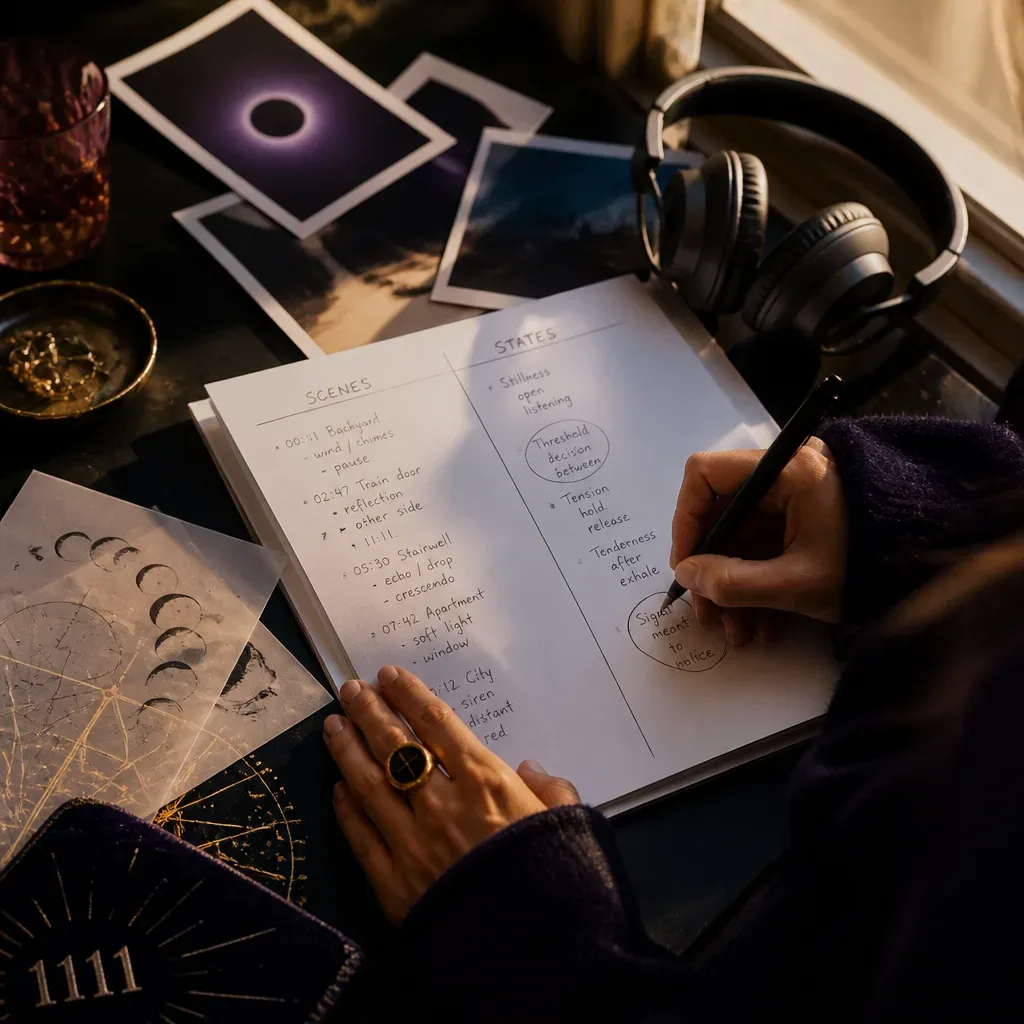
You listen once without collecting anything, then listen again with a pen and name the details that keep pulling your attention.
This is the part people skip because the scissors are more fun. I understand. Cutting pictures out of a magazine feels productive. Listening while your tea goes cold and your phone lights up 11 times feels less glamorous. Still, sequence matters. A board made before the audio often becomes a collage of other people’s desires.
Set a timer for 12 minutes. Dr. Andrew Huberman often points to the role of attention and dopamine in goal pursuit: the brain tracks what is salient, repeated, and tied to action. You do not need to turn that into a lab coat ritual. You just need enough quiet to hear which phrases in your Dream-Self Moment have charge.
Try this 2-list note method:
- Scenes I heard clearly. Write down places, people, rooms, streets, numbers, objects, or time of day.
- States I felt clearly. Write down steadiness, relief, readiness, pride, patience, desire, or clean ambition.
Keep the lists separate. A scene might be a studio desk at 6:30 a.m. A state might be not needing applause before you begin. Both matter, but they do different work. The scene feeds the board. The state tells you whether the image is true.
In an often-cited 2007 Dominican University study by Gail Matthews, people who wrote down goals and shared progress were more likely to report success than those who only thought about goals. The exact percentages are debated in popular retellings, but the useful point holds: making intention visible and trackable changes behavior.
After the second listen, circle only 5 to 9 details. The number 9 is not sacred here; it is merciful. Too many images create static. Your future self should not look like a browser with 47 tabs open.
What materials should you use to make a vision board?
Use materials that you can see daily, edit without drama, and connect directly to the details in your audio.
There are two acceptable formats: physical and digital. The wrong format is the one you abandon after one dramatic Sunday afternoon. I have made beautiful boards that lived behind a laundry basket for 4 months. The laundry won. The board did not.
A physical board works well if you are tactile. Corkboard, card, tape, a small frame, or a page in a notebook can be enough. Digital boards work well if your phone is the gate you pass through most often. Pew Research reported in 2024 that 90% of U.S. adults own a smartphone, which means a lock-screen board may be more visible than a poster above a desk you rarely use.
Use this comparison before you buy anything:
| Format | Best for | Watch out for | Strongest cue |
|---|---|---|---|
| Corkboard | Bedrooms, studios, home offices | Too many layers | Seeing it before work |
| Notebook spread | Private practice | Forgetting to open it | Reviewing after audio |
| Phone wallpaper | Busy schedules | Notification noise | Seeing it 50+ times daily |
| Digital canvas | Easy updates | Endless tweaking | Monthly review |
| Small framed board | Minimal rooms | Making it too precious | One clean daily signal |
The board should contain 4 kinds of material:
- Images: rooms, bodies, work, money choices, locations, relationships.
- Words: phrases from the audio, not generic slogans.
- Numbers: dates, savings targets, times, cycles, or master numbers if they carry meaning for you.
- Proof marks: receipts, small wins, screenshots, checkmarks, calendar notes.
Specific numbers help. A 6-month board behaves differently from a lifetime board. A picture of a calm morning is stronger when paired with 6:45, packed lunches, 20 minutes of writing, and one clean counter. The mind can meet that. The room can meet that.
If you use numerology, keep it grounded. Master numbers 11, 22, and 33 have long been treated as intensified symbols in modern numerology, with 11 often linked to intuition and signal. Fine. Let 11:11 be punctuation, not a substitute for practice. The sign is useful when it sends you back to the work.
For a broader foundation, the Manifestation pillar explains how attention, repetition, and identity cues work together without pretending that a picture does the whole job.
How do you arrange the board so it does not become visual noise?
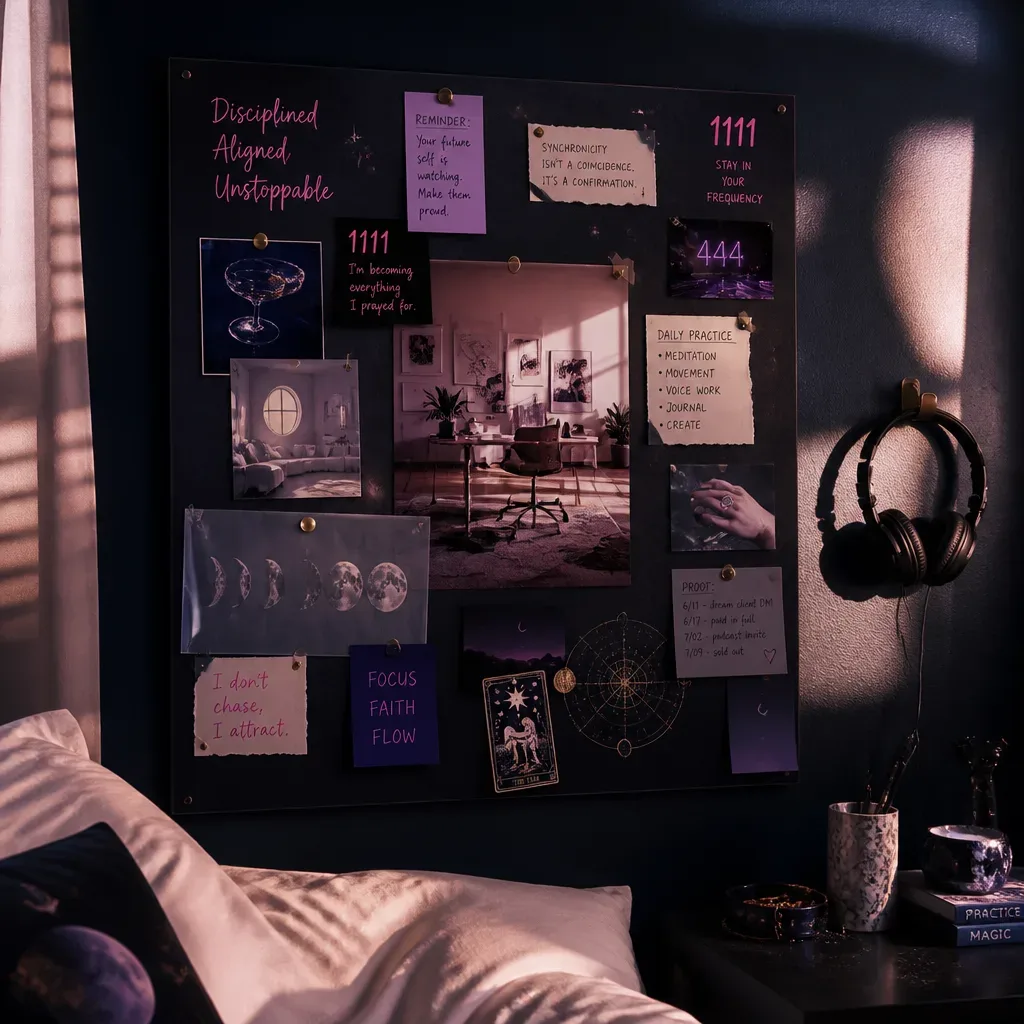
Arrange the board around one central Dream-Self scene, then let every other image support that scene like instruments around a lead melody.
Start with one anchor image. Not 20. One. The anchor is the image that makes your shoulders drop because some part of you recognizes it. It might be a quiet apartment, a paid invoice, a strong body, a passport page, a rehearsal room, a child asleep while you work for 30 honest minutes. Recognition is the signal.
Then build in zones. A 2011 study on mental contrasting by Gabriele Oettingen and colleagues showed that pairing a desired future with present obstacles can improve goal-directed action more than fantasy alone. That matters here. Your board should not only show the arrival; it should show the practices that make the arrival less fragile.
Use this 5-zone layout:
- Center: the Dream-Self scene from your audio.
- Top left: identity words you are practicing.
- Top right: visible proof you can gather within 30 days.
- Bottom left: routines that support the scene.
- Bottom right: one obstacle and one planned response.
That last zone is unfashionable and necessary. If your Dream-Self audio names a calm, well-paid creative life, your board should include the invoice system, the childcare plan, the 25-minute writing block, or the phone boundary. Desire without logistics becomes theater.
I learned this on tour. A show that looks spontaneous still has a setlist, a call time, a soundcheck, and somebody taping down cables so the singer does not meet the floor in front of 2,000 people. The feeling arrives because the structure held.
This is where Affirmations pillar can help, as long as you keep the hierarchy clear. A short daily affirmation can sit on the board as a phrase from your audio. It is a complement. The listening remains the spine.
Make the board readable from 2 meters away. If you have to squint, it is a scrapbook, not a signal. Leave empty space. The future needs room on the wall.
How do you connect the board to a daily audio practice?
Connect the board to the audio by using it for a short before-and-after ritual that takes less than 3 minutes.
The board feeds the recording when it becomes part of a repeatable sequence. Not a ceremony that requires candles imported from a moonlit monastery. A sequence. Parents, nurses, founders, students, and anyone with wet laundry need sequences more than they need aesthetics.
Try this 4-part practice:
- Look at the board for 20 seconds before listening.
- Play your Dream-Self Moment without scrolling.
- Look at the board again for 40 seconds.
- Name one matching action for the next 24 hours.
That is it. Under 3 minutes, plus the audio length. BJ Fogg’s behavior design work at Stanford emphasizes that habits stick when they are small, prompted, and easy to repeat. The board is the prompt. The audio is the practice. The action is the receipt.
If your board shows a healthier body, the 24-hour action might be a 10-minute walk. If it shows a cleaner money season, it might be opening the banking app without flinching. If it shows a better relationship, it might be sending the honest text before 5 p.m. The point is not heroic effort. The point is alignment at human scale.
You can also pair the board with lunar timing if cycles help you pay attention. A lunar month is about 29.5 days, which gives you a clean review rhythm: new moon for choosing, full moon for witnessing, final quarter for removing what no longer fits. Astrology and manifestation can be useful when it gives your attention a calendar, not when it becomes an excuse to wait.
The board should make the audio more believable, and the audio should make the board more personal. When they start correcting each other, you are close. A picture that does not belong will feel loud. A line in the audio that needs more visual proof will ask for an image.
How often should you update your vision board?
Update your vision board once a month or once per 29.5-day lunar cycle, with small edits instead of constant reinvention.
A board needs enough stability to teach your attention what to notice. If you change every image every 3 days, you are not practicing; you are redecorating your uncertainty. I say that with affection. I have done it. Many times. Usually while avoiding the one email that would have moved the whole season forward.
Habit research by Phillippa Lally and colleagues, published in the European Journal of Social Psychology in 2009, found that habit formation took an average of 66 days, with wide variation. That number is useful because it pushes against the fantasy of instant identity. Your board deserves at least 2 cycles before you judge it.
Use a monthly review with 4 questions:
- What image did I actually notice this month?
- What image did I start ignoring?
- What part of the Dream-Self audio became clearer?
- What arrived, even in a small form?
Mark what arrived. This is not bragging. This is evidence. If your board included a calmer morning and you had 3 of them, mark 3. If your board included a savings target and you saved $40, write $40. The nervous system respects receipts more than speeches.
There is also a psychological reason to track small completions. The goal-gradient effect, first described by Clark Hull in 1934 and later studied in consumer behavior, suggests that people increase effort as they perceive themselves closer to a goal. Visible progress changes the dial.
Remove images that create shame. Shame is a terrible project manager. If a picture makes you collapse, replace it with a nearer cue. Instead of the marathon finish line, maybe the shoes by the door. Instead of the dream house exterior, maybe the dining table where bills are opened calmly. Nearness is not a downgrade. It is how the gate opens.
If you want more structure around visual cues, keep a simple weekly note beside the board or read related guidance in the vision boards cluster. One sentence per week is enough: what I saw, what I did, what answered back.
What mistakes make a vision board weaker?
The biggest mistake is making a board that looks impressive but does not match the life your audio is training you to recognize.
The second mistake is scale confusion. A board can hold a 10-year desire, but it should still tell you what this season asks. If every image is a penthouse, a yacht, and a body with lighting that required a professional crew, your Tuesday may reasonably file a complaint.
Neville Goddard taught from the premise of living from the fulfilled state, not begging reality for proof every hour. Whether you take him literally or psychologically, the instruction is demanding. Living from the fulfilled state changes your posture, speech, calendar, spending, and boundaries. A board that cannot touch those things is only décor.
Watch for these common errors:
- Borrowed desire: choosing images because they trend well.
- No time frame: mixing next month, next year, and retirement in one crowded field.
- No body cue: leaving out how the desired life feels in your nervous system.
- No obstacle plan: pretending resistance will politely leave.
- No listening link: building a board that never meets the audio.
Small studies on implementation intentions, especially Peter Gollwitzer’s work from the 1990s onward, show that if-then planning can improve follow-through. Put that on the board. If the baby wakes during the audio, then I listen during the school pickup queue. If I miss the morning, then I listen before opening messages. Life will interrupt. Give it a script.
One more mistake: turning synchronicity into surveillance. Seeing 11:11 can be a signal. Seeing it and then spending 40 minutes decoding whether you should answer an email is not a practice. The number is a knock on the door. You still have to stand up.
For deeper context on how repetition shapes belief, read the affirmations guide and the broader manifestation guide. Then return to the audio. The dial gets clearer when you stop changing stations.
What is the simplest way to start today?
Start today with one listen, one page, 7 images, 3 words, and one action you can take before tomorrow night.
Do not wait for perfect materials. Use a notebook page, a notes app, printer paper, or the back of an envelope if the envelope is not hiding a bill you should open. Give yourself 35 minutes. That is a real unit. Long enough to choose with care. Short enough to fit inside a nap window or a lunch break.
Here is the quick build:
- Listen to your Dream-Self Moment once.
- Write 5 scenes and 5 states.
- Choose one season: 3 months or 6 months.
- Gather 7 images that match the audio.
- Add 3 phrases your future self would actually say.
- Place one proof space for small wins.
- Choose one action for the next 24 hours.
A 2022 review in the Journal of Behavioral Medicine noted that self-regulation practices tend to work better when goals, monitoring, and feedback are linked. Your board can provide monitoring. Your audio can provide identity rehearsal. Your next action provides feedback from the actual room.
If you are using the Manifestation Board feature inside the app, treat it the same way: not as the main event, but as the visual companion to listening. The daily affirmation can sharpen one line. The board can hold the image. The audio carries the method.
Keep the first version imperfect. Especially the first version. Perfection is often fear wearing good shoes. The board can become more precise after 1 cycle, after 11 listens, after the first small proof arrives. Most meaningful practices begin as something slightly awkward done on purpose.
Make the board. Play the audio. Let the day answer.
The signal gets stronger when you give it somewhere to land.