audio manifestation
Audio Manifestation Method: 3 Minutes While Getting Ready
Use this audio manifestation method in 3 minutes while you get ready: listen, witness your Dream-Self Moment, and carry the signal into the day.

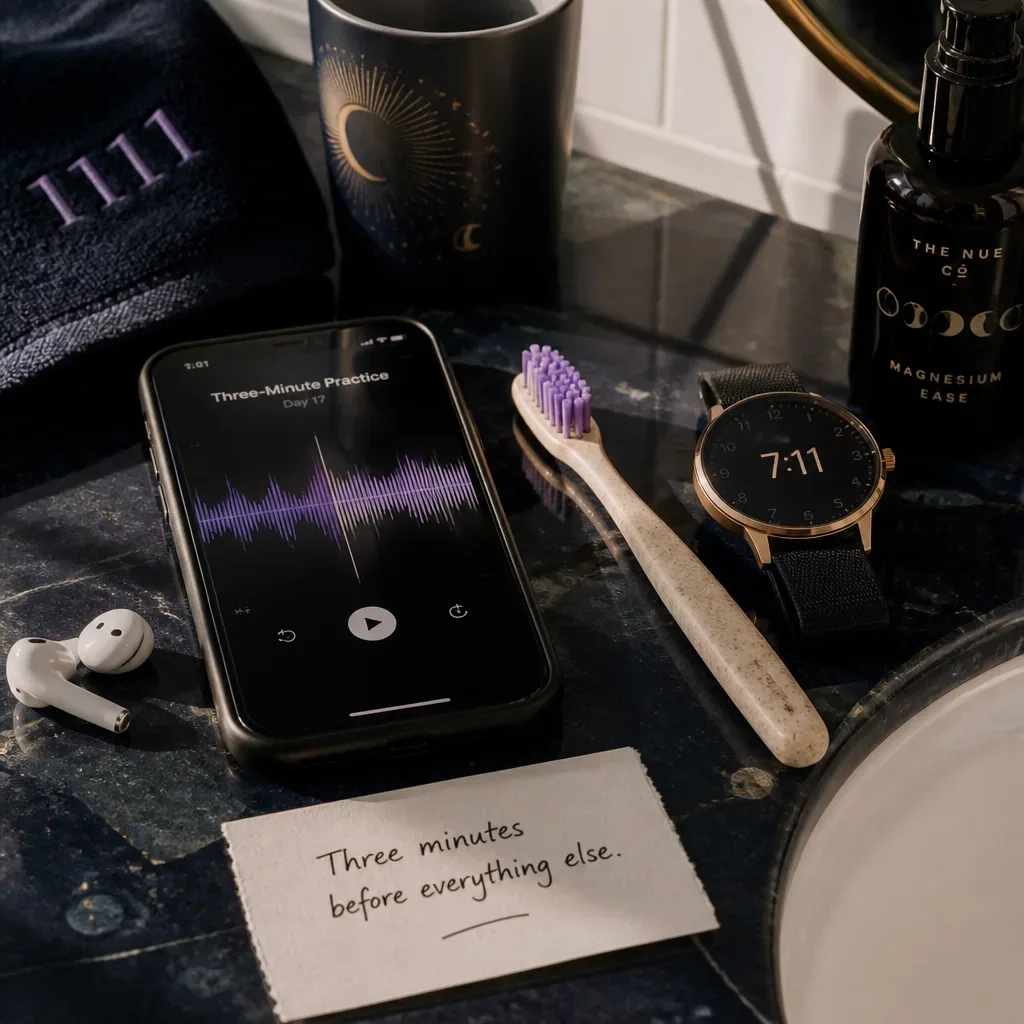
At 7:11, before the kettle finished and before my youngest found one shoe, the audio manifestation method was simple: press play, listen for three minutes, and let your Dream-Self Moment set the dial. The practice works best when it rides an existing routine, not a fantasy schedule.
What is an audio manifestation method?
An audio manifestation method is a daily listening practice that uses sound to rehearse the identity you are claiming before the day begins speaking louder.
For Manifest 11, the cleanest definition sits inside the AYA Method: The AYA Method is a daily audio manifestation practice. Each day you listen to a short personalized recording — your Dream-Self Moment — narrated from the version of you who has already manifested the life you intend. Listening is the practice. Repetition is the work. The audio is the method.
That last line matters. The audio is not background decoration. It is not a wellness soundtrack with a nicer font. It is the main act, the three minutes where your nervous system hears a future-tense life stated in present-tense language. Joe Dispenza often talks about rehearsing a new state before the body has evidence for it; you do not need to accept every claim around his work to understand the behavioral point. Rehearsal changes readiness.
A musician knows this in the hands. You play the same bass line 400 times before it feels like freedom. Fatherhood taught me the household version: a groove is just a promise kept at tempo. Three minutes is not small when you repeat it on purpose.
The practice sits inside the wider field of manifestation, but it is more specific than wishing, scripting, or staring at a candle until your rent behaves. It asks for one repeatable act: listen daily. In habit research, Phillippa Lally’s 2009 study in the European Journal of Social Psychology found that automaticity took a median of 66 days, with wide variation from 18 to 254 days. The number is less glamorous than 11:11, but more useful.
Why can three minutes be enough?
Three minutes can be enough because the method depends on repetition, attention, and emotional salience, not duration.
The brain is not impressed by a heroic routine you abandon after two mornings. It is moved by cues that return. Psychologist Peter Gollwitzer’s research on implementation intentions, published across multiple studies since the 1990s, shows that specific if-then planning improves goal follow-through. “After I turn on the bathroom light, I press play” beats “I should be more intentional” by a long mile.
Three minutes also slips past the household committee. No one in my house votes for a 45-minute dawn ritual. Someone needs toast. Someone has placed a plastic dinosaur in my shoe. A short audio manifestation method survives because it is built for friction. It does not require silence. It requires a cue, a recording, and the small dignity of returning.
There is a nervous-system reason too. Dr. Andrew Huberman has often pointed to the power of brief, repeated protocols when they are tied to state change, especially breathing or attention practices. A 2023 randomized study in Cell Reports Medicine found that five minutes of daily breathwork improved mood and reduced respiratory rate more than mindfulness meditation in that sample. Your three-minute audio is not the same intervention, but the principle rhymes: short can still be physiological.
Here is the quiet trick: the method works because it gives identity a voice before the day gets a vote. Most mornings, your phone wants first chair. News, messages, numbers, other people’s urgency. Pressing play first is not dramatic. It is governance.
How do you set it up while you get ready?
Set it up by attaching the audio to one unavoidable action in your morning routine.
Pick a cue that already has a place in the room. Brushing teeth. Putting in contact lenses. Applying lotion. Tying laces. Sitting in the car before turning the key. BJ Fogg’s behavior design model from Stanford puts this plainly: behavior needs motivation, ability, and a prompt. If the prompt is already there, the practice has somewhere to land.
Do not build a cathedral when you need a hook on the wall. Your setup should take less than 30 seconds tonight so it can take three minutes tomorrow. Put the audio where your thumb can find it. Charge the earbuds. If you have children, use one earbud and keep the other ear available for suspicious silence. Suspicious silence has ruined more routines than doubt.
Use this setup table before the first day:
| Morning cue | Audio action | Signal to carry |
|---|---|---|
| Bathroom light goes on | Press play before toothpaste | One sentence from the recording |
| Kettle starts | Listen while waiting | One word for the day |
| Shoes go on | Play the final three minutes before leaving | One decision you will not postpone |
| Car door closes | Listen before driving | One tone to bring into work |
The best cue is boring. Boring survives. In Lally’s habit study, missing one day did not destroy habit formation, but inconsistency slowed automaticity. That is good news for actual humans. You can miss Tuesday and still return Wednesday. The mirror is not the altar; it is the witness.
If you want context around spoken identity work, the Affirmations pillar is useful. Just keep the hierarchy clean. The daily affirmation is a complement after the audio, not a replacement for listening.
What exactly do you do during the three minutes?
During the three minutes, press play, soften your attention, listen for one line that feels charged, and connect it to the next real action.
Here is the simple version. Not grand. Not cinematic. It fits between deodorant and finding your keys.
- Press play before your phone starts negotiating. If you check messages first, the day has already opened a tab.
- Let the first 30 seconds settle your body. Notice your feet, jaw, shoulders, and breath.
- Listen to the Dream-Self Moment as testimony. You are hearing a version of you speak from the other side of repetition.
- Catch one signal. A word, image, sentence, or tone. One is enough.
- Tie it to the next action. Send the email cleanly. Speak slower. Make the call. Leave on time.
The key is not to perform belief. Some mornings the recording will feel like prophecy. Some mornings it will feel like a polite stranger reading your mail. Both count. The practice is listening, not passing a mood exam.
Neville Goddard taught “feeling is the secret,” and his work still runs through modern manifestation culture. I would add a parent’s amendment: sometimes the feeling arrives after the school run. Start anyway. A signal can be chosen before the emotion catches up.
If you use timing as a cue, master numbers can be helpful without becoming the boss of you. Seeing 11:11 may function as a reminder to return to the sentence you heard that morning. Historical numerology treats 11, 22, and 33 as master numbers, but the practical value is attentional. A number becomes useful when it changes your next choice.
What should you listen for in the recording?
Listen for the sentence that makes your posture change by one degree.
Not the prettiest sentence. Not the most impressive outcome. The one that catches in the room. In my own practice, I notice the line that makes me stand differently at the sink. That is usually the line with behavioral teeth: “I finish what I said I would finish,” or “I speak with calm authority,” or “I do not confuse urgency with importance.”
Cognitive psychology gives us a useful frame here. The “self-reference effect,” studied since the 1970s by researchers including Rogers, Kuiper, and Kirker, suggests people remember information better when it is related to the self. A personalized recording has an advantage over generic audio because the language points at your life, your decisions, your room.
Use three listening targets:
- Identity: Who am I practicing being today?
- State: What tone does that version of me carry?
- Behavior: What is the next visible proof?
The visible proof matters. If the audio says you are steady, the proof might be answering one message without apology. If it says you are creative, the proof might be 12 minutes on the draft before the house wakes. If it says you are financially clear, the proof might be opening the budget without theatre.
A signal that never becomes behavior is just pretty weather. The audio gives the signal a body. That is where the day starts to tilt.
How do affirmations and boards support the audio?
Affirmations and a Manifestation Board support the audio by extending the signal, but they are not the core method.
This distinction saves a lot of confusion. The audio is the method because listening is the repeated act. A daily affirmation can compress the morning’s signal into one sentence. A Manifestation Board can give the eye a visual return point. Both are useful. Neither should become a second job with glitter on it.
Think of the order like a band. The Dream-Self Moment is the bass and drums. It holds time. The affirmation is a hook you can hum later. The board is stage lighting. Lovely when it works, but nobody dances to lighting alone.
Research on mental imagery is mixed but interesting. Sports psychology has used imagery rehearsal for decades, and meta-analyses have found benefits when imagery is paired with physical practice. The pairing matters. In manifestation language, that means the board should not replace action. It should remind action where it is going.
This is also where astrology and manifestation can be used intelligently. A lunar cycle, a Saturn return, or an 11:11 sighting can mark a gate in time. It does not need to issue orders. The sky can be a calendar with better lighting.

If you want the affirmation, write it after the audio, not before. Let the recording choose the sentence. Keep it under 12 words if possible. “I move steadily and finish cleanly” will serve you better than a paragraph that collapses under its own incense.
How do you make the audio manifestation method stick for seven days?
Make it stick for seven days by lowering the standard to daily listening and raising the standard for honest return.
Seven days is not a life overhaul. It is a clean first cycle. The number has cultural weight because weeks shape work, worship, school, custody schedules, and laundry piles. It is also long enough to reveal friction. By day three, the novelty fades. By day five, the room tests the practice. Good. Now you know where the gate is.
Use this seven-day frame:
- Day 1: Choose the cue. Do not optimize. Pick the routine that happens.
- Day 2: Notice resistance. Write down the excuse without arguing with it.
- Day 3: Keep it ugly. Listen even if the sink is full.
- Day 4: Carry one sentence. Use it in a real decision.
- Day 5: Reduce friction. Move the audio, earbuds, or cue if needed.
- Day 6: Add a short affirmation. Only if it helps recall the audio.
- Day 7: Review the proof. Name one behavior that shifted.
James Clear popularized the idea of habit tracking for visible consistency, but the older behavioral point is simple: what gets witnessed is more likely to return. Put seven small marks on paper. Do not make the tracker prettier than the practice.
If you want a broader map of this work, the Manifestation pillar gives the philosophy, and the AYA Method gives the daily audio spine. For voice-based practice specifically, keep your attention on the recording. Listening is where the repetition enters the body.
The seven days will not all feel aligned. That is fine. A method that only works when the house is calm is not a method; it is a vacation plan. Press play when the dial is messy. Especially then.
Three minutes. One signal. On cue.