audio manifestation
Future Self Audio Script: 7 Dream-Self Lines
Use this future self audio script to write a grounded Dream-Self Moment with seven clear lines, daily listening cues, and practical timing.

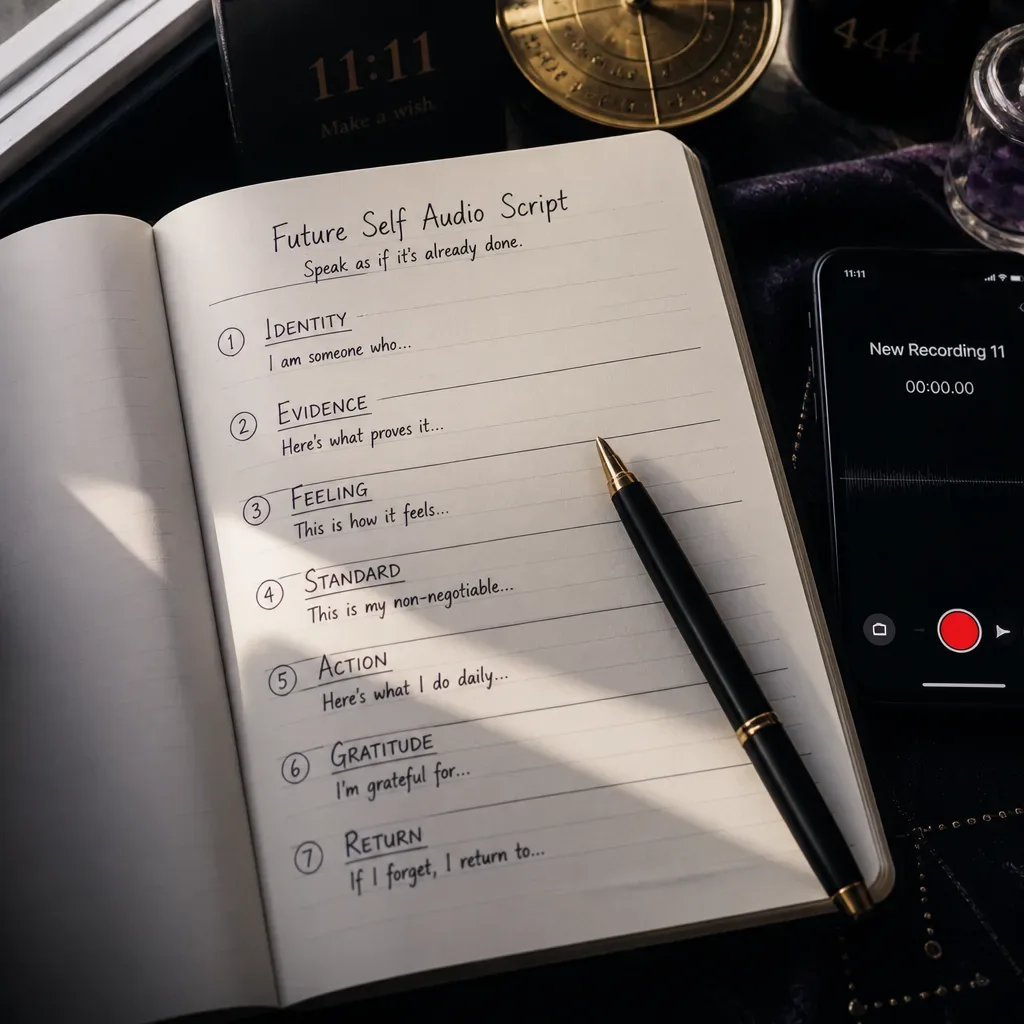
A future self audio script is a short recording written from the version of you who has already arrived. For a strong Dream-Self Moment, write seven lines: identity, evidence, feeling, standard, action, gratitude, and return. Keep it under 2 minutes, then listen daily.
The number 7 has a funny discipline to it. Not as loud as 11:11, not as architectural as 22, but clean. Seven days in a week. Seven notes before the octave returns. Seven lines is enough to build a signal without building a speech.
I learned that on stage before I learned it in manifestation work. A bass line does not need 40 ideas. It needs the right few, repeated until the room trusts them. Your Dream-Self Moment works the same way. The dial lines up because you return to it.
What should a future self audio script actually do?
A future self audio script should give your attention a believable future to rehearse, then make one present-day behavior feel obvious.
That matters because the brain does not treat rehearsal as nothing. Dr. Andrew Huberman has discussed mental rehearsal as a way to prime neural circuits, and sports psychology has used imagery training for decades. A 2012 review in Psychological Bulletin found that mental practice can improve performance, especially when paired with physical practice. Audio gives that rehearsal a voice and a tempo.
In the AYA Method, the structure is precise: The AYA Method is a daily audio manifestation practice. Each day you listen to a short personalized recording, your Dream-Self Moment, narrated from the version of you who has already manifested the life you intend. Listening is the practice. Repetition is the work. The audio is the method.
That last sentence is the gate. The daily affirmation and the Manifestation Board can help, but they are not the spine. The spine is listening. A board gives the eye a symbol. An affirmation gives the tongue a sentence. Audio gives the nervous system a scene it can revisit on cue.
A good script does 3 jobs at once:
- It names who you are becoming in plain language.
- It gives sensory evidence so the scene feels lived-in.
- It points to one behavior you can repeat within 24 hours.
Neville Goddard called this living from the end, and Joe Dispenza often speaks about rehearsing a future until the body recognizes it. You do not need to agree with every metaphysical claim to use the practical mechanism. Attention repeated becomes preference. Preference repeated becomes pattern.
A future self audio script is not a wish in costume. It is a rehearsal with a timestamp.
For the broader frame, the Manifestation pillar explains why intention needs repetition, evidence, and action. Without all 3, the script becomes decorative. Pretty, but not useful.
What are the 7 lines your Dream-Self Moment needs?
Your Dream-Self Moment needs seven lines because seven is short enough to repeat and complete enough to change the inner weather.
Here is the working structure. Use it as a script map, not a cage. Each line can be 1 sentence. If you record slowly, 7 sentences usually lands between 60 and 120 seconds, which is practical enough for a school pickup queue, a train platform, or a kitchen with wet laundry waiting.
| Line | Purpose | Example opening |
|---|---|---|
| 1. Identity | Names who is speaking | ”I am the version of me who…“ |
| 2. Evidence | Shows the life is real | ”I can tell because…“ |
| 3. Feeling | Gives the body a cue | ”In my body, this feels like…“ |
| 4. Standard | States the new normal | ”I no longer negotiate with…“ |
| 5. Action | Links future to today | ”Today I prove it by…“ |
| 6. Gratitude | Marks what has arrived | ”I am grateful that…“ |
| 7. Return | Invites repetition | ”I come back to this every day…” |
The psychology here is not exotic. Implementation-intention research by Peter Gollwitzer, widely cited since the 1990s, shows that specific if-then plans can improve follow-through. Your fifth line uses that same muscle. It does not say, “I am successful someday.” It says, “Today I send the invoice before noon.” The room hears the difference.
Line 4 is where many scripts get honest. A future self has standards, not just outcomes. If your script is about creative work, the standard might be: “I no longer wait for a perfect mood before I begin.” If it is about money, it might be: “I check the numbers every Friday without making them a verdict on my worth.”
That is the kind of sentence that survives Monday morning.
Numbered, the seven-line method looks like this:
- Identity: Who are you as the arrived self?
- Evidence: What proves this life is happening?
- Feeling: What does it feel like in the body?
- Standard: What is no longer acceptable?
- Action: What will you do today?
- Gratitude: What are you naming as received?
- Return: How will you keep listening?
If you want one line to carry the whole piece, make it line 5. Audio without action becomes a beautiful room you never enter.
How do you write the script so it sounds like you, not a poster?
Write it the way your calmest honest self would speak at 7:06 a.m., before the performance voice has warmed up.
Most people overwrite the first draft. I do too. Ten years of touring taught me that the first take often has speed but not pocket. The pocket arrives when you remove the clever thing and keep the true thing. The same applies here. A line like “I am a radiant channel of infinite success” may look shiny. If you would never say it without laughing, cut it.
Self-affirmation research gives us a useful caution. A 2009 study by Wood, Perunovic, and Lee in Psychological Science found that unrealistically positive self-statements can make some people feel worse, especially when the statement clashes with existing self-belief. The lesson is not to avoid bold language. The lesson is to make the bridge believable.
Try this editing test:
- If the line makes your jaw tighten, soften it.
- If the line sounds like someone selling to you, simplify it.
- If the line has no physical detail, add one.
- If the line asks nothing of your day, add one action.
- If the line could belong to anyone, make it more specific.
For example, “I am wealthy and free” may not land if your bank app currently looks like a small horror film. A stronger line might be: “I am the version of me who checks the numbers calmly, sends the proposal on time, and lets money have a chair in the room without letting it run the meeting.” That sentence has a job.
The Affirmations pillar is useful here because it treats affirmation as language with weight, not decoration. Your audio script can include one affirmation-like sentence, but the recording needs more than a slogan. It needs scene, standard, and rhythm.
Believable does not mean small. Believable means your body does not reject the signal.
Read your draft aloud twice. On the second read, mark every word that feels inflated. In a 7-line script, cutting 20 percent often improves the whole recording. Musicians know this. Parents know it too. The house gets calmer when fewer things are shouting.
How should you record a future self audio script?
Record the script slowly, warmly, and close to the microphone, as if you are leaving a voice note for someone you love but refuse to flatter.
You do not need a studio. A phone microphone is enough. The technical goal is clarity, not cinema. According to Edison Research’s 2023 Infinite Dial report, 75 percent of Americans age 12 and older had listened to online audio in the past month. We are already trained to receive guidance through earbuds. Use the format your daily life already accepts.
Set a timer for 20 minutes. Five minutes to settle. Ten minutes to record a few takes. Five minutes to choose the one that does not make you wince. If you are a parent, that may be the entire nap window. Good. A practice that cannot survive real life is not a practice. It is set design.
Use this simple recording sequence:
- Put the phone on airplane mode.
- Sit or stand where your voice can stay relaxed.
- Take 3 slow breaths before the first line.
- Read at about 75 percent of your normal talking speed.
- Leave 1 full second between lines.
- Save the file with the date and focus, such as “2026-08-money-standard.”
The pause matters. In audio, silence is not empty. It gives the body time to receive the sentence. Tara Brach often teaches the power of the pause in mindfulness practice; a few seconds can change whether we react or recognize. Your recording borrows that wisdom.
If you use music, keep it low. As a bassist, I say this with love: the groove should hold the voice, not compete with it. Around -18 LUFS for background music is a practical editing target if you know audio levels. If you do not, just make sure you can understand every word at low volume.
For a deeper frame on sound as practice, the audio manifestation guide sits in the same cluster. Audio has a peculiar intimacy. It enters while your hands are busy. That is why it can work inside ordinary time.
When is the best time to listen to your Dream-Self Moment?
The best time to listen is the same time every day, attached to a cue you already keep.
Consistency beats drama. The Journal of Behavioral Medicine has published work for years connecting routine cues with health behavior change, and the habit literature keeps pointing to the same unglamorous truth: repeated context helps repeated action. Your Dream-Self Moment should not depend on a perfect candlelit hour. It should survive Tuesday.
I like morning because the day has not started arguing yet. Some people listen before sleep because memory consolidation is active overnight. Dr. Matthew Walker’s sleep research has popularized the importance of sleep for learning and emotional processing, though your audio should not become a substitute for actual rest. If the recording keeps you awake, move it earlier.
Use this cue table:
| Daily cue | Best for | Watch for |
|---|---|---|
| After brushing teeth | Building consistency | Rushing through the audio |
| Before opening email | Work and money scripts | Turning it into productivity pressure |
| During a walk | Health and identity scripts | Letting notifications interrupt |
| Before sleep | Emotional safety scripts | Falling asleep before line 5 |
| In a parked car | Parents and commuters | Skipping because the day feels messy |
The cue is the gate. Once chosen, protect it for 11 days before judging the practice. Eleven is a master number in numerology, often associated with intuition and signal, but here it also gives you a clean test window. Not forever. Not vague. Eleven listens.
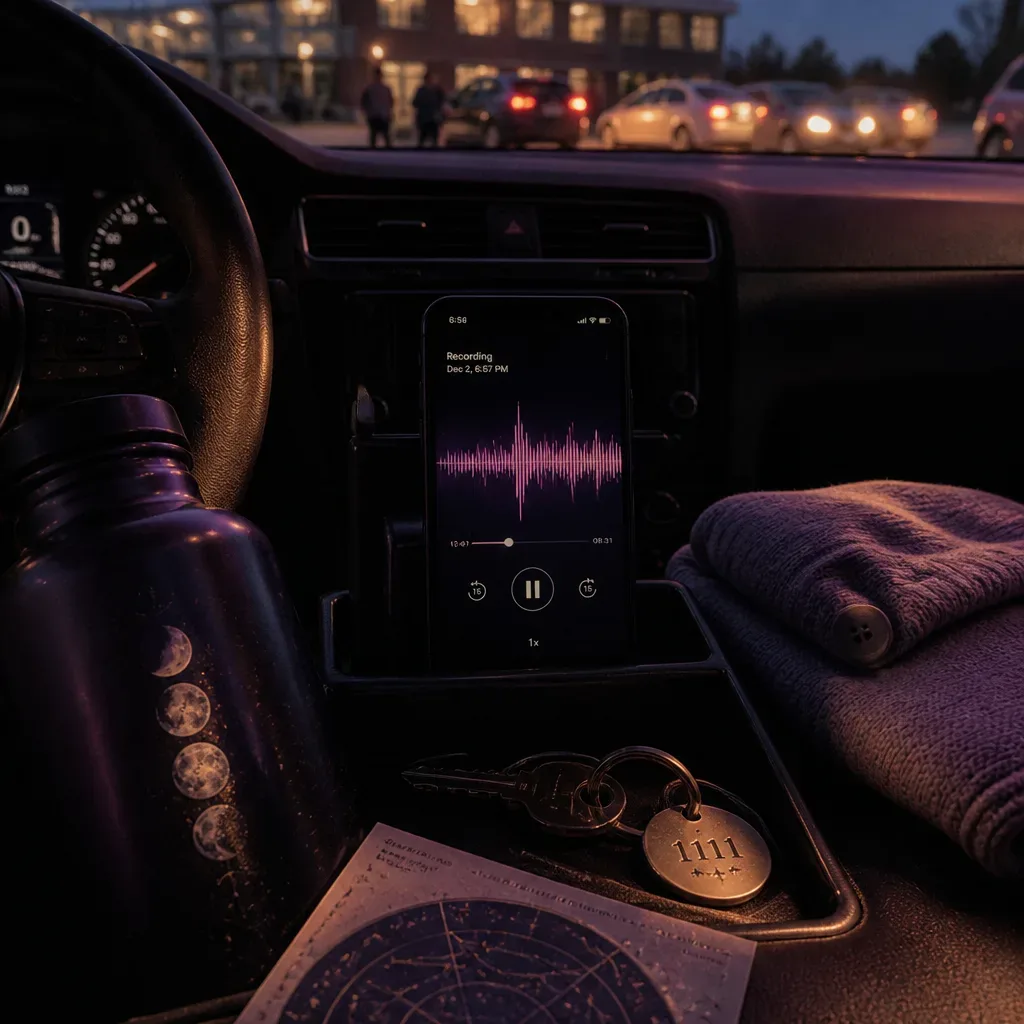
You can use astrology and manifestation as a timing layer if lunar cycles help you name a season. New moons are useful for writing. Full moons are useful for reviewing. Still, the moon is not doing your repetition for you. The dial may point. You still place the needle.
Synchronicity is not an excuse to stop practicing. It is a reason to pay better attention.
How do you know if the future self audio script is working?
You know it is working when your daily choices begin to match the script before your mood catches up.
Do not measure only by the final result. Measure by earlier signals. Are you avoiding the old spiral 10 percent faster? Are you sending the email before negotiating with fear for 45 minutes? Are you speaking to yourself with less contempt after a mistake? Those are not small signs. Those are the floorboards moving.
Princeton’s Engineering Anomalies Research program, often called PEAR, studied intention and random systems from 1979 to 2007. Its conclusions remain debated, and they should be held with care. But even outside that controversial field, attention research is clear that what we repeatedly notice shapes what we prioritize. The script is a noticing machine.
Track 3 metrics for 14 days:
- Listening streak: Did you listen today, yes or no?
- Action proof: What one behavior matched the script?
- Emotional residue: What feeling stayed after listening?
Keep the tracking boring. A note app is fine. One sentence per day is enough. The goal is not to build a shrine to self-improvement. The goal is to witness whether the audio is changing your defaults.
There is a useful difference between evidence and obsession. Evidence says, “I noticed I made the call even though I was nervous.” Obsession says, “Why is the whole life not here by Friday?” One is a witness. The other is a heckler with a calendar.
If a script feels stale after 21 days, revise one line, not all seven. In habit studies, changing too many variables makes it harder to know what helped. Keep the identity, adjust the action. Keep the feeling, sharpen the evidence. A good script has a season. When the season changes, edit.
The Manifestation pillar makes this point plainly: intention asks for participation. The audio does not replace your life. It rehearses the version of you willing to meet it.
What is a complete future self audio script example?
A complete future self audio script is seven grounded lines spoken from the arrived self, with one sensory detail and one action for today.
Here is a sample for creative work. Use the shape, not the exact language:
I am the version of me who finishes the work I said mattered.
I can tell because the draft is open before the noise of the day gets a vote.
In my body, this feels like a slower breath, both feet down, the room no longer asking me to prove myself.
I no longer confuse resistance with a sign to stop.
Today I prove it by writing for 25 minutes before I check messages.
I am grateful for the clean line, the honest page, and the people who will meet the work when it is ready.
I come back to this voice every day, and repetition keeps the promise at tempo.
That last phrase is mine because I cannot escape being a bass player. A groove is just a promise kept at tempo. The same is true here. The future self is not only ahead of you. Some mornings, it is the part of you that presses play before the kettle boils.
If your focus is money, swap the action. If your focus is love, swap the standard. If your focus is health, make the evidence physical and modest: shoes by the door, water on the desk, bedtime honored 4 nights this week. The script should know your actual floor plan.
For a money script, line 5 might be: “Today I send the invoice, check the account, and let clarity be kinder than avoidance.” For a relationship script: “Today I answer with honesty instead of theater.” For a body script: “Today I take the walk before I bargain with the couch.” Clear. Slightly wry. On cue.
You can pair one sentence from the script with a daily affirmation, then place a visual cue on your Manifestation Board. Keep the hierarchy clean. The audio is the method. The affirmation and board are complements, useful punctuation around the main signal.
The future self does not need to sound impressive. It needs to sound returnable.
Keep the dial where your real life can reach it.