audio manifestation
Record Your Own Affirmations as Future-Self Audio
Learn how to record your own affirmations as future-self audio: script, voice, edit, and repeat a short practice that sounds like your life arrived.
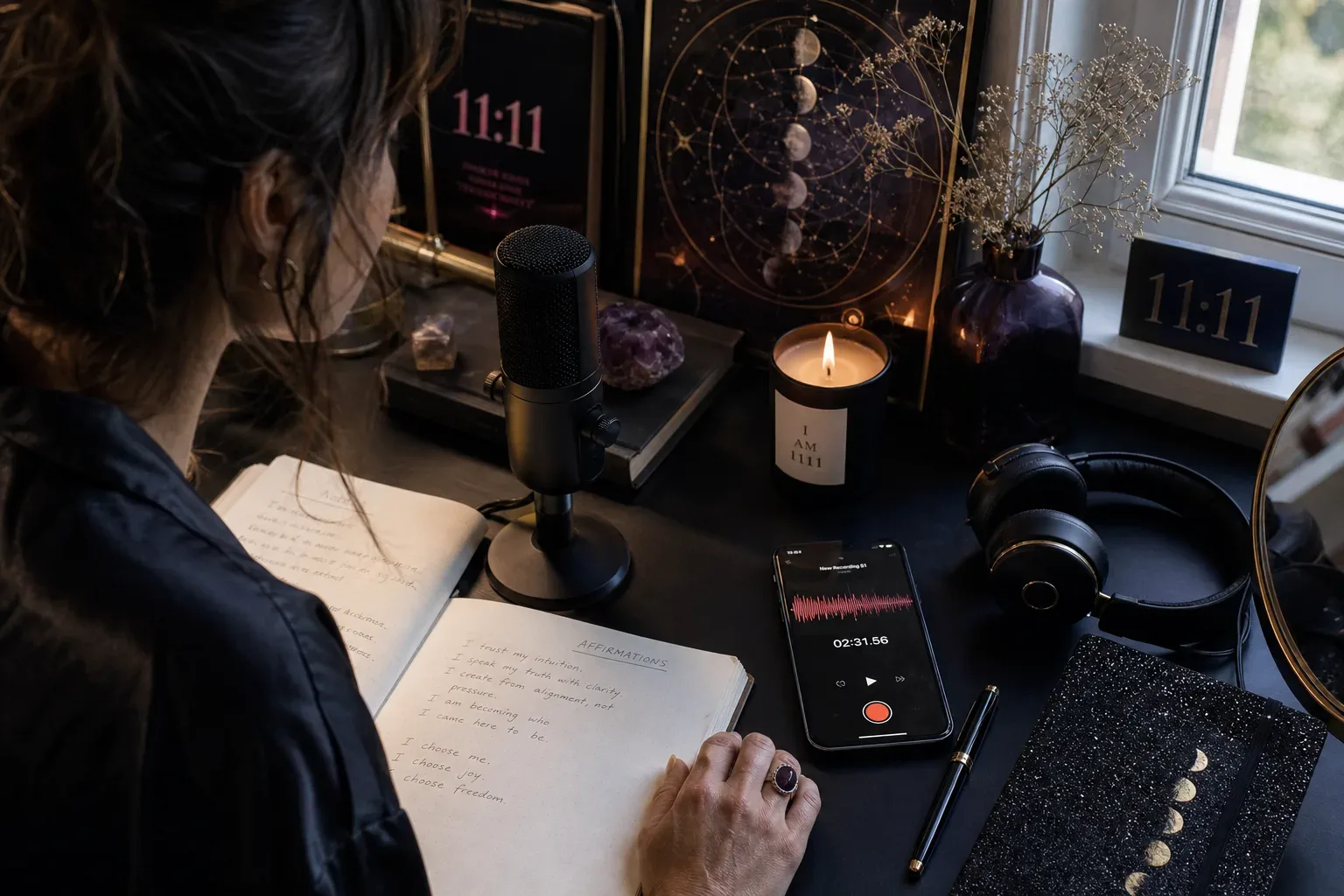
To record your own affirmations as future-self audio, write a short script from the version of you who has already arrived, record it slowly in your own voice, then listen daily for one clear cycle. The practice works best when the audio is specific, believable, and repeated without negotiation.
What are you really recording when you record your own affirmations?
You are recording a believable identity cue, not a motivational speech.
A good future-self audio is less like a pep talk and more like a witness statement from the life you keep circling. The dial is not set to fantasy. It is set to recognition. You hear a voice, ideally yours, describing how you move now, how you choose now, what no longer gets your consent. The room changes because the script names the room differently.
This is why the audio matters. In the AYA Method, the daily practice is listening to a Dream-Self Moment: a short personalized recording narrated from the version of you who has already manifested the life you intend. Listening is the practice. Repetition is the work. The audio is the method. Your DIY version can borrow that same spine: one recording, one future-self scene, daily contact.
Self-affirmation research is not as sparkly as the internet makes it sound, which is useful. Claude Steele introduced self-affirmation theory in 1988, and later work by Sherman and Cohen in 2006 showed that affirming core values can reduce defensiveness under threat. That does not mean one sentence bends reality on cue. It means identity-consistent language can change how you meet pressure.
A future-self recording is a place to rehearse recognition before the outside world agrees.
If you want a wider frame for the practice, the Manifestation pillar explains the difference between wishing, rehearsing, and acting. Audio sits in the middle space. It keeps the signal warm while your behavior catches up.
How do you choose the right future-self scene?
Choose one ordinary scene that proves the change has already happened.
The mistake is trying to record your entire life in one file. Career, body, love, money, apartment, nervous system, family, skin, inbox, all arriving in 4 minutes like an overbooked parade. The mind hears that and politely leaves the room. Start with one scene. One Tuesday. One doorway. One email sent without spiraling.
A scene works because the brain likes concrete cues. In mental imagery studies, athletes and performers often rehearse specific movements rather than vague excellence; a 2017 review in Frontiers in Psychology found that imagery is most useful when it is vivid, controlled, and tied to task conditions. Your affirmation audio should do the same. Name the calendar, the posture, the sentence you say.
Try this filter before writing:
- What has already changed in this future-self moment?
- Where am I standing, sitting, walking, or speaking?
- What would another person notice in 10 seconds?
- What old pattern is absent, without making the whole script about the old pattern?
- What action did I take that made this identity visible?
If your primary intention is financial, the scene might be opening your banking app without dread. If it is creative, it might be sending the pitch before noon. If it is relational, it might be leaving a conversation without auditioning for approval.
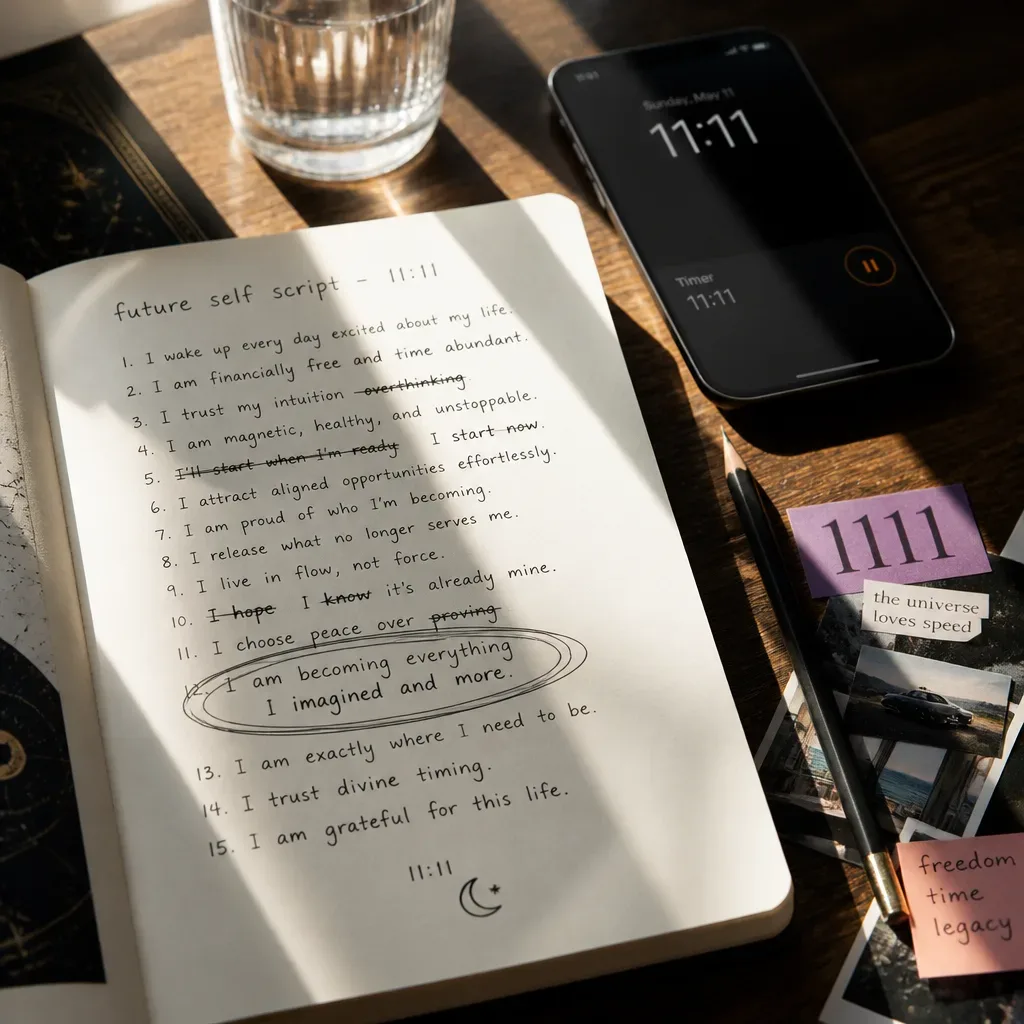
The number can help. I like 11 lines for a first script, partly because Manifest 11 is not shy about its master number, and partly because 11 is enough to create shape without turning the recording into a novella. In numerology, 11 is often treated as intuition under voltage. Take that poetically, not as a court order.
What should your affirmation script actually say?
Your script should say what your future self does, notices, allows, and refuses in plain present-tense language.
Keep the language clean. Not tiny. Clean. The sentence should sound like something you could hear every morning without rolling your eyes at yourself. A line like “I am a radiant magnet for everything” might work for someone, somewhere, under flattering lighting. For many people, it creates distance. Try: “I answer the message when it matters, and I do not chase what has gone quiet.” The second line has a door handle.
The Affirmations pillar goes deeper on wording, but the short rule is this: make it specific enough to test in real life. A statement that cannot meet Tuesday is not ready for your recording. If your body tenses when you hear the line, revise it until it becomes believable without becoming small.
Here is a practical structure for a 2-to-5-minute script:
| Script part | Number of lines | What it does | Example |
|---|---|---|---|
| Arrival | 1 to 2 | Names the future-self scene | “I wake up in the apartment that feels like mine.” |
| Evidence | 3 to 5 | Shows changed behavior | “I open the laptop and begin before checking for approval.” |
| Regulation | 2 to 3 | Calms the body | “My breath stays low when the room gets loud.” |
| Choice | 2 to 3 | Names boundaries and action | “I answer from clarity, not panic.” |
| Return | 1 | Closes the signal | “This is the version of me I return to daily.” |
There is evidence for writing close to values. In a 2006 Science study, Cohen and colleagues found that brief values-affirmation exercises reduced the racial achievement gap in a school setting over time. The point was not magical phrasing. It was identity steadiness under pressure.
Use “I” when you want ownership. Use “you” when you want to feel guided. Use your name once if it lands cleanly. I have recorded scripts both ways, and the strangest thing is how a single name can ring like a bell when the rest of the day is trying to make you forget yourself.
The best affirmation is not the prettiest sentence. It is the sentence your behavior can begin obeying.
How do you record it so it sounds believable?
Record slowly, warmly, and close enough to the microphone that the message feels private.
You do not need a studio. You need a quiet room, a charged phone, and 10 minutes without someone asking where the scissors are. Most phone voice memo apps record at a quality high enough for spoken audio; the difference between useful and unusable is usually room noise, not gear. Soft surfaces help. A closet full of clothes is still undefeated by many expensive microphones.
Before you press record, read the script once while standing. Then sit and record. Standing gives the body authority; sitting gives the voice intimacy. Dr. Andrew Huberman has often discussed how breathing patterns affect arousal, and while he is not prescribing manifestation audio, the physiology is relevant: longer exhales can support parasympathetic calm. Take 3 slow breaths before the first line.
Use this recording sequence:
- Put the phone 6 to 10 inches from your mouth.
- Turn off fans, alerts, and buzzing lamps.
- Smile slightly for the first line, even if it feels theatrical.
- Speak 15 percent slower than your normal pace.
- Leave 2 seconds after important sentences.
- Re-record only the lines that truly break the spell.
Do not chase the perfect take. A too-polished recording can start to sound like an ad for your own potential, and no one needs that in their nervous system at 6:40 a.m. Keep a little humanity in it. A breath is allowed. A tiny pause is allowed. Your future self presumably still has lungs.
For some people, hearing their own voice is uncomfortable at first. That is normal. A 2013 study in PLOS ONE on recorded voice perception noted that people often rate their recorded voice differently than others do because bone conduction changes how we hear ourselves internally. The mirror is odd at first. Stay with it for 7 days before deciding your voice is impossible.
If you truly cannot listen to yourself, ask a trusted person to read it or use a calm text-to-speech voice. But try your own voice first. The signal has a different weight when it comes from inside the house.
Should you add music, binaural beats, or silence?
Add sound only if it helps you return to the recording more consistently.
Music can make future-self audio feel cinematic. It can also become a velvet curtain hiding weak language. Start with the voice alone. Listen once. If the script holds without music, you have something sturdy. If it collapses, fix the sentences before you decorate the room.
Binaural beats are often marketed with more certainty than the research supports. Some small studies suggest binaural stimulation may influence mood or attention, but reviews have found mixed results depending on frequency, duration, and study design. Treat beats as optional atmosphere, not the engine. The engine is repeated identity rehearsal.
Silence is underrated. A quiet 2-second pause after “I do not abandon myself to be chosen” can do more than a swelling track. The pause lets the line land. Tara Brach often teaches the power of pausing as a way to come back to presence; in audio practice, the pause is where the body gets time to believe you.
Here are simple sound choices:
- Voice only: best for clarity, morning walks, and skeptical listeners.
- Low instrumental bed: useful if you need warmth or ritual.
- Nature sound: good for evening listening, especially rain or steady water.
- Binaural track: optional, best with headphones, not necessary.
- No lyrics: almost always better, because lyrics compete with your future-self lines.
Set the music low enough that every consonant remains clear. If you use editing software, reduce the music to roughly 15 to 25 percent of the voice volume. If you are using only a phone app, choose a quieter track and test it in the place you will actually listen: bed, walk, train, kitchen, parked car.
There is a reason Astrology and manifestation people often time practices with lunar cycles: rhythm makes attention easier to repeat. You do not need the moon to approve your file. Still, recording on a new moon, the 1st of the month, or at 11:11 can give the mind a clean gate.
How often should you listen before rewriting it?
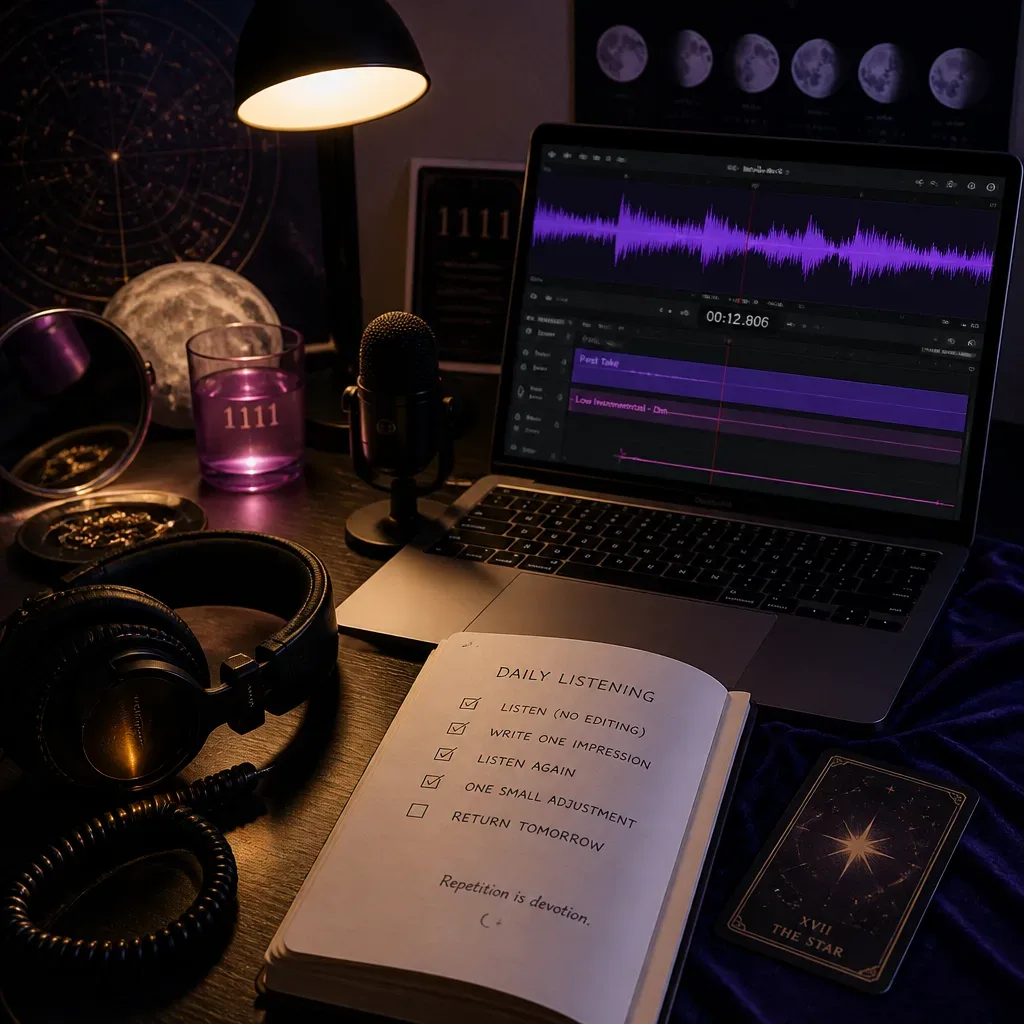
Listen daily for one full cycle before you judge the recording.
A useful cycle is 21 to 33 days. The popular “21 days makes a habit” line is too neat; a 2009 study by Lally and colleagues in the European Journal of Social Psychology found habit automaticity took 18 to 254 days, with an average of 66 days. Still, 21 days is long enough to hear your resistance patterns. Thirty-three days, a master number in numerology, gives the practice a stronger container.
Listen at the same anchor point each day. Not because the clock is mystical, though clocks do enjoy flirting with us. Because repetition reduces decision fatigue. Morning works for some. Evening works for others. I walk before I write: no headphones on the way out, one Dream-Self Moment on the way back. That arrangement has survived more than 100 podcast episodes and several questionable hair decisions.
Pair the audio with one visible complement if you like. A daily affirmation on paper can catch the key line. A Manifestation Board can hold the image of the scene. But do not confuse the accessories with the practice. The audio is the method here. The board is the mirror. The written line is the receipt.
Track lightly. Obsessive tracking can turn a tender practice into a courtroom. Use a simple note:
| Day | Listened? | One action that matched the audio |
|---|---|---|
| 1 | Yes | Sent the invoice before lunch |
| 7 | Yes | Did not soften the boundary text |
| 14 | Yes | Applied for the role despite the old story |
| 21 | Yes | Re-recorded one line that had become too small |
Repetition is not proof that nothing is happening. Repetition is how the new self stops sounding like a stranger.
After the cycle, revise only what has genuinely changed. If a line now feels too timid, sharpen it. If a line still feels false, make it more embodied. Keep the file name dated. There is strange evidence in old recordings. Sometimes the thing arrives four months later wearing a coat you did not recognize.
What mistakes make affirmation audio feel fake?
Affirmation audio feels fake when it asks you to perform certainty instead of practice recognition.
The first mistake is overclaiming. “I never feel fear” is not a future-self line. It is a hostage note. A stronger version is: “Fear can enter the room without taking the chair.” That sentence leaves room for biology. It also gives you something to do when fear arrives, on cue, holding a clipboard.
The second mistake is copying language from someone else’s desire. This happens often with money scripts, beauty scripts, and romance scripts. You borrow the aesthetic and skip the reckoning. Pew Research Center reported in 2022 that about 30 percent of U.S. adults had used a dating site or app, which means many people are swimming in other people’s scripts for desirability. Your recording has to cut through that noise, not join it.
The third mistake is making the audio too long. More words can dilute the signal. If your recording passes 7 minutes, ask whether you are practicing or negotiating. A future-self audio should feel like a gate you can step through daily, not a legal document drafted by your anxious committee.
Watch for these fixes:
- Replace “always” and “never” with behavior you can repeat.
- Replace grand identity claims with sensory evidence.
- Replace borrowed phrases with words you would say out loud.
- Replace pressure with instruction.
- Replace vague success with a scene that has time, place, and action.
If you want a broader map for pairing audio with intention, revisit the AYA Method and compare your recording to the Dream-Self Moment structure. For wording support, the Affirmations pillar is the cleaner companion. And when the practice starts throwing numbers at you, as practices rudely do, the Astrology and manifestation guide can help you place timing without handing timing the whole steering wheel.
The final test is simple: after listening, do you know the next honest action? Not the whole plan. Not the 5-year arc. The next honest action. A message. A walk. A draft. A boundary. One small move that makes the recording less imaginary than it was yesterday.
Name it clearly. Press record. Return tomorrow.