audio manifestation
Manifestation Music vs Dream-Self Audio
Manifestation music can set the mood, but Dream-Self audio gives the mind a precise signal. Here is what to play daily and why.

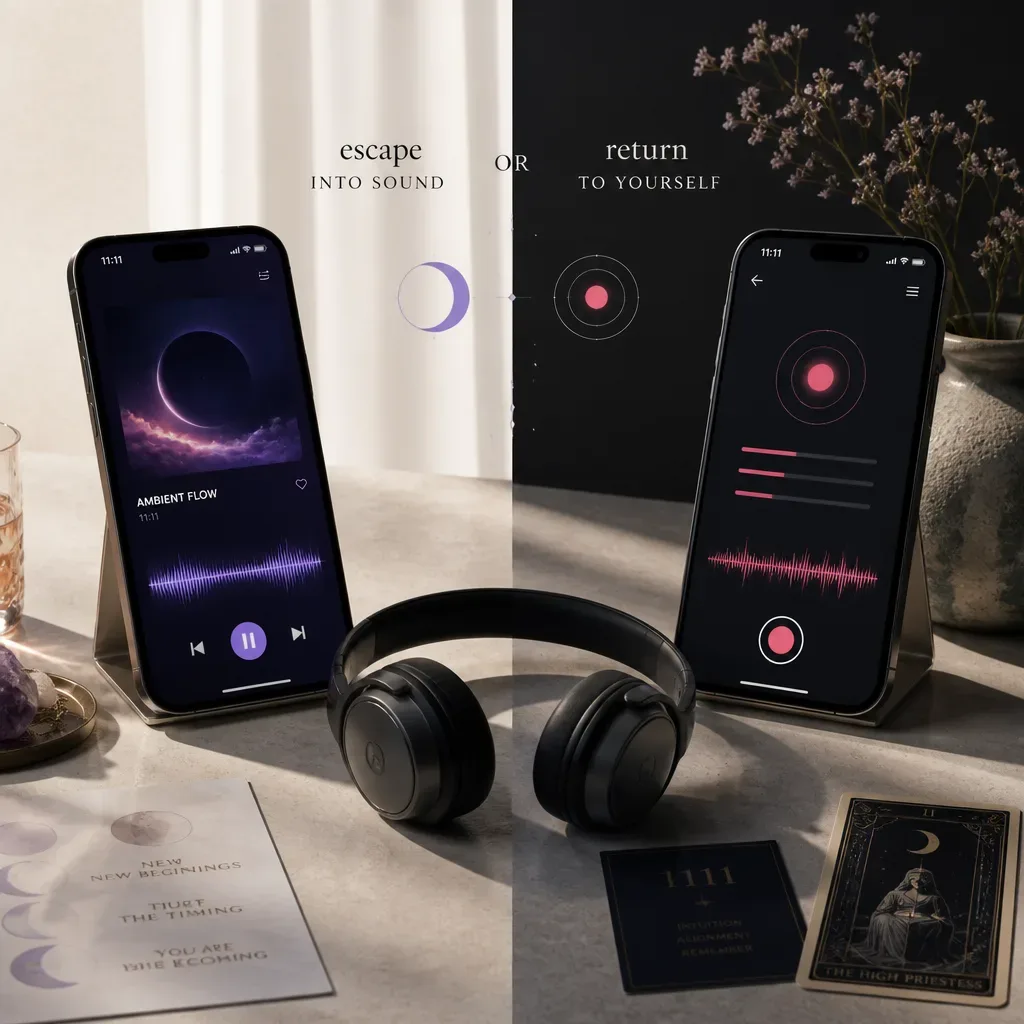
At 7:11, you reach for headphones and the choice is simple: play Dream-Self audio daily, and use manifestation music as support. Manifestation music can settle your nervous system. Dream-Self audio gives it a named direction. Mood opens the gate; personalized narration tells you where to walk.
What is the real difference between manifestation music and Dream-Self audio?
Manifestation music changes the room; Dream-Self audio changes the instruction.
Most manifestation music is built from tone, tempo, repetition, ambient texture, or frequency language. The promise is atmospheric: feel calmer, feel receptive, feel as if the dial is turning. There is a reason that works. A 2013 Cochrane review on music interventions found meaningful reductions in anxiety across several medical settings, though the size of the effect varied by study design and context. Music is not nothing. It can move the body before the mind has finished arguing.
Dream-Self audio is more exacting. It uses words, identity, and repetition. In the AYA Method, the definition matters: The AYA Method is a daily audio manifestation practice. Each day you listen to a short personalized recording — your Dream-Self Moment — narrated from the version of you who has already manifested the life you intend. Listening is the practice. Repetition is the work. The audio is the method.
That is a different category from a three-hour track labeled 528 Hz. The music may be beautiful. The Dream-Self Moment is a mirror with a script.
Here is the clean comparison:
| Daily audio type | Best use | Main limitation | Daily role |
|---|---|---|---|
| Manifestation music | Regulating mood and attention | Often generic | Supportive atmosphere |
| Binaural or frequency tracks | Focus cue or relaxation cue | Evidence is mixed and context-dependent | Optional experiment |
| Affirmation recordings | Repeating clear statements | Can feel flat if not embodied | Useful complement |
| Dream-Self audio | Rehearsing identity and choice | Requires personal specificity | Core practice |
Music says, “Be ready.” Dream-Self audio says, “This is who you are practicing being.”
If you want the broader foundation, the Manifestation pillar frames manifestation as attention, belief, identity, and action working in sequence. Music helps attention. Dream-Self audio recruits all four.
Which one should you play every day?
Play Dream-Self audio every day, then use manifestation music when your state needs tuning.
Daily practice needs a spine. Not a mood board with headphones. A spine. In behavior research, repetition wins because it reduces the decision cost. The 2009 habit study by Phillippa Lally and colleagues found that habit automaticity took anywhere from 18 to 254 days, with a median of 66. The point is not the famous number. The point is the spread. Your daily method has to survive ordinary Tuesdays.
Dream-Self audio survives because it is short, specific, and repeatable. You do not need to decide which track fits the moon, the forecast, or your caffeine level. You press play and meet the same signal. That repetition is not boring. It is how the nervous system learns that the future is no longer a costume.
Manifestation music is better treated like weather. Some mornings need rain sounds. Some need piano. Some need silence, because the room is already loud enough. When music becomes the main practice, the listener can start chasing a state instead of rehearsing a standard.
A simple daily order works well:
- Listen to your Dream-Self audio first. Give the clearest signal the first seat.
- Sit for 30 seconds after it ends. Let the last sentence land without grabbing your phone.
- Play manifestation music after, if useful. Use it for focus, journaling, walking, or recovery.
- Name one decision by noon. The practice proves itself in choice, not goosebumps.
Joe Dispenza has popularized future-self meditation for years, and Neville Goddard wrote in 1944 about assuming the feeling of the wish fulfilled. Those teachers differ in method, but they point to the same hinge: repeated inner rehearsal changes what feels available. Dream-Self audio makes that rehearsal portable.
The track that makes you feel mystical is not always the track that makes you honest. Daily practice should make you more precise.
When does manifestation music actually help?
Manifestation music helps when your body needs a cue before your mind can receive one.
If you are tense, rushed, or emotionally scattered, music can lower the entry barrier. Slow tempo music near resting heart rate can support downshifting, and clinical music therapy research often uses rhythm and familiarity to help regulate arousal. One 2011 Nature Neuroscience study by Salimpoor and colleagues connected pleasurable music to dopamine release in reward-related brain regions. That does not prove every manifestation playlist changes your life. It does explain why the right sound can make the room feel less hostile.
Music is especially useful in the margins around the core practice:
- before listening, if you need to settle your breathing;
- after listening, if you want to journal without rushing;
- during a walk, if movement helps the message integrate;
- while preparing your space, if ritual helps you show up;
- at night, if your system needs a softer return.
The caution is simple. Do not confuse state change with identity rehearsal. A calm body is a gate, not the entire city. You can feel serene for 20 minutes and still make the same old decision at 10:03. That is why the audio you play daily should include language that names the version of you you are practicing.
There is also the frequency question. Tracks labeled 432 Hz, 528 Hz, or 963 Hz may feel meaningful to listeners, and ritual meaning has its own psychological force. But strong scientific claims around specific manifestation frequencies are not settled. The Princeton Engineering Anomalies Research program studied mind-matter questions for decades before closing in 2007; its findings remain controversial and should not be treated as everyday proof.
Use manifestation music because it helps you become available to the work. Do not ask it to do the work.
For readers who work with timing, lunar cycles, or number patterns, Astrology and manifestation can add a useful calendar. The sky can mark the season. The daily audio still marks the practice.
Why does personalized narration cut through faster?
Personalized narration cuts through because the brain treats specific self-relevant language differently from generic atmosphere.
Your name, your work, your city, your real fear, your next decision: these are not decorative details. They are coordinates. Cognitive neuroscience has repeatedly shown that self-referential processing recruits midline brain regions associated with personal meaning, including the medial prefrontal cortex. A 2012 review in NeuroImage by Qin and Northoff described the self as a major organizing frame for conscious experience. Translation: the mind pays attention when the message has your fingerprints on it.
That is where generic manifestation music runs into its ceiling. It may help you feel open, but it cannot say, “You no longer apologize before naming your fee,” or “You answer the email before the old avoidance script arrives.” A Dream-Self Moment can. It can speak in the tense and texture of your life.
This is also why the Affirmations pillar is useful but not identical. Affirmations often work as compact statements: “I am steady under pressure.” Dream-Self audio can include that, but it places the statement inside a lived scene. You hear the room. You hear the decision. You hear your future self narrating from after the turn.
Specificity is the difference between a lantern and a street address.
In practical terms, personalized narration has three advantages:
- It reduces interpretation. You do not have to translate ambient sound into meaning.
- It rehearses identity in context. The future self is not abstract; they are doing something.
- It creates a repeatable signal. The same words return until they become familiar.
Tara Brach often teaches the power of kind attention, especially in her RAIN practice: recognize, allow, investigate, nurture. Dream-Self audio can sit beside that kind of work because it is not about forcing belief. It is about repeatedly witnessing a truer position until the old one loosens.
The future does not become credible because it is loud. It becomes credible because it is repeated without flinching.
How do you build a daily listening stack without overdoing it?
Build the stack around one core audio, one optional support track, and one real-world action.
The mistake is turning a five-minute practice into a 47-minute production. That looks devoted for three days. Then life arrives, on cue, with traffic, laundry, invoices, children, or the small domestic theater of a missing charger. A 2023 Pew Research Center report found that about 31% of U.S. adults say they are online “almost constantly.” Your attention is already being auctioned in public. Do not make your practice compete by becoming complicated.
A daily stack can be very plain:
| Moment | What to play | Time | Why it works |
|---|---|---|---|
| On waking | Dream-Self audio | 3–8 minutes | Sets identity before inputs |
| After listening | Silence or soft music | 1–5 minutes | Lets the signal settle |
| During action | Manifestation music | 10–30 minutes | Supports focus or emotional tone |
| Before sleep | Optional replay | 3–8 minutes | Reinforces familiarity |
If you use the AYA Method as the core, keep the Dream-Self Moment first. The Manifestation Board can help you see the season you are claiming, and a daily affirmation can sharpen one sentence from the audio. They are complements. They are not the spine.
Here is a rule from my old finance life: if a system only works when conditions are perfect, it is not a system. It is a mood with a calendar invite.
That is why I like a minimum viable practice. Press play before you check messages. Listen all the way through. Let one phrase follow you into the day. If you want to add manifestation music while making coffee or walking to the train, good. If not, the work has still been done.
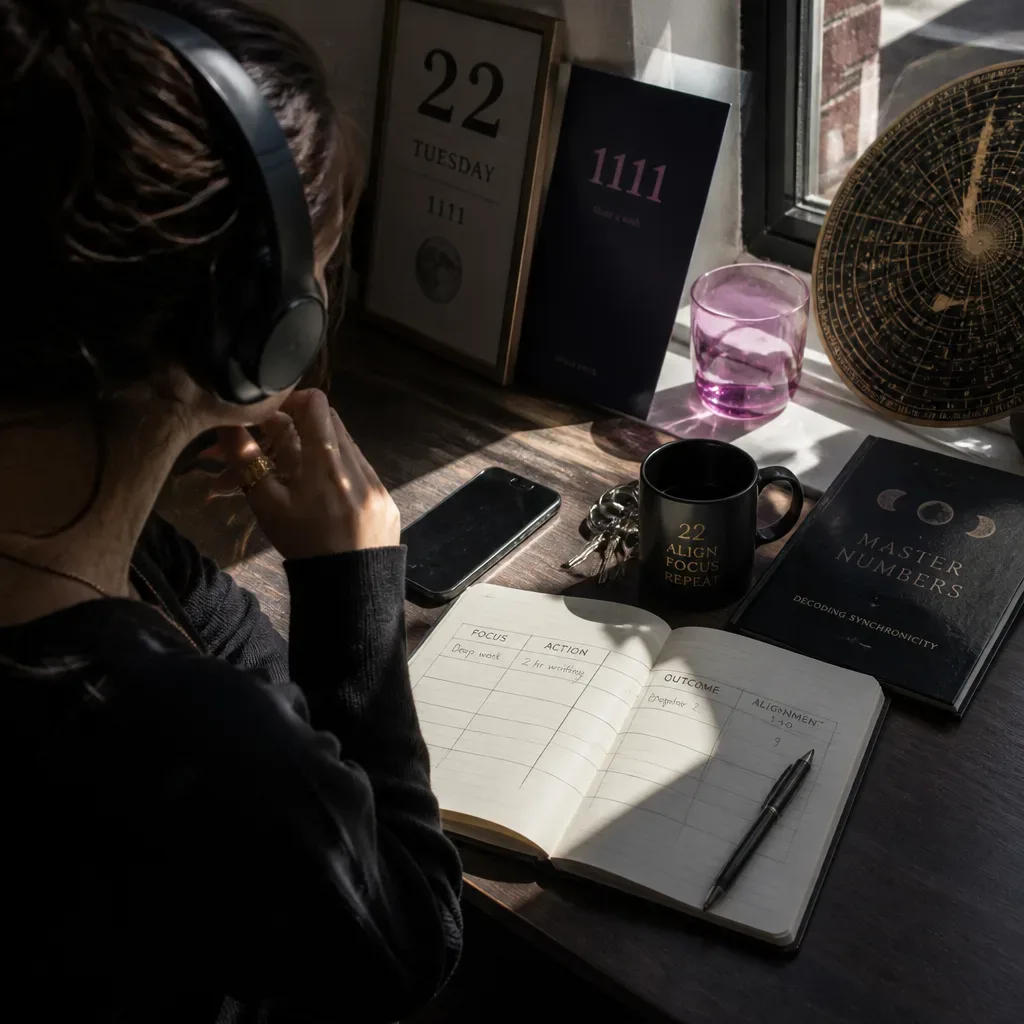
For a broader orientation to signs, master numbers, and timing, Manifest 11 often treats synchronicity as punctuation rather than proof. Seeing 11:11 may make you pause. The audio tells you what to practice when you do.
What mistakes make both practices weaker?
Both practices weaken when you use them to avoid a decision.
This is the part I would rather not dress up. I have used beautiful audio to delay ugly tasks. A playlist can become a velvet curtain. A Dream-Self recording can become performance if you listen, nod, and refuse the one next move it keeps implying. The ocean taught me this faster than any teacher: intention does not matter if your position is wrong.
Common mistakes are easy to spot:
- Playing too many tracks. More audio can mean less signal.
- Changing the core practice every few days. The mind cannot learn a pattern you keep replacing.
- Using lyrics that compete with narration. Language on language gets crowded.
- Demanding instant proof. Many effects are cumulative and subtle.
- Ignoring behavior. Audio should show up in choices, not just feelings.
In small studies on implementation intentions, including work associated with Peter Gollwitzer, people are more likely to act when they pair a cue with a specific behavior: “If situation X occurs, I will do Y.” Your Dream-Self audio becomes stronger when you attach one sentence to one behavior. If the recording says you speak clearly in rooms where money is discussed, then today’s cue might be the 2:00 pricing call.
Another mistake is treating angel numbers as instructions. Doreen Virtue helped popularize angel-number interpretations, though she later publicly distanced herself from that work. The cultural imprint remains: 111 as initiation, 222 as balance, 333 as support. Use those meanings lightly. A number can be a bell. It cannot make the call for you.
The clean test is this: after listening, are you one degree more available for the choice you already know is yours?
If the answer is yes, the practice is working. If the answer is no, adjust the audio, shorten the stack, or remove the music that is making the moment prettier but less honest.
How do you know the audio is working?
You know the audio is working when your decisions start matching the identity you hear.
Not every result announces itself. Some arrive like a quiet ledger entry. You answer faster. You negotiate without theatrics. You stop checking one person’s reaction as if it were a verdict. You notice that the old reflex still appears, but it no longer gets the only chair in the room.
Track evidence for 30 days. Not miracles. Evidence. In clinical and coaching settings, self-monitoring is one of the most reliable behavior-change tools; a 2011 meta-analysis in Psychological Bulletin by Michie and colleagues found that interventions combining self-monitoring with other self-regulation techniques were more effective for physical activity and healthy eating outcomes. Different domain, same principle: what gets witnessed gets clearer.
Use four columns:
| Day | Played Dream-Self audio? | Music used? | One decision that shifted |
|---|---|---|---|
| 1 | Yes | Piano, 12 min | Sent the proposal before editing again |
| 11 | Yes | None | Asked directly for the meeting |
| 22 | Yes | Rain track | Did not reopen the old thread |
| 30 | Yes | Ambient, 20 min | Chose the harder honest sentence |
Notice the numbers if they come. Day 11. Day 22. Day 33. Master numbers have a long symbolic history in modern numerology, especially 11 as intuition, 22 as building, and 33 as service. Treat them as markers, not commandments. The calendar can wink. You still have to move your hand.
The Manifestation pillar gives the larger map, and the Affirmations pillar can help you refine the sentence you carry after listening. But for the daily question of what to play, keep the order clean: Dream-Self audio first, manifestation music second.
The best practice is not the one that makes the morning cinematic. It is the one that makes the next choice cleaner.
Play the signal you can live by before the room gets loud.