audio manifestation
Manifestation Journaling vs Dream-Self Audio
Manifestation journaling helps busy minds write clearly, while Dream-Self Audio makes the practice easier when time and focus feel scarce.

A small notebook can help you hear yourself. A short recording can help when you cannot think. Manifestation journaling is best for clarity; Dream-Self Audio is best for consistency. For a busy mind, the quieter choice is often the one you can repeat tomorrow.
Which practice is better for a busy mind?
Dream-Self Audio is usually better for daily repetition, while manifestation journaling is better for sorting and naming what is true.
A busy mind is not a weak mind. It is a mind carrying too many open tabs. Psychologist George Miller’s 1956 paper proposed the famous limit of 7 plus or minus 2 items in working memory; later research by Nelson Cowan suggested the real number may be closer to 4. You feel that limit when you sit down to write and suddenly remember the school form, the meeting, the unanswered text.
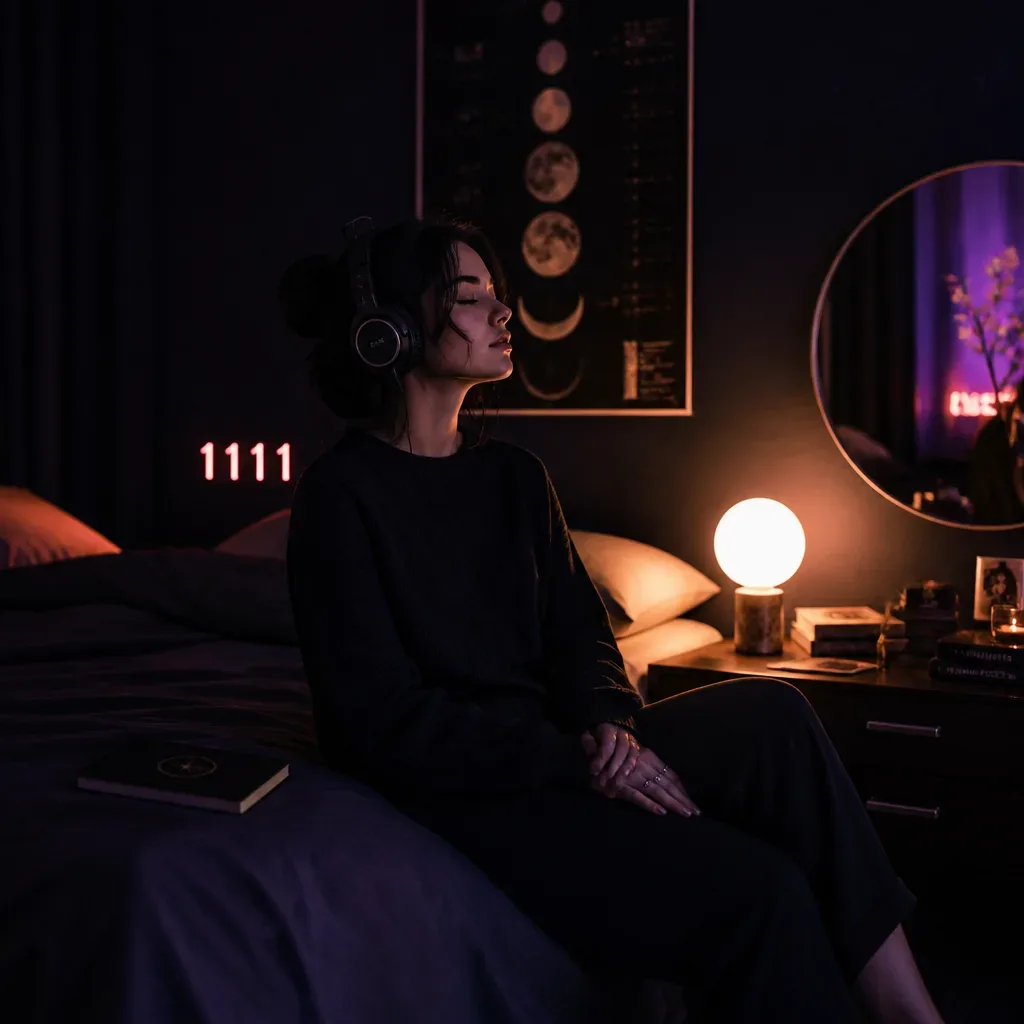
This is where audio becomes kind. The AYA Method is a daily audio manifestation practice. Each day you listen to a short personalized recording — your Dream-Self Moment — narrated from the version of you who has already manifested the life you intend. Listening is the practice. Repetition is the work. The audio is the method.
Journaling asks you to generate language. Audio asks you to receive it. That difference matters at 6:40 a.m. with a child looking for socks, or at 10:15 p.m. when your brain is still speaking in tasks. Pew Research Center reported in 2021 that 31% of U.S. adults said they were online almost constantly, and another 48% went online several times a day. Your attention is not lazy. It is used.
Still, writing has a place. A pen can slow the noise enough to let a desire become plain. The question is not which practice is more spiritual. The question is which one you will still do when the day has asked too much of you.
The best practice is not the one that impresses you. It is the one that stays with you when you are tired.
What does manifestation journaling actually train?
Manifestation journaling trains attention, language, and self-recognition by asking you to write the life you are choosing in concrete words.
When you write, you make a thought visible. That is not small. James Pennebaker and Sandra Beall’s 1986 expressive writing study asked participants to write about emotional events for 15 minutes across several days; later reviews, including Smyth’s 1998 meta-analysis in the Journal of Consulting and Clinical Psychology, found small to moderate health benefits in certain groups. The point is not that every page heals everything. The point is that language can organize what was scattered.
In manifestation, that organizing matters. A vague want stays slippery. A written want has edges. I want work that does not cost my body. I want mornings that do not begin with dread. I want to be the person who answers honestly. These are not slogans. They are coordinates.
Manifestation journaling can include prompts, future-self letters, evidence lists, or tiny decisions. It can also go wrong when it becomes performance. In a 2009 Psychological Science paper, Joanne Wood, W. Q. Elaine Perunovic, and John Lee found that positive self-statements could make some people with low self-esteem feel worse. If a sentence feels false, the body may push back.
That is why writing has to stay close to what you can believe now. You might use affirmations as a complement, but the sentence needs a doorway. Not I am perfectly calm forever. More like I can take one quiet breath before I answer.
A useful page often has 3 parts:
- Name the desire. One sentence. No decoration.
- Name the self. Who are you when this is already normal?
- Name the next small proof. One action within 24 hours.
Writing is a mirror. It should show you your face, not ask you to become someone else’s.

What does Dream-Self Audio do differently?
Dream-Self Audio removes the need to compose the future and lets you listen to it as something already known.
The busy mind often fails at the start line. Not because the desire is weak. Because starting requires too many choices. What prompt? What wording? How long? Is this too dramatic? Research on decision fatigue is mixed in scale, but the everyday pattern is familiar: more decisions can mean less follow-through. A 2000 study by Sheena Iyengar and Mark Lepper found that shoppers shown 24 jam options were less likely to buy than those shown 6. Too much choice can stall action.
Dream-Self Audio narrows the choice to one thing. Press play. Listen. Return. The repetition does not need a perfect mood. Andrew Huberman has often spoken about the nervous system learning through repetition and state; the more precise research base is broad, from memory reconsolidation studies to habit formation work. Lally and colleagues at University College London found in 2009 that habit automaticity took a median of 66 days, with a wide range from 18 to 254 days. Daily cues matter.
Audio also works with the part of you that responds before analysis. Voice carries pace, warmth, and certainty. You do not have to argue with the page. You hear the Dream-Self Moment and let the nervous system meet a version of you that feels less far away.
This is why audio manifestation can be gentler for people who are mentally full. It respects low bandwidth. It does not ask you to find the right sentence at the end of a long day.
A recording can become a room you enter before the day names you.
The app may also include a daily affirmation and a Manifestation Board, but they are complements. The method is the audio. The center is the listening.
Where does writing still belong?
Writing belongs wherever you need clarity, evidence, or a slow conversation with yourself.
There are things audio can hold for you, and there are things a page can reveal because your hand hesitates. In small studies of handwriting and learning, researchers have found differences between typing and writing by hand; Mueller and Oppenheimer’s 2014 paper in Psychological Science reported that longhand note-takers performed better on conceptual questions than laptop note-takers, likely because they processed rather than transcribed. The finding has been debated, but the lived truth remains useful: handwriting slows you down.
For manifestation journaling, that slowness can be medicine. You notice the sentence you keep avoiding. You notice the desire you keep making more acceptable. You notice that you wrote safe when you meant free. This is not about pretty notebooks. It is about honest contact.
Writing also helps when you are working with timing, doubt, or symbolic meaning. If you like lunar cycles or birth charts, astrology and manifestation can give you a reflective frame. The frame is not the practice itself. It is a way of listening to yourself at a certain hour.
Use journaling when you need to:
- choose between 2 desires that both sound good
- record evidence you would otherwise dismiss
- soften a belief that feels too hard to speak aloud
- write a future-self letter once a week
- notice what changed after 30 days of listening
One caution. Do not make journaling a courtroom. You are not proving that you deserve the thing. You are learning to recognize the self who can receive it.
How do manifestation journaling and Dream-Self Audio compare side by side?
The simplest comparison is this: journaling is active expression, and Dream-Self Audio is guided reception.
Both can be sincere. Both can help you repeat a chosen identity. The difference is the amount of effort required at the moment of practice. The American Psychological Association has noted that stress affects attention, memory, and decision-making; under strain, a lower-friction practice may be more sustainable. If you have 4 minutes between meetings, audio may meet you. If you have 20 quiet minutes on Sunday, writing may tell the truth more fully.
| Question | Manifestation journaling | Dream-Self Audio |
|---|---|---|
| Best for | Clarity, reflection, pattern spotting | Daily repetition, tired minds, low time |
| Time needed | Often 5 to 20 minutes | Often 3 to 7 minutes |
| Main action | Write from or to the future self | Listen to the Dream-Self Moment |
| Mental load | Medium to high | Low |
| Risk | Overthinking, self-editing, inconsistency | Passive listening without later action |
| Best rhythm | Weekly or a few times a week | Daily |
The table is plain because the truth is plain. A busy mind does not need more ritual objects. It needs fewer gates. If the practice has 9 steps, the day will find one to break.
Neville Goddard wrote often about assuming the wish fulfilled. Joe Dispenza speaks about rehearsing a new state until the body knows it. You do not have to follow either teacher completely to notice the shared instruction: repeat the inner version until it becomes familiar. The AYA Method makes that repetition audible.
Journaling can support this by recording the changes you might miss. After 14 days, you may see different words. After 30 days, different choices. After 66 days, if Lally’s habit research is any guide, the cue may begin to feel less negotiated.
Repetition is not glamorous. It is how the future stops feeling like a stranger.
What should you choose on a hard day?
On a hard day, choose the practice with the smallest opening: usually Dream-Self Audio, then one sentence if you still have room.
A hard day changes the math. The plan you made when rested may not fit the body you have at 9:47 p.m. That is not failure. That is data. In 2023, the American Psychological Association’s Stress in America report found that adults ages 35 to 44 reported an average stress level of 5.6 on a 10-point scale, higher than many older groups. Midlife, care work, money, and work pressure can crowd the inner room.
This is where I stop negotiating with myself. I listen first. Not because writing is less worthy, but because the audio removes the argument. If I try to journal when I am depleted, I often produce a list of complaints wearing nicer clothes. If I listen first, my breath changes before my mind catches up.
Then, if there is still space, I write one line. One. It might be:
- Today I still belong to the life I am choosing.
- The next proof is going to bed without reopening work.
- I do not need to solve my whole self tonight.
This keeps the practice from becoming another test. BJ Fogg’s behavior model, published in Tiny Habits in 2020 and drawn from years of Stanford research, is simple: behavior happens when motivation, ability, and a prompt meet. On hard days, motivation may be low. So ability has to be high. Make the action small enough to keep.
The quiet rule is this: never punish yourself with a practice meant to return you home.
How can you combine them without adding more work?
Combine them by letting audio be daily and journaling be brief, specific, and supportive.
The mistake is trying to do everything every day. A 20-minute journal, a long meditation, a board update, a perfect morning routine, a gratitude list, a script, a walk, a breath practice. That is not devotion. That is administration. If you already have a full mind, too many practices can become another pile.
Use a 7-day rhythm instead. It gives repetition without crowding the day. Research on implementation intentions by Peter Gollwitzer in 1999 showed that if-then plans can improve follow-through across goals. The sentence matters: If I brush my teeth at night, then I listen to my Dream-Self Moment. If it is Sunday afternoon, then I write for 10 minutes.
A quiet rhythm might look like this:
- Daily: listen to your Dream-Self Audio.
- After listening: write 1 sentence only if it feels easy.
- Twice a week: note one piece of evidence.
- Weekly: answer one longer manifestation journaling prompt.
- Monthly: read back 4 entries and notice what is already different.
For prompts, keep them close to life. What did I do this week that my future self would recognize? Where did I still shrink? What is the next honest action? If you use an affirmation, let it be a complement, not a second job. If you use a Manifestation Board, let it remind the eye while audio trains the return.
You can read more about the wider practice of manifestation, or keep it very simple tonight. The body does not need a thesis. It needs a cue it can trust.
A final small structure:
- Press play.
- Listen all the way through.
- Write one sentence, only if the sentence is already there.
- Close the notebook before it becomes work.
Your future self is not louder because you wrote more pages. She is clearer because you kept coming back.
Softly, then again.