audio manifestation
Guided Manifestation Meditation vs Dream-Self Audio
Guided manifestation meditation and Dream-Self audio both use attention and imagery, but they train the mind in different daily ways.

The kettle clicks off. You have six minutes before the house asks for you. A guided manifestation meditation gives you a led practice. Dream-Self audio gives you a repeated identity rehearsal. Both use listening, but one guides the moment while the other lets your future self speak until it feels familiar.
What is guided manifestation meditation?
Guided manifestation meditation is a led audio practice that uses relaxation, imagery, and intention to help you focus on a desired outcome.
Usually, a voice tells you when to breathe, what to picture, and how to feel toward the thing you want. A session may last 5 minutes or 45. Many include a body scan, a visualization scene, and a closing phrase. In a 2019 National Health Interview Survey analysis, about 14.2% of U.S. adults reported using meditation in the previous year, up from 4.1% in 2012. The form is no longer strange. It’s in the kitchen now. It’s on the bus. It’s in the earbuds.
Manifestation adds a specific aim to meditation. You aren’t only watching the breath. You’re rehearsing a future as if it could become normal. That sits close to manifestation, which is less about wishing and more about attention, meaning, and repeated inner contact. Quiet contact. Honest contact. Not performance.
The strength of guided manifestation meditation is containment. You don’t have to create the structure yourself. For a tired mind, that matters. A 2021 review in Frontiers in Psychology noted that guided imagery has been used across health settings for stress, pain, and performance preparation, though study quality varies. The evidence isn’t a crown. It’s a lamp. It shows where to look.
A good guided session often does three things:
- It settles the body enough for attention to gather.
- It gives the mind a clear image to enter.
- It ends before the image becomes strain.
A practice doesn’t have to be dramatic to be real. It has to be returnable.
The limit is that every session may be different. New words. New scenes. New emotional cues. That variety can feel nourishing, but it can also keep the desired self slightly distant, like a recipe you keep reading but never cook the same way twice.
What is Dream-Self audio?
Dream-Self audio is a short personalized recording spoken from the version of you who already lives the life you’re practicing.
The AYA Method is a daily audio manifestation practice. Each day you listen to a short personalized recording — your Dream-Self Moment — narrated from the version of you who has already manifested the life you intend. Listening is the practice. Repetition is the work. The audio is the method.
This is different from being led through a fresh visualization each day. Dream-Self audio is closer to hearing a future memory. The recording may speak about your morning, your work, your relationships, your body, your steadiness. It doesn’t ask you to force belief. It asks you to hear the same true direction often enough that the mind stops treating it as foreign.
Repetition is the quiet engine here. In habit research, one widely cited 2009 study from University College London found that automaticity took a median of 66 days to form, with a range from 18 to 254 days depending on the behavior. A daily listening practice respects that range. It doesn’t shame you for needing many returns.
I think of it like masa. The first touch is not the tortilla. The water needs time. The salt needs evenness. Your hands learn the texture by coming back. Dream-Self audio works through that same kind of familiarity.
The app may also include a daily affirmation and Manifestation Board, and those can help you see or name the intention. But the audio is the method. If there’s only one thing you do, you listen. One recording. One future voice. One small return.
How do the two practices compare?
Guided manifestation meditation is session-led, while Dream-Self audio is identity-led.
The difference shows up in the role you play. In a guided meditation, you follow instructions. In Dream-Self audio, you receive a specific version of yourself again and again. Both can involve images, emotion, and attention. But they ask the nervous system for different kinds of trust. One says, come with me for this practice. The other says, remember who you’re becoming until it starts to feel like home.
| Feature | Guided manifestation meditation | Dream-Self audio |
|---|---|---|
| Main structure | A guide leads breath, imagery, and intention | A personalized future-self recording repeats daily |
| Typical length | Often 10 to 30 minutes | Often 2 to 7 minutes |
| Best for | Resetting, relaxing, entering imagery | Daily repetition, identity rehearsal, consistency |
| Personalization | Sometimes general, sometimes themed | Built around your specific future self |
| Main risk | Too much variety, too much dependence on the guide | Repetition can feel plain if you’re chasing novelty |
That last line matters. Repetition can feel too simple. The mind likes novelty because novelty gives a quick sense of progress. But behavior change often comes from boring contact. In a 2020 Pew Research Center survey, roughly half of U.S. adults said they use digital tools to track or support health behaviors. The tool is not the change. The return is.
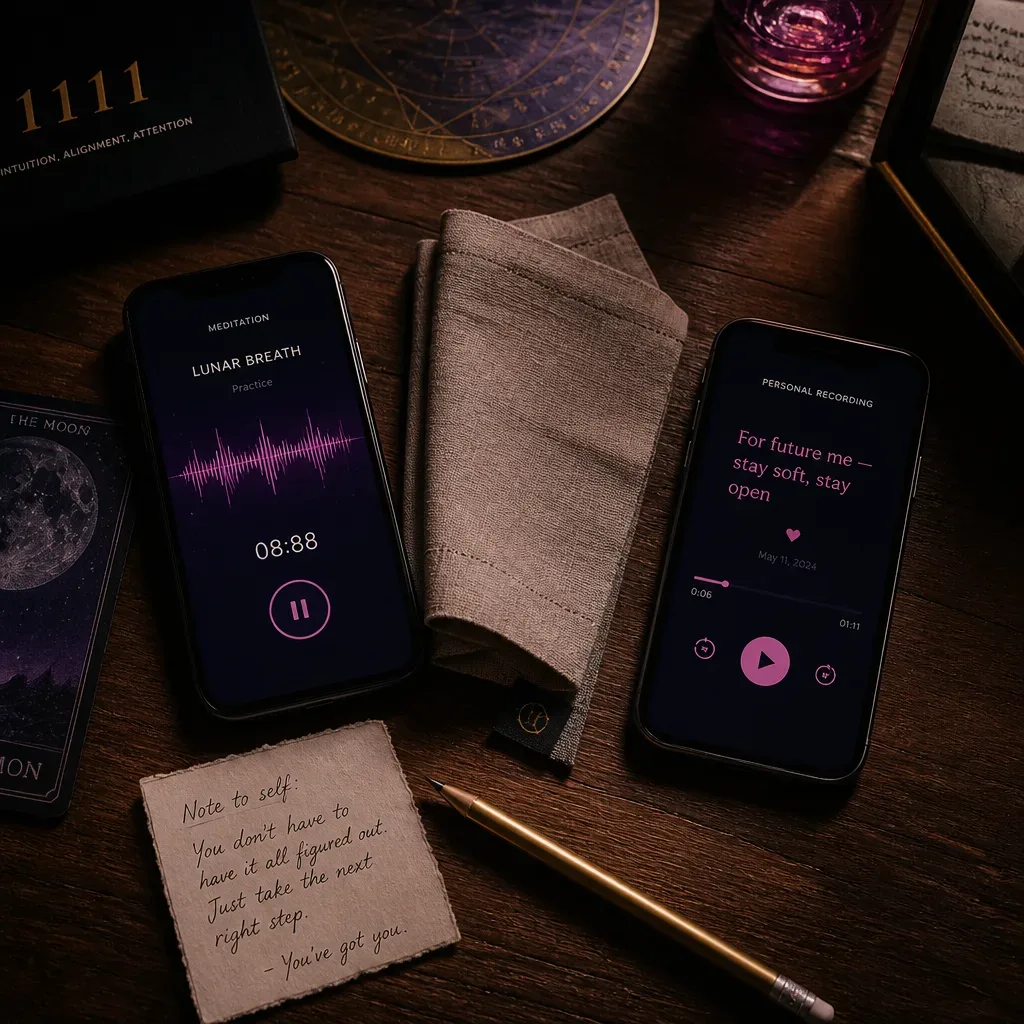
Guided manifestation meditation may be better when you’re overwhelmed. A calm voice can slow the room down. Dr. Andrew Huberman has often discussed how respiration patterns influence arousal states; even without using his protocols, many guided meditations lean on longer exhalations because breath can be a direct handle. Dream-Self audio may be better when your aim is already named and you need daily contact with it.
There is no need to make them enemies. The spoon and the flame both belong in the kitchen. One stirs. One cooks.
Which practice helps more with consistency?
Dream-Self audio is often easier to repeat daily because it’s short, personal, and already made for your exact intention.
Consistency is not a personality trait. It’s a design issue. If a practice requires a silent room, perfect focus, and 30 free minutes, it will vanish on hard days. A 2018 report from the U.S. Bureau of Labor Statistics showed that adults with children under 6 had less leisure time than adults without children. You don’t need a moral lecture. You need a practice that fits the life you actually have.
Guided manifestation meditation can be steady too, especially if you choose one track and repeat it for a set period. But many people browse. They choose by mood. They search for the voice that feels right tonight. That can become another form of delay. The practice starts after the choosing, and sometimes the choosing eats the practice.
Dream-Self audio removes some of that friction. You press play. The words are already yours. The future being rehearsed doesn’t change every day. That matters because the brain learns through pattern. Neuroscientist Donald Hebb’s 1949 phrase is often shortened to neurons that fire together wire together. The line is older than most apps. Still useful.
A simple consistency test can help:
- Can you do it when you’re tired?
- Can you do it when you don’t feel inspired?
- Can you do it without needing a new mood first?
- Can you repeat it for 14 days without making it a project?
- Can it fit before coffee, after brushing teeth, or just before sleep?
If the answer is yes, the practice has a place to live. If the answer is no, it’s still beautiful, but it may be a retreat practice rather than a daily one.
For people who already use affirmations, Dream-Self audio can feel like a fuller voice around a single phrase. An affirmation names the line. The audio gives the line a room, a body, and a day.
What does research suggest about voice, imagery, and repetition?
Research doesn’t prove manifestation as magic, but it does support several parts that manifestation audio uses.
Mental imagery has a long research history in sports and clinical psychology. A 2017 review in Psychology of Sport and Exercise found that imagery interventions can support performance, especially when paired with physical practice and clear goals. That doesn’t mean picturing a life replaces action. It means inner rehearsal can shape readiness. The body often practices before the body moves.
Self-talk also matters. In a 2011 meta-analysis in Perspectives on Psychological Science, Ethan Kross and colleagues found that using non-first-person self-talk could help people regulate stress and reflect with more distance. Dream-Self audio does something adjacent, though not identical. It lets you hear yourself from a wiser position. Not above you. Ahead of you.
Neville Goddard wrote often about assuming the feeling of the wish fulfilled. Joe Dispenza speaks about mentally rehearsing a new self. You don’t have to accept every claim from either teacher to notice the shared pattern: repeated inner contact changes what feels available. The claim becomes softer when you make it practical. What you hear every day becomes part of what you can notice.
This is also where astrology and manifestation can become a timing language for some people. Not proof. Not command. More like a calendar with symbols. If the symbols help you listen with care and act with honesty, they can serve the practice. If they make you passive, they don’t.

There is one more thread. The Princeton Engineering Anomalies Research lab, often called PEAR, studied mind-matter questions for decades before closing in 2007. Its results remain debated, and mainstream science has not accepted broad paranormal claims. Still, the public fascination says something human: people want to know whether intention matters. A quieter answer is safer and still useful. Intention matters when it changes attention, behavior, and what you keep choosing.
The most believable future is the one you can practice without leaving your life.
When should you choose guided manifestation meditation?
Choose guided manifestation meditation when you need support entering stillness or when your intention isn’t clear yet.
A guided session can hold you while you find the shape of the desire. Maybe you only know you want to feel less scattered. Maybe the future is still foggy. A teacher’s voice can ask the right questions: What do you see? What do you feel? What can your body release? In mindfulness research, 8-week programs such as Mindfulness-Based Stress Reduction have shown moderate benefits for stress in many studies, including reviews published in JAMA Internal Medicine in 2014.
Guided manifestation meditation also helps if your body is keyed up. Before you can picture the future, you may need to feel the chair under you. Before you ask for more, you may need to know you’re safe enough now. A voice that counts the breath can be medicine in ordinary clothes.
Choose it when:
- You want a longer reset.
- You need help relaxing your body.
- You enjoy being led step by step.
- You don’t yet know the exact identity you want to rehearse.
- You want a weekly or occasional practice, not only a daily anchor.
There is no failure in needing guidance. My grandmother never let me grind chile alone the first time. She stood there, correcting the pressure of my hand. Later, I could do it by sound.
If you want more context for how these practices fit together, the manifestation pillar is a steadier place to begin than a hundred scattered tips. Read one thing. Then listen to one thing. Small is not less sacred.
When should you choose Dream-Self audio?
Choose Dream-Self audio when your intention is clear enough to be heard daily in the voice of the future you.
Dream-Self audio is for the stage after naming. You know the direction. You may not know the steps. That’s fine. The recording doesn’t replace action, but it helps you recognize the self who takes action. In implementation intention research, psychologist Peter Gollwitzer has shown across many studies that if-then planning can improve goal follow-through. Dream-Self audio isn’t the same method, but it shares a respect for specificity. Vague longing is hard to practice. Specific identity is easier to meet.
This is why audio can be more intimate than a written list. The ear is tender. A 2022 Edison Research report found that a majority of Americans had listened to online audio in the previous month, and daily audio habits keep growing. People let voices into private rooms: morning kitchens, bedsides, walks, parked cars. A future-self recording uses that closeness carefully.
Use Dream-Self audio when the practice needs to be:
- short enough for real mornings
- personal enough to feel yours
- repeatable without searching
- emotionally clear but not theatrical
- connected to action you can take today
You can still keep a board. You can still write one line from affirmations. But those are complements. The listening is the center. The Dream-Self Moment is the part you return to when the day is plain, when nothing sparkles, when the dishes are still in the sink.
A recipe becomes yours when you stop needing to read every line. A future can become yours the same way: not by force, but by repeated contact.
For some, the kindest answer is both. Guided manifestation meditation for the nights when you need to be held. Dream-Self audio for the mornings when you need to remember. If you want the daily form, start with the AYA Method. Let the audio be simple enough to keep.
The voice waits where you left it.